Loading...
Analysis will be generated on first visit.
Scores and timeline are available below. The page will refresh automatically when ready.
Ernest Augustus of Hanover vs Napoleon Bonaparte
Napoleon Bonaparte leads by 20.0 pts · 2 figures compared
…

Ernest Augustus of Hanover
Emperor · Modern
62.4Total
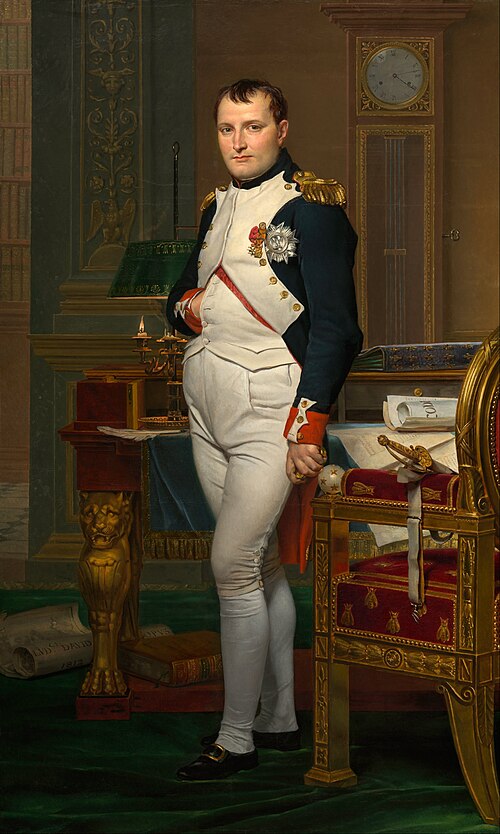
Napoleon Bonaparte
General · Modern
82.4Total
Basic Information
Born
1771
1769
Died
1851
1821
Era
Modern
Modern
Nationality
Hanover
France
Occupation
Emperor
General
Civilization
Western
Western
Score Comparison
Military (10%)
32.5
94.0
Political (20%)
72.0
75.0
Influence (20%)
64.8
82.0
Legacy (20%)
48.9
78.0
Leadership (15%)
87.7
80.0
Strategy (15%)
58.9
93.0
TOTAL
62.4
82.4
Rankings
🥇
Napoleon BonaparteLeader
Mil: 94.0Pol: 75.0Inf: 82.0
82.4
🥈
Ernest Augustus of Hanover
Mil: 32.5Pol: 72.0Inf: 64.8
62.4
+20.0 behind
How This Comparison Works
Algorithm
Each figure is scored on 6 dimensions (0—100 scale) based on structured historical data: Military (10%), Political (20%), Influence (20%), Legacy (20%), Leadership (15%), Strategy (15%). The weighted total produces the final ranking.
Data Sources
Scores are computed from structured sub-indicators in the database. Scale factors adjust for era (Ancient ×0.85, Modern ×1.0) and civilization size (Eastern ×1.05, Other ×0.80) to account for differences in population and military scale.
Maximum 3 Figures
Comparisons are limited to 2—3 figures to ensure readability and statistical meaningfulness.
Error Margins
±5 points per dimension — Sub-scores are derived from historical records with inherent uncertainty. Two figures within 5 points on a dimension should be considered roughly equivalent in that area.
Total Score Accuracy
±3 points overall — The weighted combination of 6 dimensions produces a total score with approximately ±3 points of uncertainty. Differences of less than 3 points are not statistically significant— the figures are effectively tied.
Known Limitations
- Historical records are incomplete and uneven across civilizations
- Figures from oral-tradition societies may be underrepresented
- Occupation labels can misclassify multi-role figures
- Scores measure capability and impact, not moral character
- Quantitative scoring is a comparison tool, not absolute truth
Capability Radar
Military (10%) — Battles & Warfare
Battles
23
95
Win Rate
27
90
Expansion
32
95
Political (20%) — Governance & Reform
Reform
20
95
Diplomacy
30
80
Economy
20
85
Influence (20%) — Cultural & Global Reach
Cultural
10
85
Global
10
90
Legacy (20%) — Historical Impact
Historical
15
95
Longevity
10
90
Leadership (15%) — Power & Stability
Tenure
40
85
Stability
25
70
Strategy (15%) — Tactics & Innovation
Strategy
33
95
Tactics
34
98
Reform
42
92
Analysis will be generated on first visit.
Scores and timeline are available below. The page will refresh automatically when ready.
Ernest Augustus of Hanover — Complete Timeline
1837 AD
Became King of HanoverPolitical Action◆ Major
Ernest Augustus ascended the throne of Hanover upon the death of his brother William IV. His accession ended the personal union with the United Kingdom, as Salic law prevented Queen Victoria from inheriting Hanover.
SuccessionHanoverPersonal Union
Impact: regional
Repealed the liberal constitution of 1833Political Action◆ Major
Ernest Augustus repealed the liberal constitution of 1833, which had been granted by his predecessor. This action provoked the 'G
ConstitutionCrisisGöttingen Seven
Impact: regionaldestructive
1850 AD
Supported the German Confederation against PrussiaPolitical Action
Ernest Augustus aligned Hanover with the German Confederation in its conflict with Prussia over the Erfurt Union. His support helped maintain the Confederation's authority, though it did not prevent eventual Prussian dominance.
German ConfederationPrussiaPolitics
Impact: regional
Similar Comparisons
Comments & Discussion
Napoleon'sWhip6/17/2026
Military historians love to romanticize battle tactics, but let’s talk logistics. Napoleon’s Grande Armée moved faster than any in Europe because of a decimal supply system—each corps foraged independently. Ernest Augustus? He spent his reign gutting Hanover’s civil service and barking about absolutism. One man figured out how to feed 500,000 men across Russia; the other couldn't keep a constitutional monarchy running. That's not "diff'rent paths," that's a chasm of competence.
法典嘴炮6/17/2026
别拿拿破仑的《民法典》当圣旨。他对外宣称的法律现代化全是宣传——法典里照样保留了对妇女和殖民地人民的系统性压迫。而鄂尔尼斯特·奥古斯都虽然反动,但他的可憎很诚实:直接撕毁1833年宪法,不玩虚的。拿破仑高明在包装,奥古斯都蠢在直白。两坨泥巴,一块镀了金,一块烂在田埂上。
ClassicsSkeptic6/17/2026
The comparison tries to paint Ernest as some "fading order" defender, but "obscurity" is generous. Waterloo defined Napoleon forever, sure, but Ernest Augustus actually shaped the 1866 dissolution of the German Confederation by stubbornly aligning Hanover with Austria. He chose losers but left a clear political footprint. Napoleon’s glory fades into myth; Ernest’s failures are documented, measurable, and honestly more interesting to a data-minded skeptic. Glory is vague; loss is specific.
反叛历史迷6/17/2026
说拿破仑靠革命机遇崛起,纯粹是事后诸葛亮。1793年土伦战役时,他不过是个24岁的炮兵少尉,要不是雅各宾派失势后他投机“雾月政变”,早该在科西嘉老家教拉丁文了。鄂尔尼斯特至少从不掩饰自己的立场——他就是个坚决的托利党人,抵制一切自由主义花招。拿破仑的“历史洪流”不过是掩盖其投机本质的漂亮借口。