Loading...
Analysis will be generated on first visit.
Scores and timeline are available below. The page will refresh automatically when ready.
Gjorge Ivanov vs Napoleon Bonaparte
Napoleon Bonaparte leads by 24.2 pts · 2 figures compared
…

Gjorge Ivanov
Politician · Modern
58.2Total
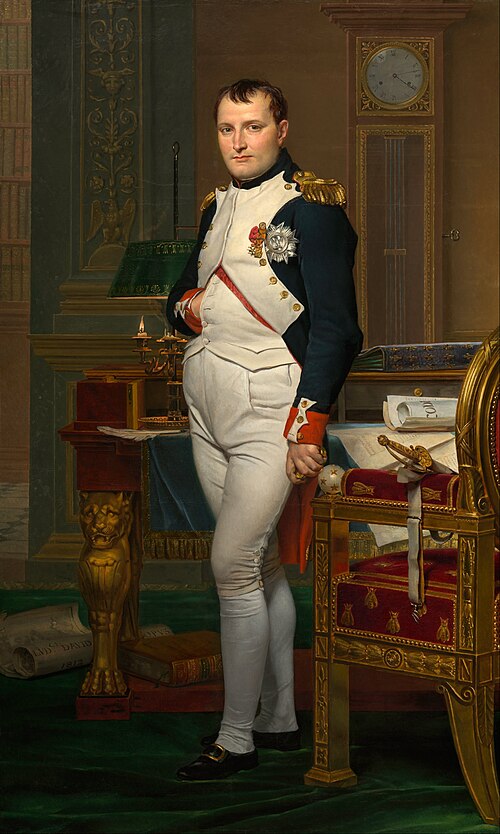
Napoleon Bonaparte
General · Modern
82.4Total
Basic Information
Born
1960
1769
Died
—
1821
Era
Modern
Modern
Nationality
North Macedonia
France
Occupation
Politician
General
Civilization
Western
Western
Score Comparison
Military (10%)
37.5
94.0
Political (20%)
63.8
75.0
Influence (20%)
69.3
82.0
Legacy (20%)
54.7
78.0
Leadership (15%)
77.1
80.0
Strategy (15%)
35.3
93.0
TOTAL
58.2
82.4
Rankings
🥇
Napoleon BonaparteLeader
Mil: 94.0Pol: 75.0Inf: 82.0
82.4
🥈
Gjorge Ivanov
Mil: 37.5Pol: 63.8Inf: 69.3
58.2
+24.2 behind
How This Comparison Works
Algorithm
Each figure is scored on 6 dimensions (0—100 scale) based on structured historical data: Military (10%), Political (20%), Influence (20%), Legacy (20%), Leadership (15%), Strategy (15%). The weighted total produces the final ranking.
Data Sources
Scores are computed from structured sub-indicators in the database. Scale factors adjust for era (Ancient ×0.85, Modern ×1.0) and civilization size (Eastern ×1.05, Other ×0.80) to account for differences in population and military scale.
Maximum 3 Figures
Comparisons are limited to 2—3 figures to ensure readability and statistical meaningfulness.
Error Margins
±5 points per dimension — Sub-scores are derived from historical records with inherent uncertainty. Two figures within 5 points on a dimension should be considered roughly equivalent in that area.
Total Score Accuracy
±3 points overall — The weighted combination of 6 dimensions produces a total score with approximately ±3 points of uncertainty. Differences of less than 3 points are not statistically significant— the figures are effectively tied.
Known Limitations
- Historical records are incomplete and uneven across civilizations
- Figures from oral-tradition societies may be underrepresented
- Occupation labels can misclassify multi-role figures
- Scores measure capability and impact, not moral character
- Quantitative scoring is a comparison tool, not absolute truth
Capability Radar
Military (10%) — Battles & Warfare
Battles
27
95
Win Rate
29
90
Expansion
35
95
Political (20%) — Governance & Reform
Reform
30
95
Diplomacy
40
80
Economy
35
85
Influence (20%) — Cultural & Global Reach
Cultural
20
85
Global
20
90
Legacy (20%) — Historical Impact
Historical
25
95
Longevity
15
90
Leadership (15%) — Power & Stability
Tenure
50
85
Stability
25
70
Strategy (15%) — Tactics & Innovation
Strategy
37
95
Tactics
41
98
Reform
44
92
Analysis will be generated on first visit.
Scores and timeline are available below. The page will refresh automatically when ready.
Gjorge Ivanov — Complete Timeline
2009 AD
Elected President of MacedoniaPolitical Action◆ Major
Ivanov won the presidential election as the candidate of VMRO-DPMNE, succeeding Branko Crvenkovski. His presidency was largely ceremonial but he wielded influence over foreign policy.
ElectionPresidencyMacedonia
Impact: nationalconstructive
2016 AD
Pardoned politicians in the wiretapping scandalPolitical Action◆ Major
Ivanov issued pardons to politicians implicated in the wiretapping scandal, including Nikola Gruevski, sparking massive protests. He later revoked the pardons under pressure from the EU and the opposition.
ScandalPardonProtests
Impact: nationaldestructive
2018 AD
Refused to sign the Prespa AgreementPolitical Action◆ Major
Ivanov refused to sign the Prespa Agreement, arguing it violated the constitution and national identity. He instead referred it to the Constitutional Court, delaying ratification but ultimately failing to block it.
Name DisputePrespa AgreementConstitutional Crisis
Impact: nationaldestructive
2019 AD
Ended his presidencyPolitical Action
Ivanov's term ended in 2019, and he was succeeded by Stevo Pendarovski. His presidency was marked by controversy over the name change and the wiretapping scandal.
PresidencyEnd of TermPolitics
Impact: national
Similar Comparisons
Comments & Discussion
**FIRED MARSHAL6/17/2026
**Comparing Ivanov to Napoleon is like comparing a firecracker to a cannon. Waterloo was a strategic masterpiece that went wrong by inches—Napoleon lost because Blucher arrived, plain and simple. Ivanov’s “defeat” was signing a name-change he had no military power to resist. That’s not a battle, it’s paperwork. One man commanded armies across the Alps; the other commanded a desk in Skopje. The only thing they share is a bad day.
**数据武士6/17/2026
**拿破仑和伊万诺夫根本不在同一个维度。前者统治过欧洲大陆,把法国推上巅峰;后者只是一个总统,在十年任期内基本没改变马其顿的经济或人口结构。普雷斯帕协议让国家改名,但GDP增长几乎没有突破2%。拿滑铁卢比这个?帝国崩溃和签字仪式能一样吗?数据不会撒谎。
**RUBICON REBEL6/17/2026
**Napoleon was a revolutionary who made his own luck—he seized power in a coup, rewrote the civil code, and crushed monarchies for a decade. Ivanov inherited a weak presidency in a fragile state and got bulldozed by EU diplomacy. Waterloo was a fight for continental dominance; Prespa was a fight for a passport. Put them in the same room: Napoleon would eat Ivanov’s lunch and then demand a second course.
**古籍守夜人6/17/2026
**拿破仑和伊万诺夫的最大共同点只有一个:他们都输给了必须赢的战役。但拿破仑输在战场,伊万诺夫输在外交桌上。前者被打败后流放圣赫勒拿岛,后者辞职后还能活在公民社会里。这叫历史?这叫降维比较。一个是恺撒一类的人物,另一个是划时代的配角。你拿亚历山大大帝和村长比,有意义吗?
**THE CHRONICLER6/17/2026
**Revisionist take: Ivanov is actually the more tragic figure. Napoleon chose Waterloo, gambled his empire, and lost gloriously. Ivanov never had an empire to lose—he had a name. He fought the Prespa agreement as a last stand for Macedonian identity, but he was outgunned by Athens, Brussels, and even his own parliament. His defeat wasn’t a romance; it was a slow bureaucratic strangulation. That’s harder to mythologize, but also harder to walk away from.