Loading...
This comparison has not been analyzed yet.
One-time AI generation (~1 minute). Scores and timeline are already available below.
Abdul Ghani Baradar vs Walid Muallem
Abdul Ghani Baradar leads by 2.0 pts · 2 figures compared
…
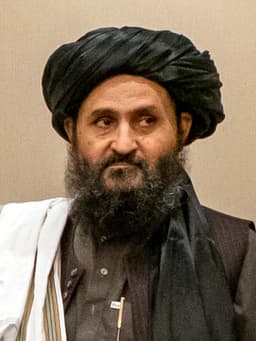
Abdul Ghani Baradar
Politician · Modern
48.8Total

Walid Muallem
Politician · Modern
46.8Total
Basic Information
Born
1968
1941
Died
—
—
Era
Modern
Modern
Nationality
Afghanistan
Syria
Occupation
Politician
Politician
Civilization
Middle Eastern
Middle Eastern
Score Comparison
Military (10%)
47.5
44.7
Political (20%)
40.8
35.1
Influence (20%)
54.9
51.0
Legacy (20%)
45.0
40.8
Leadership (15%)
58.8
65.7
Strategy (15%)
41.0
42.7
TOTAL
48.8
46.8
Abdul Ghani Baradar — Complete Timeline
1994 AD
Co-founded the Taliban MovementPolitical Action
Abdul Ghani Baradar co-founded the Taliban movement alongside Mullah Omar in Kandahar. He played a key role in organizing the group's early military campaigns and establishing its ideological framework, becoming a top military commander.
AfghanistanTalibanFounding
Impact: global
2010 AD
Captured in Karachi by US-Pakistan ForcesPolitical Action◆ Major
Abdul Ghani Baradar was captured in a joint US-Pakistan intelligence operation in Karachi, Pakistan, in February 2010. His arrest was a major blow to the Taliban's leadership and disrupted their command structure during the war.
AfghanistanTalibanCapture
Impact: global
2018 AD
Released from Pakistani CustodyPolitical Action◆ Major
Abdul Ghani Baradar was released from Pakistani custody in October 2018 at the request of the US. His release was part of efforts to facilitate peace negotiations between the Taliban and the US, leading to the Doha Agreement.
AfghanistanTalibanPeace Process
Impact: global
2020 AD
Signed the Doha Agreement with the USPolitical Action
Abdul Ghani Baradar signed the Doha Agreement on behalf of the Taliban in February 2020. The agreement outlined the withdrawal of US troops from Afghanistan in exchange for Taliban security guarantees, paving the way for the Taliban's return to power.
AfghanistanPeace AgreementUS-Taliban
Impact: global
2021 AD
Appointed Deputy Prime Minister of AfghanistanPolitical Action◆ Major
Abdul Ghani Baradar was appointed Deputy Prime Minister of the Taliban-led government in Afghanistan in September 2021. He became a key figure in the new administration, overseeing economic and political affairs.
AfghanistanTalibanGovernment
Impact: national
Walid Muallem — Complete Timeline
2006 AD
Appointed Syrian Foreign MinisterPolitical Action◆ Major
Walid Muallem was appointed Minister of Foreign Affairs of Syria on February 11, 2006, replacing Farouk al-Sharaa. He served in this role until his death in 2020, making him one of the longest-serving foreign ministers in the region. He was a key figure in Syrian diplomacy, particularly regarding Lebanon and the Arab-Israeli conflict.
Syrian DiplomacyForeign MinisterAssad
Impact: regional
2011 AD
Led Syrian Diplomacy During Civil WarPolitical Action◆ Major
Muallem served as the chief diplomat for the Syrian government throughout the Syrian Civil War, which began in 2011. He defended the Assad regime's actions at the United Nations and in international forums, denying allegations of war crimes and chemical weapons use. He was sanctioned by the US and EU for his role.
Syrian Civil WarDiplomacySanctions
Impact: globaldestructive
2013 AD
Negotiated Chemical Weapons AgreementPolitical Action◆ Major
In September 2013, following a chemical weapons attack in Ghouta, Muallem played a key role in negotiating Syria's accession to the Chemical Weapons Convention. The agreement, brokered with Russia and the US, led to the destruction of Syria's declared chemical weapons stockpile, though allegations of continued use persisted.
Chemical WeaponsDiplomacyRussia
Impact: global
This comparison has not been analyzed yet.
One-time AI generation (~1 minute). Scores and timeline are already available below.
Rankings
🥇
Abdul Ghani BaradarLeader
Mil: 47.5Pol: 40.8Inf: 54.9
48.8
🥈
Walid Muallem
Mil: 44.7Pol: 35.1Inf: 51.0
46.8
+2.0 behind
How This Comparison Works
Algorithm
Each figure is scored on 6 dimensions (0—100 scale) based on structured historical data: Military (10%), Political (20%), Influence (20%), Legacy (20%), Leadership (15%), Strategy (15%). The weighted total produces the final ranking.
Data Sources
Scores are computed from structured sub-indicators in the database. Scale factors adjust for era (Ancient ×0.85, Modern ×1.0) and civilization size (Eastern ×1.05, Other ×0.80) to account for differences in population and military scale.
Maximum 3 Figures
Comparisons are limited to 2—3 figures to ensure readability and statistical meaningfulness.
Error Margins
±5 points per dimension — Sub-scores are derived from historical records with inherent uncertainty. Two figures within 5 points on a dimension should be considered roughly equivalent in that area.
Total Score Accuracy
±3 points overall — The weighted combination of 6 dimensions produces a total score with approximately ±3 points of uncertainty. Differences of less than 3 points are not statistically significant— the figures are effectively tied.
Known Limitations
- Historical records are incomplete and uneven across civilizations
- Figures from oral-tradition societies may be underrepresented
- Occupation labels can misclassify multi-role figures
- Scores measure capability and impact, not moral character
- Quantitative scoring is a comparison tool, not absolute truth
Capability Radar
Military (10%) — Battles & Warfare
Battles
30
23
Win Rate
40
24
Expansion
30
27
Political (20%) — Governance & Reform
Reform
25
20
Diplomacy
50
40
Economy
20
15
Influence (20%) — Cultural & Global Reach
Cultural
30
15
Global
40
30
Legacy (20%) — Historical Impact
Historical
40
25
Longevity
30
20
Leadership (15%) — Power & Stability
Tenure
40
55
Stability
15
10
Strategy (15%) — Tactics & Innovation
Strategy
40
29
Tactics
35
31
Reform
20
37
Similar Comparisons
Comments & Discussion
No comments yet. Be the first to share your thoughts!