Loading...
Abdul Qadir vs Samuel Doe
Abdul Qadir leads by 5.6 pts · 2 figures compared
…

Abdul Qadir
General · Modern
43.2Total
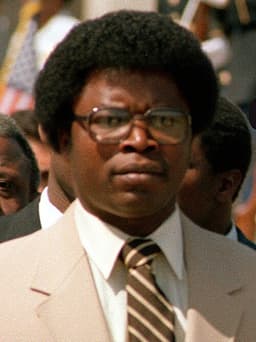
Samuel Doe
General · Modern
37.6Total
Basic Information
Born
1947
1951
Died
—
—
Era
Modern
Modern
Nationality
Afghanistan
Liberia
Occupation
General
General
Civilization
Middle Eastern
Other
Score Comparison
Military (10%)
38.3
10.2
Political (20%)
32.2
27.9
Influence (20%)
49.4
47.1
Legacy (20%)
40.0
37.5
Leadership (15%)
41.5
45.0
Strategy (15%)
60.0
45.0
TOTAL
43.2
37.6
Abdul Qadir — Complete Timeline
1996 AD
Led Northern Alliance Forces in Eastern AfghanistanWar◆ Major
Abdul Qadir served as a commander in the Northern Alliance, leading forces in eastern Afghanistan against the Taliban. He controlled areas in Nangarhar and Kunar provinces, resisting Taliban rule until the US-led invasion in 2001.
AfghanistanCivil WarNorthern Alliance
Impact: regional
2001 AD
Appointed Vice President of AfghanistanPolitical Action◆ Major
Abdul Qadir was appointed Vice President of Afghanistan under Hamid Karzai in 2001. He was a prominent Northern Alliance commander and his appointment was part of the post-Taliban government formation.
AfghanistanVice PresidencyNorthern Alliance
Impact: nationalconstructive
2002 AD
Assassinated in KabulPolitical Action
Abdul Qadir was assassinated in Kabul on July 6, 2002, along with his son-in-law. The attack occurred near the Ministry of Public Works. The perpetrators were never definitively identified, and the assassination was a major blow to the new government.
AfghanistanAssassinationPolitical Violence
Impact: nationaltragic
Samuel Doe — Complete Timeline
1980 AD
1980 Liberian coup d'étatPolitical Action
Master Sergeant Samuel Doe led a group of non-commissioned officers in a coup that overthrew President William Tolbert. Tolbert was killed, and Doe became the first indigenous Liberian head of state, ending 133 years of Americo-Liberian rule.
CoupLiberiaMilitary Rule
Impact: nationaldestructive
Execution of Tolbert cabinet membersPolitical Action◆ Major
Doe ordered the public execution of 13 former officials from the Tolbert government on a beach in Monrovia. The executions were broadcast on television and marked the beginning of Doe's repressive rule.
ExecutionHuman RightsRepression
Impact: nationaltragic
1985 AD
1985 Liberian general electionPolitical Action◆ Major
Doe staged a presidential election under a new constitution. He won amid widespread fraud and international condemnation. The election was intended to legitimize his rule but instead deepened political instability.
ElectionFraudLegitimacy
Impact: nationaldestructive
1989 AD
Outbreak of First Liberian Civil WarWar
Charles Taylor's National Patriotic Front of Liberia (NPFL) invaded Liberia from Ivory Coast, triggering a civil war. Doe's forces fought the rebels, leading to widespread atrocities and the collapse of state authority.
Civil WarRebellionTaylor
Impact: regionaltragic
1990 AD
Capture and execution of Samuel DoeWar
Doe was captured by Prince Johnson's Independent National Patriotic Front of Liberia (INPFL) while visiting the Economic Community of West African States (ECOWAS) peacekeeping headquarters. He was tortured and killed, ending his decade-long rule.
ExecutionCivil WarDeath
Impact: nationaltragic
Expert Analysis
Origins
Abdul Qadir was born around 1951 in the Nangarhar province of Afghanistan, into a Pashtun family. His father was a landowner, and Qadir received military training, eventually joining the Afghan army. He later defected to the Mujahideen during the Soviet-Afghan war, rising to prominence as a commander in eastern Afghanistan. Samuel Doe was born on May 6, 1951, in Tuzon, Grand Gedeh County, Liberia, into the Krahn ethnic group. He had limited formal education and enlisted in the Armed Forces of Liberia in 1969, where he became a master sergeant. His background was shaped by ethnic tensions and poverty.
Rise to Power
Abdul Qadir rose to power as a key commander in the Northern Alliance, a coalition of anti-Taliban forces. After the US-led invasion in 2001, he was appointed Vice President of Afghanistan under Hamid Karzai in December 2001. His influence was rooted in his control of Nangarhar province and his ability to mobilize forces. Samuel Doe rose to power through the 1980 Liberian coup d'état on April 12, 1980. He led a group of non-commissioned officers to overthrow President William Tolbert, killing him and seizing power. Doe became the first indigenous Liberian head of state, but his regime was marked by ethnic favoritism and repression.
Leadership & Governance
Abdul Qadir's leadership was characterized by military command rather than administrative governance. He focused on stabilizing eastern Afghanistan and integrating Northern Alliance forces into the new Afghan army. His political role was brief, as he was assassinated within a year. Samuel Doe's governance was authoritarian and corrupt. He suspended the constitution, ruled by decree, and executed 13 former officials publicly in 1980. He staged a fraudulent election in 1985, winning amid widespread irregularities. His leadership style fostered ethnic divisions, particularly favoring the Krahn ethnic group.
Triumph & Tragedy
Abdul Qadir's greatest success was his role in the Northern Alliance's resistance against the Taliban, holding territory in eastern Afghanistan. His appointment as Vice President was a recognition of his military contributions. His tragedy was his assassination on July 6, 2002, in Kabul, along with his son-in-law. The attack undermined the stability of the new government. Samuel Doe's initial triumph was the overthrow of the Tolbert regime, ending the Americo-Liberian elite's dominance. However, his rule led to economic collapse, international isolation, and the outbreak of the First Liberian Civil War in 1989. His capture and execution by Prince Johnson's forces on September 9, 1990, was a brutal end; he was tortured and killed.
Character & Destiny
Abdul Qadir was seen as a pragmatic commander, respected among Pashtun factions. His decision to join the US-backed government showed willingness to cooperate. However, his assassination reflected the volatile security environment. Samuel Doe was paranoid and vengeful, often acting on ethnic bias. His character led to severe human rights abuses, including the execution of opponents. His destiny was sealed by the civil war he helped ignite; his capture was a direct result of the chaos he created.
Legacy
Abdul Qadir's legacy is limited to his role in the Northern Alliance and his brief vice presidency. He is remembered as a martyr in Afghanistan, but his death did not significantly alter the course of Afghan history. His military score of 38.3 reflects limited strategic impact. Samuel Doe's legacy is profoundly negative: he destabilized Liberia, institutionalized corruption, and sowed ethnic hatred. The civil war he started lasted 14 years, causing over 250,000 deaths. His influence score of 47.1 indicates his impact, but his legacy score of 37.5 shows how poorly he is viewed.
Conclusion
While Abdul Qadir had a higher total score (43.2 vs 37.6), his impact was more localized and brief. Samuel Doe, despite lower military and political scores, had a far greater and more destructive impact on Liberia. Doe's actions triggered a civil war that devastated the country, while Qadir's death did not change Afghanistan's trajectory. Therefore, Samuel Doe had greater historical impact, albeit catastrophic.
Rankings
🥇
Abdul QadirLeader
Mil: 38.3Pol: 32.2Inf: 49.4
43.2
🥈
Samuel Doe
Mil: 10.2Pol: 27.9Inf: 47.1
37.6
+5.6 behind
How This Comparison Works
Algorithm
Each figure is scored on 6 dimensions (0—100 scale) based on structured historical data: Military (10%), Political (20%), Influence (20%), Legacy (20%), Leadership (15%), Strategy (15%). The weighted total produces the final ranking.
Data Sources
Scores are computed from structured sub-indicators in the database. Scale factors adjust for era (Ancient ×0.85, Modern ×1.0) and civilization size (Eastern ×1.05, Other ×0.80) to account for differences in population and military scale.
Maximum 3 Figures
Comparisons are limited to 2—3 figures to ensure readability and statistical meaningfulness.
Error Margins
±5 points per dimension — Sub-scores are derived from historical records with inherent uncertainty. Two figures within 5 points on a dimension should be considered roughly equivalent in that area.
Total Score Accuracy
±3 points overall — The weighted combination of 6 dimensions produces a total score with approximately ±3 points of uncertainty. Differences of less than 3 points are not statistically significant— the figures are effectively tied.
Known Limitations
- Historical records are incomplete and uneven across civilizations
- Figures from oral-tradition societies may be underrepresented
- Occupation labels can misclassify multi-role figures
- Scores measure capability and impact, not moral character
- Quantitative scoring is a comparison tool, not absolute truth
Capability Radar
Military (10%) — Battles & Warfare
Battles
30
5
Win Rate
35
5
Expansion
25
5
Political (20%) — Governance & Reform
Reform
15
5
Diplomacy
25
5
Economy
10
5
Influence (20%) — Cultural & Global Reach
Cultural
15
5
Global
10
5
Legacy (20%) — Historical Impact
Historical
20
10
Longevity
10
5
Leadership (15%) — Power & Stability
Tenure
20
30
Stability
10
5
Strategy (15%) — Tactics & Innovation
Strategy
35
5
Tactics
40
5
Reform
20
5
Similar Comparisons
Comments & Discussion
No comments yet. Be the first to share your thoughts!