Loading...
This comparison has not been analyzed yet.
One-time AI generation (~1 minute). Scores and timeline are already available below.
Abdulla Yameen vs Belisario Betancur
Belisario Betancur leads by 12.5 pts · 2 figures compared
…
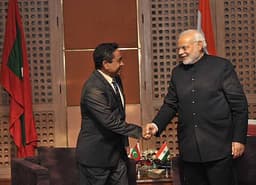
Abdulla Yameen
Politician · Modern
42.4Total

Belisario Betancur
Politician · Modern
54.9Total
Basic Information
Born
1959
1923
Died
—
—
Era
Modern
Modern
Nationality
Maldives
Colombia
Occupation
Politician
Politician
Civilization
Other
Western
Score Comparison
Military (10%)
15.3
49.4
Political (20%)
39.4
55.0
Influence (20%)
47.1
57.2
Legacy (20%)
37.5
49.2
Leadership (15%)
62.2
72.0
Strategy (15%)
44.4
43.0
TOTAL
42.4
54.9
Abdulla Yameen — Complete Timeline
2013 AD
Became President of the MaldivesPolitical Action◆ Major
Yameen was elected President of the Maldives, succeeding Mohamed Nasheed. His presidency was marked by authoritarian tendencies, including crackdowns on political opposition and the judiciary.
PresidentMaldivesAuthoritarianism
Impact: national
2015 AD
Imprisoned former President Mohamed NasheedPolitical Action◆ Major
Yameen's government arrested and imprisoned former President Nasheed on terrorism charges related to the arrest of a judge. The conviction was widely criticized internationally as politically motivated.
Political ImprisonmentNasheedHuman Rights
Impact: nationaldestructive
2018 AD
Lost re-election to Ibrahim Mohamed SolihPolitical Action◆ Major
Yameen was defeated in the presidential election by Ibrahim Mohamed Solih, ending his authoritarian rule. The election was seen as a victory for democracy and international pressure.
Election DefeatDemocratic Transition
Impact: national
2022 AD
Convicted of money laundering and corruptionPolitical Action◆ Major
Yameen was convicted of money laundering and corruption related to the sale of a resort island. He was sentenced to 11 years in prison, though the sentence was later reduced on appeal.
CorruptionMoney LaunderingConviction
Impact: nationaldestructive
Belisario Betancur — Complete Timeline
1982 AD
Presidency of ColombiaPolitical Action◆ Major
Belisario Betancur became President of Colombia in 1982. His administration pursued peace negotiations with guerrilla groups and implemented social reforms, earning him a reputation as a peacemaker.
PresidencyPeace ProcessSocial Reform
Impact: nationalconstructive
1984 AD
Peace Process with Guerrilla GroupsPolitical Action◆ Major
Betancur negotiated ceasefires with the FARC, M-19, and ELN guerrilla groups in 1984. The peace process included amnesty for guerrillas and political reforms, though it ultimately failed as violence continued.
Peace ProcessCeasefireGuerrilla Groups
Impact: nationalconstructive
1985 AD
Palace of Justice SiegeWar
The M-19 guerrilla group seized the Palace of Justice in Bogot
Palace of JusticeM-19TragedyMilitary Response
Impact: nationaltragic
Armero TragedyOther◆ Major
The Nevado del Ruiz volcano erupted on November 13, 1985, causing a lahar that destroyed the town of Armero, killing approximately 25,000 people. Betancur's government faced criticism for inadequate warning and response.
Natural DisasterArmeroVolcanic Eruption
Impact: nationaltragic
This comparison has not been analyzed yet.
One-time AI generation (~1 minute). Scores and timeline are already available below.
Rankings
🥇
Belisario BetancurLeader
Mil: 49.4Pol: 55.0Inf: 57.2
54.9
🥈
Abdulla Yameen
Mil: 15.3Pol: 39.4Inf: 47.1
42.4
+12.5 behind
How This Comparison Works
Algorithm
Each figure is scored on 6 dimensions (0—100 scale) based on structured historical data: Military (10%), Political (20%), Influence (20%), Legacy (20%), Leadership (15%), Strategy (15%). The weighted total produces the final ranking.
Data Sources
Scores are computed from structured sub-indicators in the database. Scale factors adjust for era (Ancient ×0.85, Modern ×1.0) and civilization size (Eastern ×1.05, Other ×0.80) to account for differences in population and military scale.
Maximum 3 Figures
Comparisons are limited to 2—3 figures to ensure readability and statistical meaningfulness.
Error Margins
±5 points per dimension — Sub-scores are derived from historical records with inherent uncertainty. Two figures within 5 points on a dimension should be considered roughly equivalent in that area.
Total Score Accuracy
±3 points overall — The weighted combination of 6 dimensions produces a total score with approximately ±3 points of uncertainty. Differences of less than 3 points are not statistically significant— the figures are effectively tied.
Known Limitations
- Historical records are incomplete and uneven across civilizations
- Figures from oral-tradition societies may be underrepresented
- Occupation labels can misclassify multi-role figures
- Scores measure capability and impact, not moral character
- Quantitative scoring is a comparison tool, not absolute truth
Capability Radar
Military (10%) — Battles & Warfare
Battles
19
31
Win Rate
22
32
Expansion
27
33
Political (20%) — Governance & Reform
Reform
30
70
Diplomacy
25
75
Economy
35
55
Influence (20%) — Cultural & Global Reach
Cultural
10
40
Global
10
45
Legacy (20%) — Historical Impact
Historical
15
55
Longevity
10
40
Leadership (15%) — Power & Stability
Tenure
45
60
Stability
15
50
Strategy (15%) — Tactics & Innovation
Strategy
28
38
Tactics
35
41
Reform
37
45
Similar Comparisons
Comments & Discussion
No comments yet. Be the first to share your thoughts!