Loading...
This comparison has not been analyzed yet.
One-time AI generation (~1 minute). Scores and timeline are already available below.
Abdullah Qutb Shah vs Francis I Stephen
Abdullah Qutb Shah leads by 3.7 pts · 2 figures compared
…

Abdullah Qutb Shah
Emperor · Modern
54.1Total
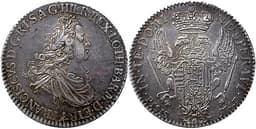
Francis I Stephen
Emperor · Modern
50.4Total
Basic Information
Born
1626
1708
Died
1672
1765
Era
Modern
Modern
Nationality
India
Holy Roman Empire
Occupation
Emperor
Emperor
Civilization
Indian
Western
Score Comparison
Military (10%)
45.0
20.0
Political (20%)
68.0
53.8
Influence (20%)
55.7
53.3
Legacy (20%)
43.3
46.7
Leadership (15%)
74.0
66.0
Strategy (15%)
35.0
54.3
TOTAL
54.1
50.4
Abdullah Qutb Shah — Complete Timeline
1636 AD
Submission to the Mughal EmpirePolitical Action
Abdullah Qutb Shah accepted Mughal suzerainty after a military campaign by Emperor Shah Jahan. He agreed to pay tribute and acknowledge Mughal authority, ending Golconda's full independence.
Mughal VassalageSubmission
Impact: regionaltragic
1640 AD
Construction of the Toli MasjidCultural
Abdullah Qutb Shah commissioned the construction of the Toli Masjid in Hyderabad, a mosque known for its intricate stucco work and Persian-style arches. The mosque became a notable example of Qutb Shahi architecture.
ArchitectureReligion
constructive
1650 AD
War against the MarathasWar◆ Major
Abdullah Qutb Shah fought a war against the Maratha Empire under Shivaji, who raided Golconda territory. The conflict weakened the sultanate and led to the loss of some border areas.
WarMarathaDefense
Impact: regional
1655 AD
Diplomatic relations with the Safavid EmpirePolitical Action
Abdullah Qutb Shah established diplomatic relations with the Safavid Empire of Persia, exchanging embassies and gifts. This alliance was aimed at countering Mughal influence in the Deccan.
DiplomacySafavidAlliance
Impact: regionalconstructive
1672 AD
Death and end of independent Qutb Shahi rulePolitical Action◆ Major
Abdullah Qutb Shah died, leaving the sultanate weakened and under Mughal control. His successor was the last Qutb Shahi ruler, and the dynasty was annexed by the Mughals in 1687.
End of DynastyMughal Annexation
Impact: regionaltragic
Francis I Stephen — Complete Timeline
1736 AD
Marriage to Maria TheresaPolitical Action
Francis Stephen married Maria Theresa of Austria, uniting the Houses of Habsburg and Lorraine. This marriage created the Habsburg-Lorraine dynasty and made Francis co-ruler of the Habsburg domains.
Dynastic MarriageHabsburg-Lorraine
Impact: regionalconstructive
1737 AD
Grand Duke of TuscanyPolitical Action◆ Major
Francis became Grand Duke of Tuscany as part of the settlement ending the War of the Polish Succession. He ceded the Duchy of Lorraine to France in exchange, establishing a new power base for his family.
Territorial ExchangeTuscany
Impact: regionalconstructive
1740 AD
Co-ruler of the Habsburg MonarchyPolitical Action
Upon Maria Theresa's accession, Francis became co-ruler of the Habsburg Monarchy. He focused on financial administration and economic reforms, including the establishment of the Habsburg state bank.
Habsburg MonarchyEconomic Reform
Impact: regionalconstructive
1745 AD
Elected Holy Roman EmperorPolitical Action◆ Major
Francis was elected Holy Roman Emperor as Francis I, succeeding Charles VII. His election was secured by Maria Theresa's diplomatic efforts and ended the Bavarian interlude, restoring the imperial title to the Habsburgs.
Imperial ElectionHabsburg Restoration
Impact: regionalconstructive
This comparison has not been analyzed yet.
One-time AI generation (~1 minute). Scores and timeline are already available below.
Rankings
🥇
Abdullah Qutb ShahLeader
Mil: 45.0Pol: 68.0Inf: 55.7
54.1
🥈
Francis I Stephen
Mil: 20.0Pol: 53.8Inf: 53.3
50.4
+3.7 behind
How This Comparison Works
Algorithm
Each figure is scored on 6 dimensions (0—100 scale) based on structured historical data: Military (10%), Political (20%), Influence (20%), Legacy (20%), Leadership (15%), Strategy (15%). The weighted total produces the final ranking.
Data Sources
Scores are computed from structured sub-indicators in the database. Scale factors adjust for era (Ancient ×0.85, Modern ×1.0) and civilization size (Eastern ×1.05, Other ×0.80) to account for differences in population and military scale.
Maximum 3 Figures
Comparisons are limited to 2—3 figures to ensure readability and statistical meaningfulness.
Error Margins
±5 points per dimension — Sub-scores are derived from historical records with inherent uncertainty. Two figures within 5 points on a dimension should be considered roughly equivalent in that area.
Total Score Accuracy
±3 points overall — The weighted combination of 6 dimensions produces a total score with approximately ±3 points of uncertainty. Differences of less than 3 points are not statistically significant— the figures are effectively tied.
Known Limitations
- Historical records are incomplete and uneven across civilizations
- Figures from oral-tradition societies may be underrepresented
- Occupation labels can misclassify multi-role figures
- Scores measure capability and impact, not moral character
- Quantitative scoring is a comparison tool, not absolute truth
Capability Radar
Military (10%) — Battles & Warfare
Battles
35
5
Win Rate
30
5
Expansion
20
5
Political (20%) — Governance & Reform
Reform
45
40
Diplomacy
40
70
Economy
50
50
Influence (20%) — Cultural & Global Reach
Cultural
55
30
Global
20
30
Legacy (20%) — Historical Impact
Historical
40
40
Longevity
30
50
Leadership (15%) — Power & Stability
Tenure
60
60
Stability
30
55
Strategy (15%) — Tactics & Innovation
Strategy
35
5
Tactics
40
5
Reform
25
5
Similar Comparisons
Comments & Discussion
No comments yet. Be the first to share your thoughts!