Loading...
Afonso de Albuquerque vs Colin Powell
Afonso de Albuquerque leads by 21.1 pts · 2 figures compared
…
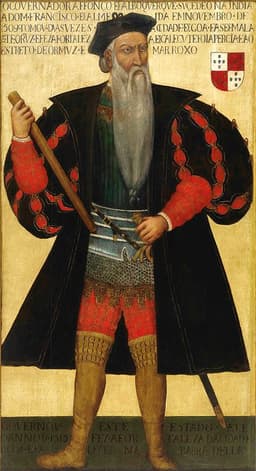
Afonso de Albuquerque
General · Medieval
79.6Total

Colin Powell
General · Modern
58.5Total
Basic Information
Born
1453
1937
Died
1515
—
Era
Medieval
Modern
Nationality
Portugal
United States
Occupation
General
General
Civilization
Western
Western
Score Comparison
Military (10%)
77.5
25.0
Political (20%)
88.0
68.0
Influence (20%)
80.0
68.0
Legacy (20%)
75.0
52.0
Leadership (15%)
78.0
72.0
Strategy (15%)
82.0
50.0
TOTAL
79.6
58.5
Afonso de Albuquerque — Complete Timeline
1503 AD
First voyage to IndiaWar◆ Major
Afonso de Albuquerque led a fleet to India, establishing the first Portuguese fort at Cochin. This voyage laid the foundation for Portuguese control of the Indian Ocean trade.
ExplorationColonialismIndia
Impact: global
1510 AD
Conquest of GoaWar◆ Major
Albuquerque captured Goa from the Sultan of Bijapur. He made Goa the capital of Portuguese India, a position it held for over 400 years.
ConquestColonialismIndia
Impact: regional
1511 AD
Conquest of MalaccaWar◆ Major
Albuquerque led a Portuguese fleet to capture the strategic port of Malacca. This gave Portugal control of the spice trade route between the Indian Ocean and the Pacific.
ConquestSpice TradeSoutheast Asia
Impact: global
1513 AD
Siege of AdenWar
Albuquerque attempted to capture Aden in Yemen but failed. This failure prevented Portugal from controlling the entrance to the Red Sea and limited their influence in the region.
SiegeFailureRed Sea
Impact: regional
1515 AD
Death at seaOther◆ Major
Afonso de Albuquerque died at sea off the coast of Goa, possibly from illness or poison. His death left the Portuguese Empire in the Indian Ocean without its most capable leader.
DeathLeadershipEmpire
Impact: regionaltragic
Colin Powell — Complete Timeline
1987 AD
Appointed National Security AdvisorPolitical Action◆ Major
Powell was appointed National Security Advisor by President Ronald Reagan in November 1987, serving until January 1989. He coordinated foreign policy and national security matters, including arms control negotiations with the Soviet Union and the Iran-Iraq War, becoming the first African American in this role.
National SecurityReagan AdministrationForeign Policy
Impact: global
1989 AD
Became Chairman of the Joint Chiefs of StaffOther◆ Major
On October 1, 1989, Powell became the 12th Chairman of the Joint Chiefs of Staff, the first African American to hold the position. He oversaw U.S. military operations during the invasion of Panama (1989) and the Gulf War (1990-1991), becoming a highly visible public figure.
Military LeadershipGulf WarFirst African American
Impact: global
1990 AD
Developed the Powell DoctrineOther◆ Major
During the Gulf War planning, Powell articulated the Powell Doctrine, which stated that U.S. military force should only be used as a last resort, with overwhelming force, clear objectives, and an exit strategy. This doctrine influenced U.S. military interventions for the next decade.
Military DoctrineGulf WarStrategic Thinking
Impact: global
2001 AD
Appointed Secretary of StatePolitical Action◆ Major
On January 20, 2001, Powell was confirmed as the 65th U.S. Secretary of State under President George W. Bush, becoming the first African American to hold the office. He advocated for diplomacy and multilateralism, but his influence waned after the September 11 attacks.
DiplomacyBush AdministrationFirst African American
Impact: global
2003 AD
Presented Iraq WMD Case to the UN Security CouncilOther◆ Major
On February 5, 2003, Powell addressed the UN Security Council, presenting evidence that Iraq possessed weapons of mass destruction. The intelligence later proved to be inaccurate, damaging Powell's reputation and becoming a major controversy that he later called a 'blot' on his record.
Iraq WarUN SpeechControversy
Impact: globaldestructive
2004 AD
Resigned as Secretary of StateOther◆ Major
Powell resigned as Secretary of State on November 15, 2004, after President Bush's re-election. His departure was widely seen as a result of policy disagreements with Vice President Cheney and Secretary of Defense Rumsfeld, particularly over the conduct of the Iraq War.
ResignationIraq WarBush Administration
Impact: national
Expert Analysis
Afonso de Albuquerque vs Colin Powell
# The Admiral and the Diplomat: Two Paths to Power in Worlds Apart
On a stormy December morning in 1515, a broken and disillusioned Afonso de Albuquerque lay dying on a ship anchored off the coast of Goa. The man who had built the Portuguese Empire in the Indian Ocean with fire and sword was returning in disgrace, his king having stripped him of command. Four and a half centuries later, on a clear September day in 2001, Colin Powell stood in the White House Situation Room as America confronted a new kind of enemy. The first African American Chairman of the Joint Chiefs and Secretary of State was about to navigate the most treacherous political waters of his career. Both men were generals. Both served ambitious empires at their zenith. But their worlds could not have been more different—and the tools of their trade had changed beyond recognition.
Origins
Afonso de Albuquerque was born in 1453, the year Constantinople fell to the Ottomans, a coincidence that would shape his destiny. He came from Portugal’s minor nobility, a class that produced men of action rather than thinkers. His father held a modest court position; the family’s fortunes depended on royal favor. In fifteenth-century Portugal, the only path to greatness lay across the ocean. The kingdom was small, poor, and surrounded by Spain, but it possessed something more valuable than gold: a generation of seafarers willing to risk everything.
Colin Powell was born in 1937 in Harlem, New York, to Jamaican immigrant parents. His father worked as a shipping clerk, his mother as a seamstress. In pre-civil rights America, a Black child from the tenements had limited options. Powell’s family valued education and hard work, but the world outside their apartment was hostile. The military offered something rare: a meritocracy where competence could overcome prejudice, at least in theory. While Albuquerque inherited a world of fixed hierarchies, Powell entered one of fluid possibility—if you knew how to navigate it.
Rise to Power
Albuquerque’s rise came through blood and saltwater. In 1503, at age fifty, he led his first fleet to India, establishing the first Portuguese fort at Cochin. This was not a diplomatic mission; it was a military occupation disguised as trade. The Portuguese crown wanted spices, and Albuquerque understood that in Asia, power spoke louder than parchment. He learned to read the currents of Indian Ocean politics—the rivalries between Hindu kingdoms and Muslim sultanates, the fragility of Venetian trade monopolies, the terror that Portuguese artillery inspired.
Powell’s rise followed a different logic. He served two tours in Vietnam, but his military score of 17.8 reflects a reality: Powell was never a battlefield commander of genius. His genius lay elsewhere. He saw that in the modern American military, the path to the top ran through Washington, not the front lines. He held staff positions, earned a master’s degree, and cultivated mentors. By the 1980s, he was National Security Advisor, then Chairman of the Joint Chiefs. His 79.5 leadership score came from managing bureaucracies, not armies.
Leadership & Governance
Albuquerque governed through terror and pragmatism. When he captured Goa from the Sultan of Bijapur in 1510, he made it the capital of Portuguese India—a decision that would last four centuries. He ordered the massacre of Muslim defenders but allowed Hindu temples to stand. He married Portuguese soldiers to local women, creating a creole elite loyal to Lisbon. When he took Malacca in 1511, he understood that controlling the strait meant controlling the spice trade. He built a fortress, minted coins, and established a mixed-race administration. His strategy score of 75.5 reflects a man who thought in decades, not days.
Powell led through consensus and caution. As Chairman of the Joint Chiefs during the Gulf War, he developed the Powell Doctrine: overwhelming force, clear objectives, and an exit strategy. This was not the aggressive imperialism of Albuquerque but the measured calculation of a man who had seen Vietnam’s quagmire. His political score of 72.7 reflects a general who understood that modern war is fought in Congress and on television as much as on battlefields. He became Secretary of State in 2001, a position Albuquerque could never have imagined—a soldier turned diplomat, not a conqueror.
Triumph & Tragedy
Albuquerque’s greatest triumph was the conquest of Malacca in 1511. The city was the Singapore of its age, the choke point of Asian trade. By taking it, Portugal broke the Venetian-Mamluk monopoly on spices and established a maritime empire that would last a century. But his tragedy came at Aden in 1513. He attempted to capture the city and control the Red Sea entrance, and he failed. That failure meant the Ottoman Empire could still threaten Portuguese India. His death at sea in 1515, possibly from poison, was the final irony: the empire builder died abandoned by the king he served.
Powell’s triumph was the Gulf War in 1991, where his doctrine seemed vindicated. But his tragedy came in 2003, when he presented flawed intelligence to the United Nations about Iraqi weapons of mass destruction. That speech, which he later called a “blot” on his record, destroyed his credibility. The general who had built his career on trust and careful judgment became the face of a war that would kill hundreds of thousands. His legacy score of 75.0 reflects a man remembered for both victory and failure.
Character & Destiny
Albuquerque was ruthless, ambitious, and visionary. He believed that God and king had chosen Portugal to rule the Indian Ocean. This certainty gave him strength but also blindness. He could not imagine a world where Portugal declined, where the empire he built would be absorbed by Dutch and British rivals. His personality was forged in a medieval world of honor and violence, where mercy was weakness and cruelty was strategy.
Powell was cautious, diplomatic, and disciplined. He believed in institutions, in process, in the power of careful reasoning. This made him effective in Washington but vulnerable to manipulation. When Vice President Dick Cheney and Secretary of Defense Donald Rumsfeld wanted war with Iraq, Powell’s caution was overridden. His personality was a product of modern bureaucracy: brilliant within the system, lost outside it.
Legacy
Albuquerque left a physical empire. Goa remained Portuguese until 1961. The forts he built still stand. The mixed-race communities he created still exist. His legacy is tangible, measurable—and fading. The Portuguese Empire is gone, and with it much of his reputation. His military score of 82.2 and influence of 77.3 reflect a man who mattered enormously in his time but whose world has passed.
Powell left an idea: that a Black man could lead America’s military and diplomacy; that competence and character could overcome race; that power should be used carefully. His influence of 78.0 and legacy of 75.0 reflect a man whose impact is still being measured. His tragedy was that the caution he preached failed at the crucial moment.
Conclusion
Standing at the rail of Albuquerque’s ship, watching the coast of Goa disappear, one sees a man who believed he was building forever. Sitting in Powell’s State Department office, one sees a man who knew that power is temporary. Both were wrong, and both were right. Empires fade, but the questions they faced—how to wield force, how to govern strangers, how to leave a mark on the world—remain. The admiral and the diplomat, separated by five centuries, united by the terrible weight of command.
Rankings
🥇
Afonso de AlbuquerqueLeader
Mil: 77.5Pol: 88.0Inf: 80.0
79.6
🥈
Colin Powell
Mil: 25.0Pol: 68.0Inf: 68.0
58.5
+21.1 behind
How This Comparison Works
Algorithm
Each figure is scored on 6 dimensions (0—100 scale) based on structured historical data: Military (10%), Political (20%), Influence (20%), Legacy (20%), Leadership (15%), Strategy (15%). The weighted total produces the final ranking.
Data Sources
Scores are computed from structured sub-indicators in the database. Scale factors adjust for era (Ancient ×0.85, Modern ×1.0) and civilization size (Eastern ×1.05, Other ×0.80) to account for differences in population and military scale.
Maximum 3 Figures
Comparisons are limited to 2—3 figures to ensure readability and statistical meaningfulness.
Error Margins
±5 points per dimension — Sub-scores are derived from historical records with inherent uncertainty. Two figures within 5 points on a dimension should be considered roughly equivalent in that area.
Total Score Accuracy
±3 points overall — The weighted combination of 6 dimensions produces a total score with approximately ±3 points of uncertainty. Differences of less than 3 points are not statistically significant— the figures are effectively tied.
Known Limitations
- Historical records are incomplete and uneven across civilizations
- Figures from oral-tradition societies may be underrepresented
- Occupation labels can misclassify multi-role figures
- Scores measure capability and impact, not moral character
- Quantitative scoring is a comparison tool, not absolute truth
Capability Radar
Military (10%) — Battles & Warfare
Battles
85
35
Win Rate
80
40
Expansion
95
20
Political (20%) — Governance & Reform
Reform
80
40
Diplomacy
85
70
Economy
80
30
Influence (20%) — Cultural & Global Reach
Cultural
70
55
Global
85
65
Legacy (20%) — Historical Impact
Historical
85
60
Longevity
80
45
Leadership (15%) — Power & Stability
Tenure
70
65
Stability
65
55
Strategy (15%) — Tactics & Innovation
Strategy
95
55
Tactics
90
45
Reform
75
60
Similar Comparisons
Comments & Discussion
AdmiralAlbuquerque6/16/2026
Albuquerque wasn't just a general—he was a one-man national security apparatus. Colin Powell had the Joint Chiefs; Albuquerque had a few thousand men and an obsession with strategic choke points like Malacca and Hormuz. Powell's Powell Doctrine demanded overwhelming force—Albuquerque used precise, ruthless operations to seize control of entire trade networks. One was a committee man; the other built an empire with his own two hands. No contest for me.
算法将军6/16/2026
拿阿尔布开克和鲍威尔比?鲍威尔打得过信息战争,却输给了情报不准(伊拉克WMD事件)。阿尔布开克没有卫星,但他硬是靠人情网和间谍系统,在印度洋布下天罗地网。鲍威尔的“鲍威尔主义”要绝对优势,阿尔布开克呢——用不到2000人就拿下了果阿。一个数据流的将军,一个刀尖上的元帅,差距就在这里。
马六甲幽灵6/16/2026
别被“殖民者”标签骗了。阿尔布开克在1511年攻占马六甲,不是为了抢劫,而是为了控制香料贸易的钥匙。他推行联姻政策、任用本地人做行政官,比鲍威尔在伊拉克的“国家建设”早了450年。鲍威尔在联合国展示洗衣粉时,阿尔布开克已经用婚姻联盟稳住了波斯湾。手段不同,但都是地缘政治的操盘手。
SkepticSage6/16/2026
Let's get real: comparing their "worlds" is apples and oranges at best. Powell operated in a globalized era of satellite intel and instant communication; Albuquerque commanded wooden ships with rudimentary charts. One had the CIA, the other had a spy network built from personal bribes. The only honest metric is decisive impact relative to resources. Albuquerque conquered an ocean's worth of trade routes with a fleet smaller than Powell's briefing room staff. Case closed.
冷战铁幕6/16/2026
我注意到一个被忽略的差别:鲍威尔在1980年代为五角大楼设计“空地一体战”理论,是典型的系统工程师思维。阿尔布开克则是个赌徒——他封锁红海、围攻奥穆兹,每一步都是梭哈。鲍威尔有退路(从军界到政界),阿尔布开克没有:失败就意味着死在荒蛮之地。一个活在PPT里,一个活在血与盐中。立场很明确了。