Loading...
Afonso de Albuquerque vs Jung Bahadur Rana
Afonso de Albuquerque leads by 18.2 pts · 2 figures compared
…
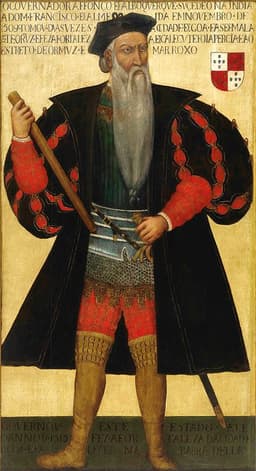
Afonso de Albuquerque
General · Medieval
79.6Total
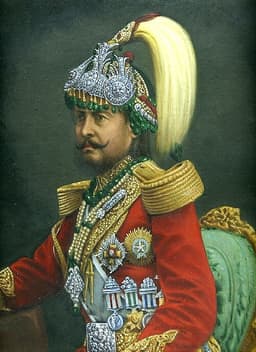
Jung Bahadur Rana
General · Modern
61.4Total
Basic Information
Born
1453
1817
Died
1515
1877
Era
Medieval
Modern
Nationality
Portugal
Nepal
Occupation
General
General
Civilization
Western
Indian
Score Comparison
Military (10%)
77.5
55.0
Political (20%)
88.0
72.0
Influence (20%)
80.0
56.7
Legacy (20%)
75.0
55.0
Leadership (15%)
78.0
78.0
Strategy (15%)
82.0
55.0
TOTAL
79.6
61.4
Afonso de Albuquerque — Complete Timeline
1503 AD
First voyage to IndiaWar◆ Major
Afonso de Albuquerque led a fleet to India, establishing the first Portuguese fort at Cochin. This voyage laid the foundation for Portuguese control of the Indian Ocean trade.
ExplorationColonialismIndia
Impact: global
1510 AD
Conquest of GoaWar◆ Major
Albuquerque captured Goa from the Sultan of Bijapur. He made Goa the capital of Portuguese India, a position it held for over 400 years.
ConquestColonialismIndia
Impact: regional
1511 AD
Conquest of MalaccaWar◆ Major
Albuquerque led a Portuguese fleet to capture the strategic port of Malacca. This gave Portugal control of the spice trade route between the Indian Ocean and the Pacific.
ConquestSpice TradeSoutheast Asia
Impact: global
1513 AD
Siege of AdenWar
Albuquerque attempted to capture Aden in Yemen but failed. This failure prevented Portugal from controlling the entrance to the Red Sea and limited their influence in the region.
SiegeFailureRed Sea
Impact: regional
1515 AD
Death at seaOther◆ Major
Afonso de Albuquerque died at sea off the coast of Goa, possibly from illness or poison. His death left the Portuguese Empire in the Indian Ocean without its most capable leader.
DeathLeadershipEmpire
Impact: regionaltragic
Jung Bahadur Rana — Complete Timeline
1846 AD
Kot MassacrePolitical Action
Jung Bahadur Runa orchestrated the Kot Massacre in Kathmandu, where dozens of nobles and courtiers were killed. This event eliminated his political rivals and allowed him to seize effective control of the Nepalese government, establishing the hereditary Rana prime ministership.
CoupMassacreRana Dynasty
Impact: nationaldestructive
Establishment of Rana DynastyPolitical Action◆ Major
Following the Kot Massacre, Jung Bahadur Rana appointed himself prime minister and commander-in-chief. He made the position hereditary, founding the Rana dynasty that ruled Nepal for over a century, reducing the Shah monarchs to figureheads.
DynastyGovernmentNepal
Impact: national
1850 AD
Visit to EuropeCultural
Jung Bahadur Rana traveled to Britain and France, becoming the first South Asian ruler to visit Europe. He observed Western military and industrial technology, which influenced his modernization efforts in Nepal, including army reforms.
DiplomacyModernizationTravel
Impact: nationalconstructive
1856 AD
Nepal-Tibet War and Treaty of ThapathaliWar◆ Major
Jung Bahadur Rana led a Nepalese military campaign into Tibet. The conflict ended with the Treaty of Thapathali, which secured Nepalese territorial claims and established a tributary relationship with Tibet, enhancing Nepal's regional influence.
WarTreatyTibet
Impact: regional
Expert Analysis
Afonso de Albuquerque vs Jung Bahadur Rana
# The Conqueror and the Consolidator
On a sweltering December morning in 1510, Afonso de Albuquerque stood on the deck of his flagship, watching flames consume the wooden walls of Goa. The Sultan of Bijapur's garrison had fled, and the Portuguese general ordered his men to spare no one who resisted. By nightfall, the city belonged to Portugal. Three centuries later and half a world away, another general, Jung Bahadur Rana, walked through the blood-soaked courtyard of the Kot Palace in Kathmandu. Forty nobles lay dead around him, their bodies testament to a different kind of conquest—one not of foreign soil, but of domestic power. Both men built empires, but their paths could not have diverged more sharply. Why did one die at sea, his creation crumbling behind him, while the other founded a dynasty that would rule Nepal for a century?
Origins
Afonso de Albuquerque was born in 1453, the year Constantinople fell to the Ottomans. Portugal was a small kingdom on the edge of Europe, but it nursed outsized ambitions. The son of a noble family, Albuquerque grew up in the court of King Afonso V, where tales of crusades and exploration filled the air. He learned mathematics and navigation, but his real education came from watching Portugal's ships push south along Africa's coast, seeking a sea route to the spice markets of Asia. His world was one of horizons and possibilities, where a man with a sword and a compass could rewrite the map.
Jung Bahadur Rana entered the world in 1817, a time when Nepal was reeling from a disastrous war with the British East India Company. He was born into the Kunwar family, minor nobles in the court of Kathmandu, where power was a game of whispers and daggers. His father served as a general, but the family's fortunes rose and fell with the whims of the king and the feuds of rival clans. Jung Bahadur learned early that in Nepal, survival depended not on conquering oceans, but on navigating the treacherous currents of court intrigue.
Rise to Power
Albuquerque's rise came through the sea. In 1503, at age fifty, he led his first fleet to India, landing at Cochin and building the first Portuguese fort on the subcontinent. He was not a charismatic leader in the mold of his rival Francisco de Almeida; he was cold, calculating, and relentless. His opportunity came in 1509 when King Manuel I appointed him Governor of Portuguese India, a position that gave him command of the ocean. He understood that Portugal's empire would not be built on trade alone—it would require fortresses, fleets, and the iron will to hold them.
Jung Bahadur's ascent was bloodier and more intimate. In 1846, Nepal's queen mother, Rajya Lakshmi, grew suspicious of the ruling prime minister. She turned to Jung Bahadur, then a young general, to eliminate her enemies. On the night of September 14, he summoned the nobles of Kathmandu to the Kot Palace under the pretense of a council. Once they were inside, his soldiers barred the doors. By dawn, the Kot Massacre had killed dozens of the most powerful men in Nepal. Jung Bahadur emerged as prime minister and commander-in-chief, a position he would make hereditary.
Leadership & Governance
Albuquerque ruled the Indian Ocean like a pirate king with a crown. He captured Goa in 1510 and made it the capital of Portuguese India, a city that would remain Portuguese for over four centuries. He understood that empire required not just soldiers, but settlers, and he encouraged Portuguese men to marry local women. In 1511, he seized Malacca, the gateway to the Spice Islands, granting Portugal control of the world's most valuable trade network. His strategy was simple: seize the strategic chokepoints and let geography enforce your will. Yet he failed at Aden in 1513, a defeat that left the Red Sea open to his enemies and foreshadowed the limits of his reach.
Jung Bahadur governed differently. He had seen the power of the British Empire firsthand during his 1850 visit to Europe, the first by any South Asian ruler. He studied their administration, their military discipline, and their diplomacy. Upon returning to Nepal, he modernized the army, reformed the tax system, and centralized power in his own hands. But unlike Albuquerque, who built an overseas empire, Jung Bahadur built a domestic one. He kept Nepal independent by playing the British and Chinese against each other, signing the Treaty of Thapathali in 1856 after a brief war with Tibet, which secured Nepal's northern border and its trade routes.
Triumph & Tragedy
Albuquerque's greatest moment came in 1511 with the fall of Malacca. He wrote to King Manuel, "I have taken this great city, and with it the keys to all the spice trade of the East." But his tragedy was equally grand. In 1515, while returning from a failed campaign in the Persian Gulf, he fell ill off the coast of Goa. Some said poison; others said the sea itself claimed him. He died on his ship, watching the shores of his empire fade into the distance. His successors lacked his vision, and within decades, the Portuguese Empire in Asia began its slow decline.
Jung Bahadur's triumph was subtler but more enduring. He survived the Kot Massacre, outmaneuvered his rivals, and established the Rana dynasty, which would rule Nepal until 1951. His tragedy was that his success came at a cost: he turned Nepal into a feudal state where power flowed from the prime minister's palace, not the people. When he died in 1877, he left behind a country stable but stagnant, its potential locked in the amber of his family's control.
Character & Destiny
Albuquerque was a man of the sea, restless and ambitious, forever chasing the next horizon. His decisions were driven by a conviction that Portugal was destined to rule the East. This arrogance made him brilliant but brittle; he could not adapt when his plans failed. Jung Bahadur was a man of the court, patient and calculating, always watching the faces around him. He knew that power in Nepal was not won on battlefields but in banquet halls, and he played the game with a cold precision that Albuquerque never needed to learn.
Legacy
Today, Albuquerque is remembered as the architect of the Portuguese Empire in Asia, a name carved into the history of Goa and Malacca. But his empire was a house of cards, dependent on his own genius. Jung Bahadur Rana is remembered as the founder of a dynasty, a man who reshaped Nepal's political landscape for a century. His legacy is more ambiguous: he preserved Nepal's independence but crushed its democracy.
Conclusion
Both men conquered, but they conquered different worlds. Albuquerque fought the ocean and the sultan, seeking to control the flow of spices and gold. Jung Bahadur fought the court and the king, seeking to control the flow of power. One died at sea, his empire already fraying; the other died in his bed, his dynasty secure. Perhaps the difference lies in their ambitions: Albuquerque reached for the infinite, Jung Bahadur for the finite. The sea is vast and unforgiving; the palace is small and suffocating. In the end, both men got exactly what they sought—and paid the price for it.
Rankings
🥇
Afonso de AlbuquerqueLeader
Mil: 77.5Pol: 88.0Inf: 80.0
79.6
🥈
Jung Bahadur Rana
Mil: 55.0Pol: 72.0Inf: 56.7
61.4
+18.2 behind
How This Comparison Works
Algorithm
Each figure is scored on 6 dimensions (0—100 scale) based on structured historical data: Military (10%), Political (20%), Influence (20%), Legacy (20%), Leadership (15%), Strategy (15%). The weighted total produces the final ranking.
Data Sources
Scores are computed from structured sub-indicators in the database. Scale factors adjust for era (Ancient ×0.85, Modern ×1.0) and civilization size (Eastern ×1.05, Other ×0.80) to account for differences in population and military scale.
Maximum 3 Figures
Comparisons are limited to 2—3 figures to ensure readability and statistical meaningfulness.
Error Margins
±5 points per dimension — Sub-scores are derived from historical records with inherent uncertainty. Two figures within 5 points on a dimension should be considered roughly equivalent in that area.
Total Score Accuracy
±3 points overall — The weighted combination of 6 dimensions produces a total score with approximately ±3 points of uncertainty. Differences of less than 3 points are not statistically significant— the figures are effectively tied.
Known Limitations
- Historical records are incomplete and uneven across civilizations
- Figures from oral-tradition societies may be underrepresented
- Occupation labels can misclassify multi-role figures
- Scores measure capability and impact, not moral character
- Quantitative scoring is a comparison tool, not absolute truth
Capability Radar
Military (10%) — Battles & Warfare
Battles
85
45
Win Rate
80
50
Expansion
95
40
Political (20%) — Governance & Reform
Reform
80
75
Diplomacy
85
70
Economy
80
65
Influence (20%) — Cultural & Global Reach
Cultural
70
55
Global
85
40
Legacy (20%) — Historical Impact
Historical
85
65
Longevity
80
60
Leadership (15%) — Power & Stability
Tenure
70
80
Stability
65
60
Strategy (15%) — Tactics & Innovation
Strategy
95
60
Tactics
90
55
Reform
75
70
Similar Comparisons
Comments & Discussion
CAPTAIN CARNAGE6/16/2026
Look, I respect the military innovation, but Albuquerque was a brute with a battleship. His "scorched earth" tactic in Goa wasn't brilliance—it was butchery. Meanwhile, Jung Bahadur knew that real power isn't about burning cities; it's about controlling the systems behind them. He abolished sati and reformed Nepal's army without a single siege. Who's the better strategist? The man who built a dynasty for 100 years, not one who died broke and broken on the high seas.
数据拆解师6/16/2026
说两位都是"军事家",你们可真会避重就轻。对比一下数字:阿尔布开克占领的马六甲给葡萄牙带来了每年600万克鲁扎多的香料贸易,但葡萄牙当时人口才150万,根本守不住。而忠格·巴哈杜尔掌控的尼泊尔,人口不过400万,却让拉纳家族统治了104年。数据不说谎:一个是短期掠夺者,一个是可持续统治者——跟谁更像现代政治家,一目了然。
THE ORIENTALIST6/16/2026
You fools romanticize Albuquerque as a "conqueror," but he was just a courtier with a navy. His real genius was PR: he claimed Goa was given by treaty, then burned it anyway. Compare that to Jung Bahadur, who actually studied British military reforms and built a stable civil service. The Portuguese empire crumbled within decades; the Rana dynasty held Nepal for over 100 years. One was a pirate in armor, the other a genuine state-builder. Stop confusing carnage with competence.
历史考古癖6/16/2026
请注意时间线的讽刺:阿尔布开克死于1515年,他离世时印度的葡萄牙据点已经开始瓦解——连遗嘱都是请求国王别抛弃他的遗孀。而忠格·巴哈杜尔1846年夺权后,不仅活到67岁,还亲手把自己的儿子送上了首相宝座。一个临终被遗忘,一个建了个家族王朝——这哪是什么"两位军事家"的对比,这是"壮烈创业者"和"精算师王朝奠基人"的天壤之别。
REALPOLITIK RAJA6/16/2026
Albuquerque was a medieval crusader with a fleet, Jung Bahadur a modern pragmatist with a rifle. The Portuguese tried to convert Hindus by force; Jung Bahadur actually married into the royal family and learned Sanskrit to legitimize his rule. One died in a shipwreck, his "empire" a collection of coastal outposts; the other died in bed, his son already trained to succeed him. If you want to compare legacy, count the years of stability: 0 vs 100. That's not a debate.