Loading...
Afonso de Albuquerque vs Qi Jiguang
Afonso de Albuquerque leads by 16.2 pts · 2 figures compared
…
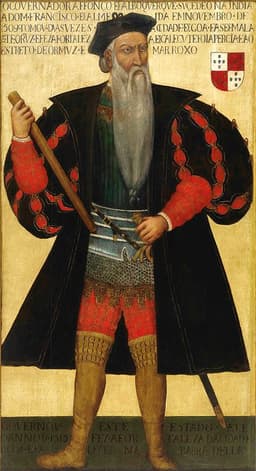
Afonso de Albuquerque
General · Medieval
79.6Total

Qi Jiguang
General · Medieval
63.4Total
Basic Information
Born
1453
1528
Died
1515
1588
Era
Medieval
Medieval
Nationality
Portugal
China
Occupation
General
General
Civilization
Western
Eastern
Score Comparison
Military (10%)
77.5
80.0
Political (20%)
88.0
68.0
Influence (20%)
80.0
61.0
Legacy (20%)
75.0
58.0
Leadership (15%)
78.0
48.8
Strategy (15%)
82.0
81.6
TOTAL
79.6
63.4
Afonso de Albuquerque — Complete Timeline
1503 AD
First voyage to IndiaWar◆ Major
Afonso de Albuquerque led a fleet to India, establishing the first Portuguese fort at Cochin. This voyage laid the foundation for Portuguese control of the Indian Ocean trade.
ExplorationColonialismIndia
Impact: global
1510 AD
Conquest of GoaWar◆ Major
Albuquerque captured Goa from the Sultan of Bijapur. He made Goa the capital of Portuguese India, a position it held for over 400 years.
ConquestColonialismIndia
Impact: regional
1511 AD
Conquest of MalaccaWar◆ Major
Albuquerque led a Portuguese fleet to capture the strategic port of Malacca. This gave Portugal control of the spice trade route between the Indian Ocean and the Pacific.
ConquestSpice TradeSoutheast Asia
Impact: global
1513 AD
Siege of AdenWar
Albuquerque attempted to capture Aden in Yemen but failed. This failure prevented Portugal from controlling the entrance to the Red Sea and limited their influence in the region.
SiegeFailureRed Sea
Impact: regional
1515 AD
Death at seaOther◆ Major
Afonso de Albuquerque died at sea off the coast of Goa, possibly from illness or poison. His death left the Portuguese Empire in the Indian Ocean without its most capable leader.
DeathLeadershipEmpire
Impact: regionaltragic
Qi Jiguang — Complete Timeline
1555 AD
Formation of the Qi family armyWar◆ Major
Qi Jiguang recruited and trained a new army from the peasantry of Zhejiang province. He implemented strict discipline, innovative tactics, and specialized weapons, creating a highly effective force against Japanese pirates.
Military ReformPiracyMing Dynasty
Impact: regionalconstructive
1560 AD
Publication of 'New Treatise on Military Efficiency'Cultural◆ Major
Qi Jiguang wrote 'New Treatise on Military Efficiency' (Jixiao Xinshu), a manual on military training and tactics. The book detailed his methods for organizing, equipping, and drilling troops, influencing later Chinese military thought.
Military ManualTacticsMing Dynasty
Impact: nationalconstructive
1561 AD
Battle of CengangWar◆ Major
Qi Jiguang led his army to a decisive victory against Japanese pirates at Cengang in Zhejiang. The battle destroyed a major pirate base and significantly reduced pirate activity along the coast.
BattlePiracyMing Dynasty
Impact: regionalconstructive
1568 AD
Defense of the Great WallWar◆ Major
Qi Jiguang was appointed to strengthen the Great Wall defenses against Mongol incursions. He rebuilt sections of the wall, added watchtowers, and trained garrison troops, improving border security for decades.
Great WallDefenseMongol Incursions
Impact: nationalconstructive
Expert Analysis
Origins
Afonso de Albuquerque (1453–1515) was born in Alhandra, Portugal, to a noble family with ties to the royal court. His father, Gonçalo de Albuquerque, served as a lord of a minor estate, and his mother, Dona Leonor, was of noble lineage. Albuquerque received a classical education and military training, entering the court of King Afonso V as a young man. His early career included service in North Africa, where he participated in the conquest of Arzila and Tangier, gaining experience in naval warfare and fortification. This background shaped his strategic focus on controlling key maritime chokepoints.
Qi Jiguang (1528–1588) was born in Luqiao, Shandong, China, into a military family with a hereditary rank. His father, Qi Jingtong, was a minor official, and his mother, Lady Zhang, managed the household. Qi Jiguang studied military classics and martial arts from a young age, passing the imperial military examinations at 17. He was appointed as a military officer in Shandong, where he first encountered the problem of Japanese pirates (wokou) raiding the coast. His early career was marked by frustration with the inefficiency of Ming military forces.
Rise to Power
Albuquerque rose to prominence through his service in the Portuguese India Armadas. In 1503, he led a fleet to India and established the first Portuguese fort at Cochin, securing an alliance with the local raja. His decisive moment came in 1509 when King Manuel I appointed him Governor of Portuguese India, replacing the less aggressive Francisco de Almeida. Albuquerque immediately launched the conquest of Goa in 1510, capturing it from the Sultan of Bijapur with 1,700 Portuguese soldiers and 300 Malabar allies. This victory made him the dominant figure in the Indian Ocean.
Qi Jiguang's rise began in the 1550s when the wokou threat escalated. In 1555, he was transferred to Zhejiang province, the epicenter of pirate raids. He recruited a new army from peasants, bypassing corrupt local garrisons. His innovative training methods and strict discipline produced the "Qi family army," which defeated pirates at the Battle of Cengang in 1559, destroying a major pirate base. This victory earned him recognition from the Ming court, leading to his appointment as commander of coastal defenses.
Leadership & Governance
Albuquerque governed with a blend of military force and diplomatic cunning. He established Portuguese forts at Hormuz (1515), Malacca (1511), and Goa, creating a network of bases that controlled trade routes. He encouraged intermarriage with local women and appointed Portuguese officials to administer conquered territories. His policy of "divide and rule" exploited rivalries among Indian states, such as supporting the Hindu Vijayanagara Empire against Muslim sultanates. Albuquerque also introduced the cartaz system, requiring ships to purchase passes from the Portuguese, effectively taxing all maritime trade.
Qi Jiguang focused on military efficiency and local defense. He reorganized Ming forces into smaller, flexible units, using the "mandarin duck formation" that combined spearmen, swordsmen, and archers. His manual "New Treatise on Military Efficiency" (1584) outlined training drills, tactics, and logistics. Unlike Albuquerque, Qi Jiguang had limited political power; he served the Ming bureaucracy and faced constant interference from court officials. He implemented defensive measures along the Great Wall, constructing over 1,000 watchtowers and training troops in anti-cavalry tactics.
Triumph & Tragedy
Albuquerque's greatest triumph was the conquest of Malacca in 1511, which gave Portugal control of the spice trade route to the Moluccas. He also captured Goa, which remained the capital of Portuguese India for over 400 years. His greatest failure was the failed siege of Aden in 1513, which prevented Portugal from controlling the Red Sea entrance. He died at sea in 1515, possibly poisoned, leaving his empire incomplete. His political score of 88.0 reflects his ability to build institutions, but his military score of 77.5 indicates mixed battlefield success.
Qi Jiguang's triumph was the suppression of the wokou threat by 1567, eliminating pirate bases along the coast. His military manual influenced later Chinese generals and remains a classic. His tragedy came after his successes: he was reassigned to the Great Wall, where his reforms were less effective against Mongols. In 1583, he was falsely accused of corruption and dismissed from command, dying in poverty in 1588. His leadership score of 48.8 reflects his difficulty navigating Ming politics, but his strategy score of 81.6 acknowledges his tactical innovations.
Character & Destiny
Albuquerque was ruthless and visionary, often acting without royal approval. He was known for his cruelty, such as ordering the massacre of Muslims in Goa, but also for his pragmatism, marrying local women to secure alliances. His character drove him to expand Portuguese influence aggressively, but his independence led to conflicts with his successors. His total score of 79.6 reflects a balanced but dominant figure.
Qi Jiguang was disciplined and methodical, but politically naive. He focused on military details rather than court intrigue, which ultimately led to his downfall. His character was shaped by Confucian values of loyalty and duty, but he failed to protect himself from enemies. His total score of 63.4 shows a competent general limited by his environment.
Legacy
Albuquerque's legacy is the Portuguese maritime empire, which lasted until the 20th century. His system of fortified bases and trade monopolies influenced European colonialism. He scored 80.0 in influence and 75.0 in legacy, reflecting his foundational role in global trade networks.
Qi Jiguang's legacy is more localized. His military manual is studied in East Asia, and his coastal defenses remained in use for centuries. However, his influence score of 61.0 and legacy score of 58.0 indicate a smaller global impact. He is remembered as a national hero in China but is less known outside.
Conclusion
Afonso de Albuquerque had greater impact than Qi Jiguang. With a total score of 79.6 against 63.4, a gap of 16.2 points, Albuquerque's empire-building reshaped global trade and colonization, while Qi Jiguang's achievements were confined to coastal defense. Albuquerque's political and strategic scores (88.0 and 82.0) outclass Qi Jiguang's (68.0 and 81.6), despite Qi Jiguang's slightly higher military score (80.0 vs 77.5). Albuquerque's actions had lasting consequences for world history, whereas Qi Jiguang's innovations, though impressive, did not transform China's global position. Therefore, Afonso de Albuquerque is the more significant historical figure.
Rankings
🥇
Afonso de AlbuquerqueLeader
Mil: 77.5Pol: 88.0Inf: 80.0
79.6
🥈
Qi Jiguang
Mil: 80.0Pol: 68.0Inf: 61.0
63.4
+16.2 behind
How This Comparison Works
Algorithm
Each figure is scored on 6 dimensions (0—100 scale) based on structured historical data: Military (10%), Political (20%), Influence (20%), Legacy (20%), Leadership (15%), Strategy (15%). The weighted total produces the final ranking.
Data Sources
Scores are computed from structured sub-indicators in the database. Scale factors adjust for era (Ancient ×0.85, Modern ×1.0) and civilization size (Eastern ×1.05, Other ×0.80) to account for differences in population and military scale.
Maximum 3 Figures
Comparisons are limited to 2—3 figures to ensure readability and statistical meaningfulness.
Error Margins
±5 points per dimension — Sub-scores are derived from historical records with inherent uncertainty. Two figures within 5 points on a dimension should be considered roughly equivalent in that area.
Total Score Accuracy
±3 points overall — The weighted combination of 6 dimensions produces a total score with approximately ±3 points of uncertainty. Differences of less than 3 points are not statistically significant— the figures are effectively tied.
Known Limitations
- Historical records are incomplete and uneven across civilizations
- Figures from oral-tradition societies may be underrepresented
- Occupation labels can misclassify multi-role figures
- Scores measure capability and impact, not moral character
- Quantitative scoring is a comparison tool, not absolute truth
Capability Radar
Military (10%) — Battles & Warfare
Battles
85
75
Win Rate
80
85
Expansion
95
40
Political (20%) — Governance & Reform
Reform
80
85
Diplomacy
85
50
Economy
80
55
Influence (20%) — Cultural & Global Reach
Cultural
70
70
Global
85
55
Legacy (20%) — Historical Impact
Historical
85
75
Longevity
80
70
Leadership (15%) — Power & Stability
Tenure
70
60
Stability
65
65
Strategy (15%) — Tactics & Innovation
Strategy
95
80
Tactics
90
90
Reform
75
95
Similar Comparisons
Comments & Discussion
No comments yet. Be the first to share your thoughts!