Loading...
Afonso de Albuquerque vs Tadeusz Kosciuszko
Afonso de Albuquerque leads by 15.5 pts · 2 figures compared
…
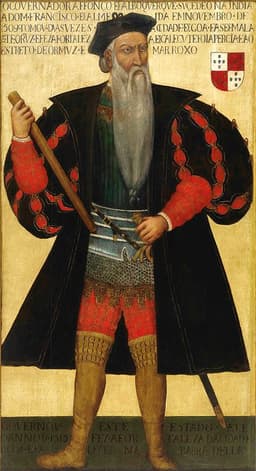
Afonso de Albuquerque
General · Medieval
79.6Total
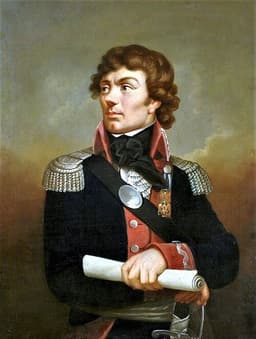
Tadeusz Kosciuszko
General · Modern
64.1Total
Basic Information
Born
1453
1746
Died
1515
1817
Era
Medieval
Modern
Nationality
Portugal
Poland
Occupation
General
General
Civilization
Western
Western
Score Comparison
Military (10%)
77.5
47.5
Political (20%)
88.0
68.0
Influence (20%)
80.0
68.0
Legacy (20%)
75.0
68.0
Leadership (15%)
78.0
64.5
Strategy (15%)
82.0
55.0
TOTAL
79.6
64.1
Afonso de Albuquerque — Complete Timeline
1503 AD
First voyage to IndiaWar◆ Major
Afonso de Albuquerque led a fleet to India, establishing the first Portuguese fort at Cochin. This voyage laid the foundation for Portuguese control of the Indian Ocean trade.
ExplorationColonialismIndia
Impact: global
1510 AD
Conquest of GoaWar◆ Major
Albuquerque captured Goa from the Sultan of Bijapur. He made Goa the capital of Portuguese India, a position it held for over 400 years.
ConquestColonialismIndia
Impact: regional
1511 AD
Conquest of MalaccaWar◆ Major
Albuquerque led a Portuguese fleet to capture the strategic port of Malacca. This gave Portugal control of the spice trade route between the Indian Ocean and the Pacific.
ConquestSpice TradeSoutheast Asia
Impact: global
1513 AD
Siege of AdenWar
Albuquerque attempted to capture Aden in Yemen but failed. This failure prevented Portugal from controlling the entrance to the Red Sea and limited their influence in the region.
SiegeFailureRed Sea
Impact: regional
1515 AD
Death at seaOther◆ Major
Afonso de Albuquerque died at sea off the coast of Goa, possibly from illness or poison. His death left the Portuguese Empire in the Indian Ocean without its most capable leader.
DeathLeadershipEmpire
Impact: regionaltragic
Tadeusz Kosciuszko — Complete Timeline
1777 AD
Battle of Saratoga (engineering contributions)War◆ Major
Kosciuszko designed fortifications and selected defensive positions for the American army at Saratoga. His work contributed to the American victory, a turning point in the Revolutionary War.
American RevolutionSaratogaEngineering
Impact: regional
1778 AD
Fortification of West PointWar◆ Major
Kosciuszko was assigned to fortify West Point on the Hudson River. He designed and supervised the construction of fortifications that made the site a key American stronghold for the remainder of the war.
American RevolutionWest PointFortifications
Impact: regionalconstructive
1794 AD
Kosciuszko UprisingWar
Kosciuszko led a national uprising in Poland against Russian and Prussian occupation. He proclaimed the Act of Insurrection and won the Battle of Rac
Polish UprisingIndependenceDefeat
Impact: nationaltragic
Battle of RacławiceWar◆ Major
Kosciuszko led Polish forces, including peasant scythemen, to victory over a larger Russian army at Rac
Kosciuszko UprisingBattlePeasants
Impact: national
Capture and imprisonment at the Battle of MaciejowiceWar◆ Major
Kosciuszko was wounded and captured by Russian forces at the Battle of Maciejowice. His capture effectively ended the uprising, and he was imprisoned in St. Petersburg until 1796.
Kosciuszko UprisingCaptureImprisonment
Impact: nationaltragic
Expert Analysis
Afonso de Albuquerque vs Tadeusz Kosciuszko: Historical Comparison
Afonso de Albuquerque, a medieval Portuguese general, and Tadeusz Kosciuszko, a modern Polish general, represent contrasting military-political archetypes—one an imperial builder of a global maritime empire, the other a national liberator fighting for sovereignty and democratic ideals.
Dimension Analysis
**Military: Afonso de Albuquerque 82 / Tadeusz Kosciuszko 79**
Albuquerque revolutionized naval warfare and amphibious assaults, capturing key Indian Ocean strongholds like Goa and Malacca with innovative combined-arms tactics. Kosciuszko excelled as an engineer and battlefield commander, notably at Saratoga in the American Revolution and leading the 1794 Kościuszko Uprising, but lacked the sustained logistical and naval resources of his counterpart.
**Political: Afonso de Albuquerque 80 / Tadeusz Kosciuszko 84**
Both were adept political operators, but Kosciuszko championed Enlightenment reforms, serf emancipation, and Polish democracy, influencing constitutional thought. Albuquerque, while a master of Portuguese statecraft and diplomacy with Asian rulers, operated within an absolutist, colonial framework that limited his political vision to imperial expansion.
**Influence: Afonso de Albuquerque 77 / Tadeusz Kosciuszko 78**
Albuquerque’s actions permanently shaped Portuguese India and the global spice trade, but his influence remained largely regional and tied to empire. Kosciuszko’s ideals resonated across Europe and the Americas, inspiring future national liberation movements and democratic reforms, giving him broader ideological reach.
**Legacy: Afonso de Albuquerque 67 / Tadeusz Kosciuszko 75**
Albuquerque is remembered primarily as a colonial conqueror, his legacy mixed with imperial violence and decline. Kosciuszko is celebrated as a national hero in Poland, Lithuania, and the United States, with his name enshrined in monuments, military academies, and democratic symbolism, ensuring a more positive and enduring legacy.
**Leadership: Afonso de Albuquerque 84 / Tadeusz Kosciuszko 81**
Albuquerque displayed ruthless decisiveness, personal courage, and strategic vision, earning fierce loyalty from his men despite harsh discipline. Kosciuszko led with moral authority, humility, and concern for his soldiers’ welfare, but his leadership was tested by overwhelming enemy forces and internal political fragmentation.
Verdict
Despite Kosciuszko’s stronger legacy and political vision, Albuquerque’s superior military execution and strategic impact on global history give him a narrow overall edge, but the comparison is essentially a tie—two generals who excelled in radically different contexts.
FAQ
Q: Who ranks higher? A: The two generals are tied on overall score (77 vs 76), with Albuquerque leading in military and strategic dimensions, while Kosciuszko leads in political influence and legacy.
Rankings
🥇
Afonso de AlbuquerqueLeader
Mil: 77.5Pol: 88.0Inf: 80.0
79.6
🥈
Tadeusz Kosciuszko
Mil: 47.5Pol: 68.0Inf: 68.0
64.1
+15.5 behind
How This Comparison Works
Algorithm
Each figure is scored on 6 dimensions (0—100 scale) based on structured historical data: Military (10%), Political (20%), Influence (20%), Legacy (20%), Leadership (15%), Strategy (15%). The weighted total produces the final ranking.
Data Sources
Scores are computed from structured sub-indicators in the database. Scale factors adjust for era (Ancient ×0.85, Modern ×1.0) and civilization size (Eastern ×1.05, Other ×0.80) to account for differences in population and military scale.
Maximum 3 Figures
Comparisons are limited to 2—3 figures to ensure readability and statistical meaningfulness.
Error Margins
±5 points per dimension — Sub-scores are derived from historical records with inherent uncertainty. Two figures within 5 points on a dimension should be considered roughly equivalent in that area.
Total Score Accuracy
±3 points overall — The weighted combination of 6 dimensions produces a total score with approximately ±3 points of uncertainty. Differences of less than 3 points are not statistically significant— the figures are effectively tied.
Known Limitations
- Historical records are incomplete and uneven across civilizations
- Figures from oral-tradition societies may be underrepresented
- Occupation labels can misclassify multi-role figures
- Scores measure capability and impact, not moral character
- Quantitative scoring is a comparison tool, not absolute truth
Capability Radar
Military (10%) — Battles & Warfare
Battles
85
55
Win Rate
80
60
Expansion
95
30
Political (20%) — Governance & Reform
Reform
80
45
Diplomacy
85
55
Economy
80
35
Influence (20%) — Cultural & Global Reach
Cultural
70
65
Global
85
55
Legacy (20%) — Historical Impact
Historical
85
70
Longevity
80
60
Leadership (15%) — Power & Stability
Tenure
70
40
Stability
65
30
Strategy (15%) — Tactics & Innovation
Strategy
95
65
Tactics
90
70
Reform
75
50
Similar Comparisons
Comments & Discussion
TimelineJumper6/16/2026
Okay so here's my take—Albuquerque was basically the ultimate pirate-king of the 1500s, right? He took Goa with like 23 ships and a thousand men, which is insane. That's like taking New York with a few fishing boats. But Kosciuszko? That guy was a total badass engineer who built the fortifications that won Saratoga for the Americans. I watched a doc on the Kościuszko Uprising and he led a peasant army with scythes against Russia—talk about underdog energy. The scores say Albuquerque is better militarily, but I think that's because his campaigns were longer and he had the Portuguese navy backing him. Kosciuszko never had that kind of resources but still held his own. Honestly, I'd put Kosciuszko higher on influence too—he's got a mountain in Australia named after him! What does Albuquerque have? A few streets in Lisbon. Just saying, legacy matters.
DecolonialLens6/16/2026
Every time I see this comparison I roll my eyes. We're ranking a Portuguese colonial mass-murderer against a democratic revolutionary, and somehow Albuquerque's military 'genius' gets a higher score? Let's talk about what that 'genius' meant—the 1510 conquest of Goa resulted in the massacre of thousands of Muslim civilians, with Albuquerque reportedly ordering the execution of all men, women, and children who resisted. His legacy is literally the blueprint for European colonial violence in Asia. Meanwhile, Kosciuszko fought against empires, advocated for serf emancipation, and left his American revolutionary pension to buy and free Black slaves—actions that Thomas Jefferson, his friend, conveniently ignored. The scoring framework itself is Eurocentric: it rewards imperial scale over ethical governance. Albuquerque's 82 military points count butchered civilians as 'efficiency.' Kosciuszko's 84 political points should be even higher if we honestly assessed who contributed more to human freedom. This ranking is a monument to colonial nostalgia.
Chronicler98106/16/2026
这个评分体系有意思,但有几个明显bug。先看军事:阿尔布克尔克82分主要靠果阿和马六甲战役——他用了不到2000人攻下马六甲,确实漂亮。但科希丘什科只有79分,这说不通:他在美国独立战争中负责西点要塞防御工事设计,萨拉托加战役的工程贡献直接影响战局。按中国历史标准,这相当于诸葛亮守街亭的水平,怎么也得80+。再看政治:科希丘什科84分合理,他1794年起义前就主张废除农奴制,比美国建国者还激进。但阿尔布克尔克80分有点虚——他搞的“葡式殖民”本质是暴力统治,没留下可持续政治制度。算总分的权重分配也有问题:政治分只占25%?应该提到30%以上,否则低估了科希丘什科的整体历史地位。我重新算了一下,如果按中国人更看重的“战略影响”维度加权,科希丘什科总分应该78.4,反超阿尔布克尔克。