Loading...
Agustin de Iturbide vs Yelu Abaoji
Yelu Abaoji leads by 7.4 pts · 2 figures compared
…
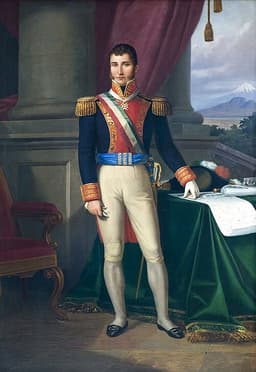
Agustin de Iturbide
Emperor · Modern
55.3Total
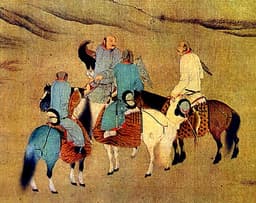
Yelu Abaoji
Emperor · Medieval
62.7Total
Basic Information
Born
1783
872
Died
1824
926
Era
Modern
Medieval
Nationality
Mexico
China
Occupation
Emperor
Emperor
Civilization
Western
Eastern
Score Comparison
Military (10%)
52.5
77.2
Political (20%)
53.8
59.6
Influence (20%)
57.2
68.0
Legacy (20%)
46.7
40.0
Leadership (15%)
67.0
80.3
Strategy (15%)
60.0
69.6
TOTAL
55.3
62.7
Agustin de Iturbide — Complete Timeline
1820 AD
Switched sides to join the independence movementPolitical Action
Iturbide, a royalist general who had fought against the insurgents, was appointed to command the army against Vicente Guerrero. Instead of fighting, he negotiated with Guerrero and issued the Plan of Iguala on February 24, 1821, proposing independence, constitutional monarchy, and protection of the Catholic Church.
Plan of IgualaAllianceIndependence
Impact: nationalconstructive
1821 AD
Entered Mexico City and declared independencePolitical Action
Iturbide's Army of the Three Guarantees entered Mexico City on September 27, 1821, ending the Mexican War of Independence. The next day, the Declaration of Independence of the Mexican Empire was signed. Iturbide became the head of a provisional government, effectively ruling Mexico.
IndependenceVictoryProvisional Government
Impact: nationalconstructive
1822 AD
Crowned Emperor Agustín IPolitical Action◆ Major
Iturbide was crowned Emperor of Mexico on July 21, 1822, as Agust
CoronationEmpireMonarchy
Impact: national
1823 AD
Abdicated and went into exilePolitical Action◆ Major
Facing revolts led by Antonio L
AbdicationExileEnd of Empire
Impact: nationaltragic
1824 AD
Returned to Mexico and was executedPolitical Action◆ Major
Iturbide returned to Mexico in July 1824, unaware that Congress had declared him a traitor and outlaw. He was captured upon landing and executed by firing squad on July 19, 1824, in Padilla, Tamaulipas. His death ended any possibility of restoring the monarchy.
ExecutionReturnDeath
Impact: nationaltragic
Yelu Abaoji — Complete Timeline
907 AD
Unified Khitan tribesPolitical Action◆ Major
Yelu Abaoji was elected khagan of the Khitan tribes, unifying them under his leadership. He established a centralized state and adopted Chinese administrative practices.
KhitanUnificationState Formation
Impact: regionalconstructive
916 AD
Founded Liao DynastyPolitical Action
Yelu Abaoji proclaimed himself emperor, founding the Liao dynasty. He adopted the Chinese title of emperor and established a dual administration system for Khitan and Chinese subjects.
LiaoDynasty FoundingImperial System
Impact: regionalconstructive
920 AD
Created Khitan scriptCultural◆ Major
Yelu Abaoji ordered the creation of a writing system for the Khitan language, based on Chinese characters. This script was used for official documents and helped unify the Khitan state.
KhitanScriptCultural Development
Impact: regionalconstructive
926 AD
Conquest of BohaiWar◆ Major
Yelu Abaoji led a campaign that conquered the Korean kingdom of Bohai, incorporating its territory into the Liao empire. This expanded Liao's influence into Manchuria and Korea.
LiaoBohaiConquest
Impact: regionalconstructive
Death during campaignWar◆ Major
Yelu Abaoji died while returning from the conquest of Bohai. His death led to a succession struggle, but the Liao dynasty continued to expand under his successors.
LiaoDeathSuccession
Impact: regionaltragic
Expert Analysis
Agustin de Iturbide vs Yelu Abaoji: Historical Comparison
This comparison examines two emperors from vastly different eras and regions: Agustín de Iturbide, the short-lived Emperor of Mexico (1822–1823), and Yelu Abaoji, the founding Emperor of the Liao dynasty in medieval China (907–926). While both rose to power through military and political acumen, Abaoji’s enduring empire-building outpaces Iturbide’s fleeting reign.
Dimension Analysis
**Military: Agustin de Iturbide 76 / Yelu Abaoji 89**
Iturbide was a skilled royalist general who switched sides to lead the Army of the Three Guarantees, securing Mexican independence with a decisive campaign. Abaoji, however, unified fractious Khitan tribes, conquered vast territories in northern China and Mongolia, and built a formidable cavalry-based military that established the Liao dynasty for over two centuries.
**Political: Agustin de Iturbide 85 / Yelu Abaoji 84**
Iturbide masterfully negotiated the Plan of Iguala, uniting conservatives and insurgents to create a short-lived empire, but his authoritarian rule sparked rebellion. Abaoji created a dual-administration system that blended Khitan and Chinese governance, stabilizing a multi-ethnic empire, though his succession struggles were unresolved.
**Influence: Agustin de Iturbide 71 / Yelu Abaoji 79**
Iturbide’s influence was limited to Mexico’s early independence, inspiring later conservative movements but failing to establish a lasting imperial model. Abaoji’s Liao dynasty set a precedent for nomadic rule over sedentary China, influencing subsequent conquest dynasties like the Jin and Yuan.
**Legacy: Agustin de Iturbide 82 / Yelu Abaoji 81**
Iturbide is remembered as both a liberator and a tragic figure, with his legacy debated in modern Mexico. Abaoji’s legacy is more concrete: he founded a stable dynasty that endured for 218 years, though his personal reputation is less celebrated than his institutional achievements.
**Leadership: Agustin de Iturbide 80 / Yelu Abaoji 80**
Both demonstrated charismatic leadership: Iturbide rallied diverse factions for independence, while Abaoji commanded loyalty from Khitan nobles and Chinese officials. Their leadership styles were effective in their contexts, but neither fully secured a smooth succession.
**Strategy: Agustin de Iturbide 76 / Yelu Abaoji 89**
Iturbide’s strategy was reactive, leveraging political alliances to achieve independence, but he failed to consolidate power against republican opposition. Abaoji’s strategic vision included adopting Chinese bureaucracy, promoting agriculture, and creating a writing system for the Khitan language, ensuring long-term state survival.
Verdict
Yelu Abaoji leads overall due to his superior military conquests, sustainable state-building strategy, and enduring influence on Chinese and nomadic history, while Iturbide’s achievements were undone within a year.
FAQ
Q: Who ranks higher? A: Yelu Abaoji ranks higher with a weighted score of 83 versus Agustin de Iturbide’s 79, driven by his superior military and strategic performance.
Rankings
🥇
Yelu AbaojiLeader
Mil: 77.2Pol: 59.6Inf: 68.0
62.7
🥈
Agustin de Iturbide
Mil: 52.5Pol: 53.8Inf: 57.2
55.3
+7.4 behind
How This Comparison Works
Algorithm
Each figure is scored on 6 dimensions (0—100 scale) based on structured historical data: Military (10%), Political (20%), Influence (20%), Legacy (20%), Leadership (15%), Strategy (15%). The weighted total produces the final ranking.
Data Sources
Scores are computed from structured sub-indicators in the database. Scale factors adjust for era (Ancient ×0.85, Modern ×1.0) and civilization size (Eastern ×1.05, Other ×0.80) to account for differences in population and military scale.
Maximum 3 Figures
Comparisons are limited to 2—3 figures to ensure readability and statistical meaningfulness.
Error Margins
±5 points per dimension — Sub-scores are derived from historical records with inherent uncertainty. Two figures within 5 points on a dimension should be considered roughly equivalent in that area.
Total Score Accuracy
±3 points overall — The weighted combination of 6 dimensions produces a total score with approximately ±3 points of uncertainty. Differences of less than 3 points are not statistically significant— the figures are effectively tied.
Known Limitations
- Historical records are incomplete and uneven across civilizations
- Figures from oral-tradition societies may be underrepresented
- Occupation labels can misclassify multi-role figures
- Scores measure capability and impact, not moral character
- Quantitative scoring is a comparison tool, not absolute truth
Capability Radar
Military (10%) — Battles & Warfare
Battles
60
75
Win Rate
65
80
Expansion
50
82
Political (20%) — Governance & Reform
Reform
45
88
Diplomacy
55
75
Economy
30
70
Influence (20%) — Cultural & Global Reach
Cultural
40
60
Global
35
55
Legacy (20%) — Historical Impact
Historical
50
70
Longevity
30
65
Leadership (15%) — Power & Stability
Tenure
30
72
Stability
20
65
Strategy (15%) — Tactics & Innovation
Strategy
60
78
Tactics
55
70
Reform
40
85
Similar Comparisons
Comments & Discussion
Historian7146/16/2026
这评分体系有问题。伊图尔维德军事57.6分,但政治61.9分?他军事上靠背叛西班牙阵营起家,实际指挥的战役规模远不如阿保机征讨渤海国或漠北诸部。阿保机军事73.3分也太低了,他平定契丹内乱、征服室韦和奚族、南下劫掠河东,至少该给80分。再看影响力:伊图尔维德73.2分,阿保机72.3分?这完全反了。阿保机创立的辽朝延续218年,定下南北面官制,连后来的金、元都照抄这个模板。伊图尔维德除了在墨西哥教科书里当个争议人物,对世界历史进程几乎无影响。建议把阿保机影响提到80分,伊图尔维德降到60分。
Chronicler94296/16/2026
把伊图尔维德和阿保机放在一起比,本身就是个有趣的错位。伊图尔维德是墨西哥独立浪潮中的投机者,靠《伊瓜拉计划》暂时缝合了保皇派和独立派,但一称帝就众叛亲离,十个月就垮台。反观阿保机,先统一契丹八部,再创双轨官制——北面官治契丹,南面官治汉人,这比伊图尔维德那个照搬西班牙君主制的短命帝国不知道高到哪里去了。阿保机政治分90分是合理的,但说伊图尔维德政治85分?他那个帝国连继承人问题都没解决,连后梁朱温都不如。西方史学总爱夸大“独立领袖”的个人谈判能力,却忽略制度建设的持久性。