Loading...
Alaric I vs Commius
Alaric I leads by 13.8 pts · 2 figures compared
…
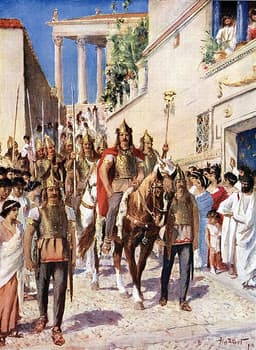
Alaric I
General · Ancient
53.5Total

Commius
General · Ancient
39.7Total
Basic Information
Born
370
-80
Died
410
-20
Era
Ancient
Ancient
Nationality
Visigothic Kingdom
Gaul
Occupation
General
General
Civilization
Western
Western
Score Comparison
Military (10%)
74.7
40.0
Political (20%)
32.2
30.7
Influence (20%)
58.3
47.9
Legacy (20%)
52.0
39.2
Leadership (15%)
47.3
33.5
Strategy (15%)
65.4
43.3
TOTAL
53.5
39.7
Alaric I — Complete Timeline
378 AD
Battle of AdrianopleWar◆ Major
Alaric I fought as a commander of Gothic auxiliaries for the Roman Empire at the Battle of Adrianople. The Roman army was decisively defeated by the Goths, leading to the death of Emperor Valens and a major shift in Roman military policy.
Gothic WarRoman DefeatMigration Period
Impact: global
401 AD
Invasion of ItalyWar◆ Major
Alaric I led the Visigoths into Italy, seeking land and recognition from the Roman Empire. He defeated Roman forces at Pollentia and Verona, but was unable to secure a permanent settlement, leading to years of negotiation and conflict.
Gothic InvasionItaly Campaign
Impact: regional
410 AD
Sack of RomeWar
Alaric I led the Visigothic army in the sack of Rome. The city was plundered for three days, marking the first time Rome had been sacked in 800 years. The event shocked the Roman world and symbolized the decline of the Western Roman Empire.
Sack of RomeVisigothsFall of Rome
Impact: globaldestructive
Death near CosenzaOther
Alaric I died suddenly in Cosenza, southern Italy, shortly after the sack of Rome. His death was attributed to fever. According to legend, his body was buried in the bed of the Busento River, with the river diverted and then restored to conceal the grave.
DeathLegendVisigoths
Impact: regionaltragic
Commius — Complete Timeline
57 BC
Appointed King of the Atrebates by CaesarPolitical Action◆ Major
Julius Caesar appointed Commius as king of the Atrebates after the Roman conquest of their territory. Commius became a loyal Roman ally, providing cavalry and support for Caesar's campaigns in Gaul and Britain.
AppointmentGallic WarsRoman Ally
Impact: regionalconstructive
55 BC
Diplomatic Mission to BritainPolitical Action
Caesar sent Commius to Britain as an envoy to negotiate with British tribes before the first Roman invasion. Commius was briefly imprisoned by the Britons but later released, providing Caesar with intelligence about British resistance.
DiplomacyRoman InvasionBritain
Impact: regional
52 BC
Battle of AlesiaWar◆ Major
Commius fought at the Battle of Alesia, where Vercingetorix's forces were besieged by Caesar. After the Gallic defeat, Commius escaped and continued resistance against Roman rule in northern Gaul.
BattleGallic WarsRoman Victory
Impact: regionaltragic
Defection to the Gallic RebellionPolitical Action
Commius joined Vercingetorix's Gallic rebellion against Rome, abandoning his alliance with Caesar. He led Atrebate forces in the uprising and became a key leader in the resistance.
DefectionGallic WarsRebellion
Impact: regionaldestructive
50 BC
Flight to BritainPolitical Action◆ Major
After continued guerrilla warfare against Roman forces, Commius fled to Britain with his followers. He established a new kingdom among the British Atrebates, escaping Roman pursuit and maintaining his independence.
FlightGallic WarsExile
Impact: regional
Expert Analysis
Origins
Alaric I (c. 370–410 AD) was born into the Balti dynasty of the Visigoths, a Germanic tribe that had settled in the Roman province of Dacia after fleeing the Huns. His early life was shaped by the Gothic experience of displacement and conflict with Rome. He served as a commander of Gothic auxiliaries for the Roman army, gaining firsthand knowledge of Roman military tactics. Commius (c. 80–50 BC) was a king of the Atrebates, a Belgic tribe in Gaul (modern-day northern France). His origins are less documented, but he emerged as a leader after the Roman conquest of Gaul under Julius Caesar. Commius initially collaborated with Rome, being appointed king by Caesar after the conquest of the Atrebates around 57 BC.
Rise to Power
Alaric rose to prominence in the aftermath of the Battle of Adrianople (378 AD), where the Goths defeated the Roman army. By 391 AD, he led a group of Goths in rebellion against the Eastern Roman Emperor Theodosius I. After Theodosius's death in 395, Alaric was elected king of the Visigoths and began a series of invasions into Roman territory, seeking land and recognition. Commius's rise was tied to Caesar's Gallic Wars. He served as a loyal ally, providing cavalry to Caesar. However, around 54 BC, Commius defected to the Gallic rebellion led by Vercingetorix, becoming a key leader of the Atrebates in the uprising. His turning point came when he joined the coalition against Rome at the Battle of Alesia (52 BC).
Leadership & Governance
Alaric's leadership was defined by military pragmatism and a relentless pursuit of settlement for his people. He repeatedly negotiated with Roman emperors, demanding land and subsidies, but his demands were often unmet. His governance was tribal, relying on a council of Gothic nobles. Commius, after his defection, led a guerrilla campaign against Roman forces. He was known for his strategic use of cavalry and his ability to unite tribes. After the Gallic defeat at Alesia, Commius continued resistance, eventually fleeing to Britain, where he established a new kingdom among the British Atrebates. His governance in Britain is less documented, but he likely maintained traditional Celtic structures.
Triumph & Tragedy
Alaric's greatest triumph was the Sack of Rome in 410 AD, the first time the city had fallen in 800 years. This event shocked the Roman world and symbolized the decline of Roman power. However, his tragedy was his inability to secure a permanent homeland for the Visigoths; he died soon after the sack, possibly from fever, and his body was legendarily buried in the Busento River. Commius's triumph was his successful escape from Roman pursuit and establishment of a new kingdom in Britain. His tragedy was the loss of his Gallic kingdom; after his flight, the Atrebates in Gaul were absorbed into Roman control. Commius's military score of 40.0 reflects his limited success against Roman forces, while Alaric's 74.7 highlights his significant victories.
Character & Destiny
Alaric was a determined and opportunistic leader, willing to use both diplomacy and force. His character was shaped by the Gothic need for survival, leading him to constantly push against Roman borders. His death shortly after his greatest achievement underscores the fleeting nature of his success. Commius was initially a collaborator but turned rebel when Roman oppression became intolerable. His decision to flee to Britain rather than surrender shows a pragmatic streak. Both leaders were defined by their resistance to Roman hegemony, but Alaric's actions had a more immediate impact on the Roman Empire.
Legacy
Alaric's sack of Rome is a landmark event in history, often cited as a key factor in the fall of the Western Roman Empire. He is remembered as a barbarian king who humbled Rome. Commius's legacy is more localized; he is known as a Gallic resistance leader and the founder of a British dynasty. His influence score of 47.9 reflects his role in the Gallic Wars, but his impact is overshadowed by Vercingetorix. Alaric's total score of 53.5 is higher than Commius's 39.7, indicating greater historical significance.
Conclusion
Alaric I had a greater impact than Commius. While Commius led a significant rebellion, his influence was limited to Gaul and southern Britain. Alaric's sack of Rome directly contributed to the decline of the Western Roman Empire, a watershed moment in world history. His military and strategic scores (74.7 and 65.4) far exceed Commius's (40.0 and 43.3), reflecting his ability to challenge Rome at its heart. Alaric's legacy endures as a symbol of barbarian triumph, whereas Commius is a footnote in the broader narrative of Roman conquest.
Rankings
🥇
Alaric ILeader
Mil: 74.7Pol: 32.2Inf: 58.3
53.5
🥈
Commius
Mil: 40.0Pol: 30.7Inf: 47.9
39.7
+13.8 behind
How This Comparison Works
Algorithm
Each figure is scored on 6 dimensions (0—100 scale) based on structured historical data: Military (10%), Political (20%), Influence (20%), Legacy (20%), Leadership (15%), Strategy (15%). The weighted total produces the final ranking.
Data Sources
Scores are computed from structured sub-indicators in the database. Scale factors adjust for era (Ancient ×0.85, Modern ×1.0) and civilization size (Eastern ×1.05, Other ×0.80) to account for differences in population and military scale.
Maximum 3 Figures
Comparisons are limited to 2—3 figures to ensure readability and statistical meaningfulness.
Error Margins
±5 points per dimension — Sub-scores are derived from historical records with inherent uncertainty. Two figures within 5 points on a dimension should be considered roughly equivalent in that area.
Total Score Accuracy
±3 points overall — The weighted combination of 6 dimensions produces a total score with approximately ±3 points of uncertainty. Differences of less than 3 points are not statistically significant— the figures are effectively tied.
Known Limitations
- Historical records are incomplete and uneven across civilizations
- Figures from oral-tradition societies may be underrepresented
- Occupation labels can misclassify multi-role figures
- Scores measure capability and impact, not moral character
- Quantitative scoring is a comparison tool, not absolute truth
Capability Radar
Military (10%) — Battles & Warfare
Battles
65
30
Win Rate
60
40
Expansion
55
25
Political (20%) — Governance & Reform
Reform
40
15
Diplomacy
55
45
Economy
30
20
Influence (20%) — Cultural & Global Reach
Cultural
60
20
Global
60
15
Legacy (20%) — Historical Impact
Historical
65
25
Longevity
55
20
Leadership (15%) — Power & Stability
Tenure
50
40
Stability
35
25
Strategy (15%) — Tactics & Innovation
Strategy
65
30
Tactics
70
35
Reform
45
10
Similar Comparisons
Comments & Discussion
No comments yet. Be the first to share your thoughts!