Loading...
This comparison has not been analyzed yet.
One-time AI generation (~1 minute). Scores and timeline are already available below.
Alaric I vs Musa ibn Nusayr
Musa ibn Nusayr leads by 5.3 pts · 2 figures compared
…
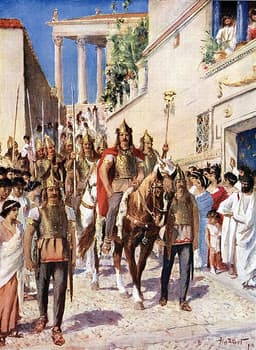
Alaric I
General · Ancient
53.5Total

Musa ibn Nusayr
General · Ancient
58.8Total
Basic Information
Born
370
-640
Died
410
—
Era
Ancient
Ancient
Nationality
Visigothic Kingdom
Umayyad Caliphate
Occupation
General
General
Civilization
Western
Middle Eastern
Score Comparison
Military (10%)
74.7
78.0
Political (20%)
32.2
54.7
Influence (20%)
58.3
55.0
Legacy (20%)
52.0
50.0
Leadership (15%)
47.3
65.0
Strategy (15%)
65.4
68.1
TOTAL
53.5
58.8
Alaric I — Complete Timeline
378 AD
Battle of AdrianopleWar◆ Major
Alaric I fought as a commander of Gothic auxiliaries for the Roman Empire at the Battle of Adrianople. The Roman army was decisively defeated by the Goths, leading to the death of Emperor Valens and a major shift in Roman military policy.
Gothic WarRoman DefeatMigration Period
Impact: global
401 AD
Invasion of ItalyWar◆ Major
Alaric I led the Visigoths into Italy, seeking land and recognition from the Roman Empire. He defeated Roman forces at Pollentia and Verona, but was unable to secure a permanent settlement, leading to years of negotiation and conflict.
Gothic InvasionItaly Campaign
Impact: regional
410 AD
Sack of RomeWar
Alaric I led the Visigothic army in the sack of Rome. The city was plundered for three days, marking the first time Rome had been sacked in 800 years. The event shocked the Roman world and symbolized the decline of the Western Roman Empire.
Sack of RomeVisigothsFall of Rome
Impact: globaldestructive
Death near CosenzaOther
Alaric I died suddenly in Cosenza, southern Italy, shortly after the sack of Rome. His death was attributed to fever. According to legend, his body was buried in the bed of the Busento River, with the river diverted and then restored to conceal the grave.
DeathLegendVisigoths
Impact: regionaltragic
Musa ibn Nusayr — Complete Timeline
698 AD
Conquest of North AfricaWar◆ Major
Musa ibn Nusayr was appointed governor of Ifriqiya (North Africa) by the Umayyad Caliphate. He led campaigns that subdued the Berber tribes, established Islamic rule across the Maghreb, and consolidated Umayyad control from Egypt to the Atlantic.
Umayyad CaliphateNorth AfricaConquest
Impact: regional
711 AD
Appointment of Tariq ibn ZiyadPolitical Action◆ Major
Musa ibn Nusayr appointed Tariq ibn Ziyad as commander of the initial invasion of the Iberian Peninsula. This decision led to the rapid conquest of Visigothic Spain, though Musa later became jealous of Tariq's success.
Islamic ConquestAl-AndalusAppointment
Impact: global
712 AD
Campaign in the Iberian PeninsulaWar◆ Major
Musa ibn Nusayr led a second wave of troops into the Iberian Peninsula, capturing cities such as Seville and Merida. He joined forces with Tariq ibn Ziyad and together they consolidated Umayyad control over most of the peninsula.
Islamic ConquestAl-AndalusCampaign
Impact: regional
714 AD
Recall and Fall from FavorPolitical Action◆ Major
Musa ibn Nusayr was recalled to Damascus by Caliph al-Walid I, where he faced accusations of corruption and mismanagement. He was fined and stripped of his positions, ending his career in disgrace despite his conquests.
Umayyad CaliphateRecallDisgrace
Impact: regionaltragic
This comparison has not been analyzed yet.
One-time AI generation (~1 minute). Scores and timeline are already available below.
Rankings
🥇
Musa ibn NusayrLeader
Mil: 78.0Pol: 54.7Inf: 55.0
58.8
🥈
Alaric I
Mil: 74.7Pol: 32.2Inf: 58.3
53.5
+5.3 behind
How This Comparison Works
Algorithm
Each figure is scored on 6 dimensions (0—100 scale) based on structured historical data: Military (10%), Political (20%), Influence (20%), Legacy (20%), Leadership (15%), Strategy (15%). The weighted total produces the final ranking.
Data Sources
Scores are computed from structured sub-indicators in the database. Scale factors adjust for era (Ancient ×0.85, Modern ×1.0) and civilization size (Eastern ×1.05, Other ×0.80) to account for differences in population and military scale.
Maximum 3 Figures
Comparisons are limited to 2—3 figures to ensure readability and statistical meaningfulness.
Error Margins
±5 points per dimension — Sub-scores are derived from historical records with inherent uncertainty. Two figures within 5 points on a dimension should be considered roughly equivalent in that area.
Total Score Accuracy
±3 points overall — The weighted combination of 6 dimensions produces a total score with approximately ±3 points of uncertainty. Differences of less than 3 points are not statistically significant— the figures are effectively tied.
Known Limitations
- Historical records are incomplete and uneven across civilizations
- Figures from oral-tradition societies may be underrepresented
- Occupation labels can misclassify multi-role figures
- Scores measure capability and impact, not moral character
- Quantitative scoring is a comparison tool, not absolute truth
Capability Radar
Military (10%) — Battles & Warfare
Battles
65
70
Win Rate
60
75
Expansion
55
75
Political (20%) — Governance & Reform
Reform
40
55
Diplomacy
55
70
Economy
30
60
Influence (20%) — Cultural & Global Reach
Cultural
60
55
Global
60
60
Legacy (20%) — Historical Impact
Historical
65
65
Longevity
55
50
Leadership (15%) — Power & Stability
Tenure
50
65
Stability
35
55
Strategy (15%) — Tactics & Innovation
Strategy
65
70
Tactics
70
65
Reform
45
60
Similar Comparisons
Comments & Discussion
No comments yet. Be the first to share your thoughts!