Loading...
This comparison has not been analyzed yet.
One-time AI generation (~1 minute). Scores and timeline are already available below.
Albrecht von Roon vs Yamauchi Kazutoyo
Albrecht von Roon leads by 16.3 pts · 2 figures compared
…
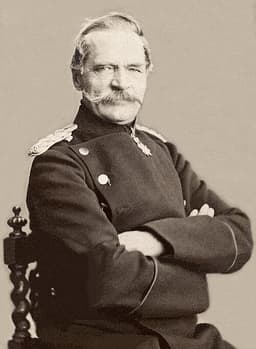
Albrecht von Roon
General · Modern
60.3Total

Yamauchi Kazutoyo
General · Modern
44.0Total
Basic Information
Born
1803
1545
Died
1879
1605
Era
Modern
Modern
Nationality
Prussia
Japan
Occupation
General
General
Civilization
Western
Eastern
Score Comparison
Military (10%)
10.0
45.0
Political (20%)
78.0
35.1
Influence (20%)
62.0
49.4
Legacy (20%)
55.0
40.8
Leadership (15%)
78.0
54.2
Strategy (15%)
66.3
35.7
TOTAL
60.3
44.0
Albrecht von Roon — Complete Timeline
1859 AD
Prussian Army ReorganizationReform
Roon, as Prussian War Minister, implemented a major reorganization of the Prussian Army. He increased the size of the standing army, extended conscription, and reformed the officer corps. These reforms created the military force that would later win the wars of German unification.
PrussiaMilitary ReformGerman Unification
Impact: nationalconstructive
1862 AD
Constitutional CrisisPolitical Action◆ Major
Roon's army reforms led to a constitutional crisis in Prussia when the Landtag refused to approve the budget. Roon advised King Wilhelm I to appoint Otto von Bismarck as Minister President. Bismarck then governed without a legal budget, implementing the reforms anyway.
PrussiaPoliticsBismarck
Impact: national
1866 AD
Austro-Prussian WarWar◆ Major
Roon's reformed Prussian Army fought the Austro-Prussian War. The army's superior organization, training, and equipment led to a decisive Prussian victory at the Battle of K
German UnificationWarPrussia
Impact: regionalconstructive
Yamauchi Kazutoyo — Complete Timeline
1570 AD
Acquisition of the Horse 'Kageyama'Other
Yamauchi Kazutoyo's wife, Yamauchi Chiyo, used her savings to purchase a famous horse named 'Kageyama' for her husband. The horse helped Kazutoyo gain favor with Oda Nobunaga and advance his career.
HorseWifeCareer
constructive
1590 AD
Siege of OdawaraWar
Yamauchi Kazutoyo participated in Toyotomi Hideyoshi's campaign against the Hojo clan. He served as a commander and contributed to the siege.
OdawaraHideyoshiCampaign
Impact: national
1600 AD
Battle of SekigaharaWar◆ Major
Yamauchi Kazutoyo fought for Tokugawa Ieyasu's Eastern Army. He commanded a contingent and contributed to the victory, later being rewarded with a domain in Tosa Province.
SekigaharaEastern ArmyTokugawa
Impact: national
This comparison has not been analyzed yet.
One-time AI generation (~1 minute). Scores and timeline are already available below.
Rankings
🥇
Albrecht von RoonLeader
Mil: 10.0Pol: 78.0Inf: 62.0
60.3
🥈
Yamauchi Kazutoyo
Mil: 45.0Pol: 35.1Inf: 49.4
44.0
+16.3 behind
How This Comparison Works
Algorithm
Each figure is scored on 6 dimensions (0—100 scale) based on structured historical data: Military (10%), Political (20%), Influence (20%), Legacy (20%), Leadership (15%), Strategy (15%). The weighted total produces the final ranking.
Data Sources
Scores are computed from structured sub-indicators in the database. Scale factors adjust for era (Ancient ×0.85, Modern ×1.0) and civilization size (Eastern ×1.05, Other ×0.80) to account for differences in population and military scale.
Maximum 3 Figures
Comparisons are limited to 2—3 figures to ensure readability and statistical meaningfulness.
Error Margins
±5 points per dimension — Sub-scores are derived from historical records with inherent uncertainty. Two figures within 5 points on a dimension should be considered roughly equivalent in that area.
Total Score Accuracy
±3 points overall — The weighted combination of 6 dimensions produces a total score with approximately ±3 points of uncertainty. Differences of less than 3 points are not statistically significant— the figures are effectively tied.
Known Limitations
- Historical records are incomplete and uneven across civilizations
- Figures from oral-tradition societies may be underrepresented
- Occupation labels can misclassify multi-role figures
- Scores measure capability and impact, not moral character
- Quantitative scoring is a comparison tool, not absolute truth
Capability Radar
Military (10%) — Battles & Warfare
Battles
20
20
Win Rate
20
25
Expansion
70
20
Political (20%) — Governance & Reform
Reform
85
15
Diplomacy
70
25
Economy
60
20
Influence (20%) — Cultural & Global Reach
Cultural
40
15
Global
60
10
Legacy (20%) — Historical Impact
Historical
70
20
Longevity
60
15
Leadership (15%) — Power & Stability
Tenure
70
30
Stability
75
25
Strategy (15%) — Tactics & Innovation
Strategy
60
15
Tactics
30
20
Reform
85
10
Similar Comparisons
Comments & Discussion
No comments yet. Be the first to share your thoughts!