Loading...
Alcuin of York vs Julius Caesar
Julius Caesar leads by 29.6 pts · 2 figures compared
…
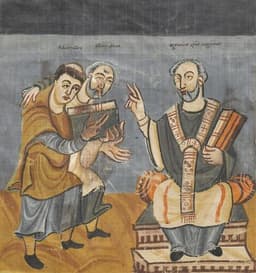
Alcuin of York
Politician · Medieval
53.2Total

Julius Caesar
General · Ancient
82.8Total
Basic Information
Born
735
-100
Died
804
-44
Era
Medieval
Ancient
Nationality
Frankish Empire
Roman Republic
Occupation
Politician
General
Civilization
Western
Western
Score Comparison
Military (10%)
28.8
88.0
Political (20%)
62.7
78.0
Influence (20%)
65.0
85.0
Legacy (20%)
40.0
82.0
Leadership (15%)
72.0
80.0
Strategy (15%)
38.5
85.0
TOTAL
53.2
82.8
Alcuin of York — Complete Timeline
782 AD
Appointment as Head of the Palace School at AachenCultural◆ Major
Alcuin of York was invited by Charlemagne to lead the Palace School at Aachen. He established a curriculum based on the seven liberal arts, including grammar, rhetoric, and logic. This school became a center of learning and a model for education in the Carolingian Empire.
EducationCarolingian RenaissanceScholarship
Impact: regionalconstructive
789 AD
Compilation of the 'Admonitio Generalis'Cultural
Alcuin contributed to the 'Admonitio Generalis', a set of reforms issued by Charlemagne. The document promoted education, the correction of texts, and the standardization of religious practices. It was a key text of the Carolingian Renaissance, emphasizing the importance of learning.
ReformEducationCarolingian Renaissance
Impact: regionalconstructive
790 AD
Development of the Carolingian Minuscule ScriptCultural◆ Major
Alcuin oversaw the development of the Carolingian minuscule script at the Palace School. This clear, standardized script improved readability and facilitated the copying of manuscripts. It became the standard script in medieval Europe and influenced later handwriting styles.
ScriptManuscriptCarolingian Renaissance
Impact: globalconstructive
800 AD
Correspondence with Charlemagne on Theological MattersCultural
Alcuin engaged in extensive correspondence with Charlemagne on theological and philosophical issues. His letters advised the emperor on matters of doctrine, liturgy, and education. This correspondence helped shape the intellectual climate of the Carolingian court.
CorrespondenceTheologyCarolingian Renaissance
Impact: regionalconstructive
Julius Caesar — Complete Timeline
58 BC
Gallic WarsWar◆ Major
Caesar, as proconsul of Gaul, launched a series of campaigns that conquered all of Gaul (modern France, Belgium, and parts of Switzerland). He fought numerous battles, including against the Helvetii, the Belgae, and the Gallic chieftain Vercingetorix. The wars brought immense wealth and a loyal army to Caesar.
Gallic WarsConquestRoman Expansion
Impact: regional
49 BC
Crossing the RubiconPolitical Action◆ Major
Caesar led Legio XIII across the Rubicon River into Italy, defying the Roman Senate's order to disband his army. This act triggered a civil war against Pompey and the Optimates, ultimately leading to Caesar's dictatorship and the end of the Roman Republic.
Roman Civil WarEnd of RepublicPower Struggle
Impact: global
48 BC
Battle of PharsalusWar◆ Major
Caesar's outnumbered army defeated the larger forces of Pompey the Great at Pharsalus in Greece. Caesar's tactical use of a reserve line to counter Pompey's cavalry charge proved decisive. Pompey fled to Egypt, where he was assassinated, leaving Caesar as the undisputed master of the Roman world.
Roman Civil WarBattleDecisive Victory
Impact: regional
44 BC
Appointment as Dictator for LifePolitical Action◆ Major
The Roman Senate appointed Caesar dictator perpetuo (dictator for life), granting him unprecedented personal power. This move concentrated military, legislative, and judicial authority in one person, effectively ending the Roman Republic's traditional system of checks and balances and alarming many senators.
DictatorshipEnd of RepublicPower Consolidation
Impact: regionaldestructive
Assassination on the Ides of MarchPolitical Action◆ Major
A group of Roman senators, led by Marcus Junius Brutus and Gaius Cassius Longinus, stabbed Caesar to death at a meeting of the Senate in the Theatre of Pompey. The assassination was intended to restore the Republic, but instead triggered another civil war that led to the rise of the Roman Empire.
AssassinationRoman PoliticsEnd of Republic
Impact: globaldestructive
Expert Analysis
alcuin-of-york-vs-julius-caesar
# The Scholar and the Sword: Alcuin of York and Julius Caesar, Architects of Western Civilization
On a winter morning in January of 49 BCE, a Roman general stood beside a small, muddy river in northern Italy. The Rubicon was little more than a stream, yet crossing it meant war with the Republic itself. Julius Caesar hesitated only a moment, then gave the order. Eight hundred years later, in the stone halls of Aachen, a different kind of transformation was taking place. A soft-spoken English monk named Alcuin of York sat with Charlemagne, carefully rewriting the textbooks of Europe—not with legions, but with ink and parchment. Two men, two worlds, one civilization in the making. How did these figures, so different in temperament and method, each become architects of the West?
Origins
Julius Caesar was born into the chaos of a dying Republic, where noble blood meant everything and money meant more. His family, the Julii, claimed descent from the goddess Venus, but their influence had faded. The young Caesar learned early that in Rome, survival required alliances, debts, and a willingness to break rules. His uncle Marius had been a populist reformer; his father-in-law Cinna a radical. From them, Caesar absorbed a lesson that would define his life: the old order was crumbling, and a man of ambition could reshape it.
Alcuin of York, by contrast, entered a world of faith and order. Born around 735 in Northumbria, he was placed in the care of the cathedral school at York, where the great scholar Ecgbert taught him Latin, logic, and the scriptures. The British Isles had become a refuge for learning after the fall of Rome, and Alcuin grew up surrounded by manuscripts that had survived centuries of barbarian chaos. His world was one of preservation, not conquest. Where Caesar saw glory in battle, Alcuin saw salvation in words.
Rise to Power
Caesar’s ascent was a masterpiece of calculated risk. He climbed the Roman political ladder—quaestor, aedile, praetor—but his true breakthrough came in 58 BCE, when he secured command of Gaul. For eight years, he waged a brutal war that brought him wealth, fame, and a loyal army. By 49 BCE, he had conquered modern France, Belgium, and parts of Germany. The Senate feared him; his rival Pompey maneuvered against him. Caesar’s response was the Rubicon crossing, an act that ended the Republic and began a civil war. By 45 BCE, he was dictator for life.
Alcuin’s rise was quieter but no less decisive. In 782, Charlemagne—the most powerful ruler in Europe since the fall of Rome—invited him to Aachen to lead the Palace School. The Frankish king needed scholars to revive learning in his vast empire, and Alcuin was the best in the West. He did not march armies; he trained scribes. He did not conquer provinces; he standardized Latin, corrected biblical texts, and composed letters that shaped Charlemagne’s policies. His appointment in 782 was a turning point not just for his own career, but for European education.
Leadership & Governance
Caesar ruled through force and charisma. As dictator, he reformed the calendar, granted citizenship to provincials, and launched massive building projects. His military genius is beyond dispute: at Alesia in 52 BCE, he surrounded a Gallic army while simultaneously defeating a relief force, a feat of logistics and nerve that still astounds strategists. Yet his political wisdom often failed him. He pardoned enemies who later killed him. He centralized power so completely that the Republic became an empty shell. His governance was brilliant in conception, fatal in execution.
Alcuin governed through persuasion. He never held a sword, but his political score of 80.0 reflects his real power: he wrote the *Admonitio Generalis* in 789, a set of reforms that required every monastery and cathedral to have a school. He oversaw the creation of the Carolingian minuscule script in 790, a clear, readable handwriting that became the standard across Europe. His leadership was collaborative, not autocratic. He advised Charlemagne on theology, philosophy, and statecraft, shaping the emperor’s decisions without ever claiming credit.
Triumph & Tragedy
Caesar’s greatest triumph was his conquest of Gaul, recorded in his own *Commentaries*—a work of propaganda and literature that remains a masterpiece. His greatest tragedy was his assassination on the Ides of March, 44 BCE. He was stabbed 23 times by senators who feared his ambition, dying at the foot of a statue of Pompey, his old enemy. The Republic he had destroyed did not return; instead, his grandnephew Octavian became Augustus, the first Roman emperor. Caesar’s death was the price of his success.
Alcuin’s triumph was the Carolingian Renaissance, a revival of learning that saved classical texts for future generations. His tragedy was more subtle: he saw his work undone by the chaos that followed Charlemagne’s death. Viking raids, civil wars, and the collapse of the empire scattered the schools he had built. Yet his influence endured in the script, the curriculum, and the manuscripts that monks continued to copy. He died in 804 at the monastery of Tours, surrounded by his students, a quiet end for a man who had changed the world with words.
Character & Destiny
Caesar was restless, ambitious, and utterly pragmatic. He gambled constantly—on war, on politics, on the loyalty of his men. His personality drove him to cross the Rubicon, to seize power, to forgive his enemies. That same personality made him unable to stop. He could not share power, could not trust the Senate, could not imagine a future without himself at the center. His destiny was to build an empire and die for it.
Alcuin was patient, devout, and systematic. He believed in order—the order of grammar, the order of scripture, the order of a well-run school. His personality drove him to preserve, not to destroy. He could have sought power for himself; instead, he served a king who could wield it. His destiny was to lay foundations that others would build upon. Where Caesar’s life was a storm, Alcuin’s was a steady flame.
Legacy
Caesar’s legacy is the Roman Empire itself. Every emperor after him ruled in his shadow. His name became a title—Kaiser, Czar—and his reforms shaped Western law, language, and governance for two millennia. His influence score of 85.0 and legacy of 82.0 reflect his permanent mark on history. Yet his methods—dictatorship, civil war, the destruction of republican institutions—remain a warning.
Alcuin’s legacy is quieter but no less profound. The Carolingian minuscule script became the basis for modern lowercase letters. The curriculum he designed—the seven liberal arts—shaped European education for centuries. His political score of 80.0 and leadership of 78.0 are not as high as Caesar’s military scores, but his influence on culture was immense. Without Alcuin, many classical texts would have been lost. Without him, the Renaissance might have been delayed by centuries.
Conclusion
Two men, separated by eight centuries, each transformed the West. Caesar did it with steel and ambition, building an empire that would outlast him. Alcuin did it with ink and humility, preserving a civilization that could be rebuilt. One died by the sword, the other in peace. The question is not which was greater—they were too different for comparison—but what they reveal about power itself. Caesar shows us that power seized is fragile; Alcuin shows us that power shared is lasting. In the end, the conqueror’s empire fell, but the scholar’s script still shapes the words you are reading now.
Rankings
🥇
Julius CaesarLeader
Mil: 88.0Pol: 78.0Inf: 85.0
82.8
🥈
Alcuin of York
Mil: 28.8Pol: 62.7Inf: 65.0
53.2
+29.6 behind
How This Comparison Works
Algorithm
Each figure is scored on 6 dimensions (0—100 scale) based on structured historical data: Military (10%), Political (20%), Influence (20%), Legacy (20%), Leadership (15%), Strategy (15%). The weighted total produces the final ranking.
Data Sources
Scores are computed from structured sub-indicators in the database. Scale factors adjust for era (Ancient ×0.85, Modern ×1.0) and civilization size (Eastern ×1.05, Other ×0.80) to account for differences in population and military scale.
Maximum 3 Figures
Comparisons are limited to 2—3 figures to ensure readability and statistical meaningfulness.
Error Margins
±5 points per dimension — Sub-scores are derived from historical records with inherent uncertainty. Two figures within 5 points on a dimension should be considered roughly equivalent in that area.
Total Score Accuracy
±3 points overall — The weighted combination of 6 dimensions produces a total score with approximately ±3 points of uncertainty. Differences of less than 3 points are not statistically significant— the figures are effectively tied.
Known Limitations
- Historical records are incomplete and uneven across civilizations
- Figures from oral-tradition societies may be underrepresented
- Occupation labels can misclassify multi-role figures
- Scores measure capability and impact, not moral character
- Quantitative scoring is a comparison tool, not absolute truth
Capability Radar
Military (10%) — Battles & Warfare
Battles
36
95
Win Rate
42
92
Expansion
43
97
Political (20%) — Governance & Reform
Reform
85
90
Diplomacy
75
85
Economy
60
82
Influence (20%) — Cultural & Global Reach
Cultural
85
88
Global
65
94
Legacy (20%) — Historical Impact
Historical
80
95
Longevity
75
96
Leadership (15%) — Power & Stability
Tenure
40
75
Stability
70
60
Strategy (15%) — Tactics & Innovation
Strategy
47
94
Tactics
51
96
Reform
53
88
Similar Comparisons
Comments & Discussion
RubiconRebuke6/17/2026
Caesar's military genius is overrated. Any general with that much luck and debt could cross a stream and call it destiny. Alcuin actually had to work a real transformation—convincing a warlord in Aachen that literacy mattered more than loot. Caesar butchered Gaul; Alcuin preserved the texts that taught us why that matters. Give me the monk every time.
数据拆解者6/17/2026
把Alcuin和凯撒放一起比较,根本是混淆了两种文明驱动力。凯撒的征服带来了罗马化的基础设施、法律和货币体系,这些才是西方文明的骨架。Alcuin的修道院抄书固然重要,但他抄的那些经典,多半还是凯撒和西塞罗的遗产。没有罗马的剑开路,Alcuin的鹅毛笔连羊皮纸都买不起。
ClassicistChronicler6/17/2026
Alcuin didn't just preserve the classics—he reinvented how we read them. His Carolingian minuscule script made texts legible for the first time in centuries. Caesar wrote his own commentaries to control his narrative; Alcuin transcribed Cicero and Virgil for generations who never knew ambition's price. One man built an empire, the other built the library that remembers it.
历史修正刀6/17/2026
你们把Alcuin神化成文明守护者,却忘了他的教育改革本质上是政治工具——为查理曼的神圣罗马帝国培养听话的教士阶层。凯撒至少跨过卢比孔河时敢说“骰子已掷”,而Alcuin一辈子都在替帝王抄写合法性。一个敢打破宪法,一个只会修补经文。我选那个冒险家。