Loading...
Alcuin of York vs Napoleon Bonaparte
Napoleon Bonaparte leads by 17.7 pts · 2 figures compared
…
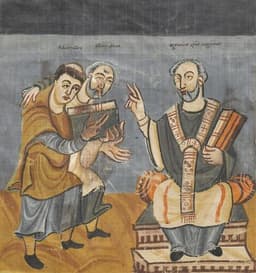
Alcuin of York
Politician · Medieval
53.2Total

Napoleon Bonaparte
General · Modern
70.9Total
Basic Information
Born
735
1769
Died
804
1821
Era
Medieval
Modern
Nationality
Frankish Empire
France
Occupation
Politician
General
Civilization
Western
Western
Score Comparison
Military (10%)
28.8
94.0
Political (20%)
62.7
72.0
Influence (20%)
65.0
40.0
Legacy (20%)
40.0
80.0
Leadership (15%)
72.0
78.0
Strategy (15%)
38.5
90.0
TOTAL
53.2
70.9
Alcuin of York — Complete Timeline
782 AD
Appointment as Head of the Palace School at AachenCultural◆ Major
Alcuin of York was invited by Charlemagne to lead the Palace School at Aachen. He established a curriculum based on the seven liberal arts, including grammar, rhetoric, and logic. This school became a center of learning and a model for education in the Carolingian Empire.
EducationCarolingian RenaissanceScholarship
Impact: regionalconstructive
789 AD
Compilation of the 'Admonitio Generalis'Cultural
Alcuin contributed to the 'Admonitio Generalis', a set of reforms issued by Charlemagne. The document promoted education, the correction of texts, and the standardization of religious practices. It was a key text of the Carolingian Renaissance, emphasizing the importance of learning.
ReformEducationCarolingian Renaissance
Impact: regionalconstructive
790 AD
Development of the Carolingian Minuscule ScriptCultural◆ Major
Alcuin oversaw the development of the Carolingian minuscule script at the Palace School. This clear, standardized script improved readability and facilitated the copying of manuscripts. It became the standard script in medieval Europe and influenced later handwriting styles.
ScriptManuscriptCarolingian Renaissance
Impact: globalconstructive
800 AD
Correspondence with Charlemagne on Theological MattersCultural
Alcuin engaged in extensive correspondence with Charlemagne on theological and philosophical issues. His letters advised the emperor on matters of doctrine, liturgy, and education. This correspondence helped shape the intellectual climate of the Carolingian court.
CorrespondenceTheologyCarolingian Renaissance
Impact: regionalconstructive
Napoleon Bonaparte — Complete Timeline
1799 AD
Coup of 18 BrumaireOther◆ Major
Napoleon Bonaparte, with support from his brother Lucien and key political figures, overthrew the Directory in a bloodless coup. He established the Consulate with himself as First Consul, effectively becoming the ruler of France. This event ended the French Revolution's most unstable period.
French RevolutionCoupRise to Power
Impact: regional
1804 AD
Promulgation of the Napoleonic CodeOther◆ Major
Napoleon enacted the Civil Code of the French, known as the Napoleonic Code, a comprehensive set of laws that replaced the fragmented feudal legal systems. The code established legal equality, protected property rights, and secularized law. It became the basis for legal systems in many European and world countries.
Legal ReformNapoleonic CodeCivil Law
Impact: globalconstructive
1805 AD
Battle of AusterlitzWar◆ Major
Napoleon's Grande Arm
Napoleonic WarsBattleDecisive Victory
Impact: global
1812 AD
Invasion of RussiaWar◆ Major
Napoleon led the Grande Arm
Napoleonic WarsInvasionDisaster
Impact: globaldestructive
1815 AD
Battle of WaterlooWar◆ Major
Napoleon's French army was defeated by the combined forces of the Duke of Wellington's Anglo-Allied army and Gebhard Leberecht von Bl
Napoleonic WarsBattleFinal Defeat
Impact: globaldestructive
Expert Analysis
alcuin-of-york-vs-napoleon-bonaparte
# The Emperor and the Scholar: Two Paths to Immortality
On a frozen December morning in 1804, Napoleon Bonaparte placed the crown upon his own head in Notre Dame Cathedral, snatching it from the Pope’s hands before the pontiff could complete the ceremony. A thousand years earlier, in the candlelit scriptorium of Aachen, a different kind of power was being forged—not with gold and iron, but with ink and parchment. Alcuin of York, a monk from the misty shores of Northumbria, sat bent over a manuscript, patiently teaching Charlemagne’s courtiers to read. Two men, separated by a millennium, each shaped the destiny of Europe. One conquered through fire; the other through the quiet revolution of the written word.
Origins
Napoleon was born in 1769 on the rugged island of Corsica, a place that had only recently become French. His family were minor nobility, proud and impoverished, speaking Italian-accented French that marked them as outsiders. This sense of being an outsider—Corsican among Frenchmen, small among giants—would drive him relentlessly. He devoured military histories and Enlightenment philosophy, dreaming of glory as he read Caesar and Rousseau under the olive trees of Ajaccio.
Alcuin of York, born in 735, came from a world where glory meant something different. The son of Northumbrian nobility, he was educated at the cathedral school of York, a rare beacon of learning in a Europe still reeling from the collapse of Roman order. While barbarian kingdoms fought for scraps of the old empire, Alcuin’s mind traveled through the texts of Virgil, Augustine, and Boethius. His ambition was not to conquer territory but to rescue civilization from oblivion—to preserve the light of classical learning before it flickered out entirely.
Rise to Power
Napoleon’s ascent was a cannonball fired through the decaying structures of the French Revolution. At twenty-four, he drove the British out of Toulon. At twenty-six, he crushed a royalist uprising in Paris with a “whiff of grapeshot.” At twenty-seven, he launched the Italian campaign, transforming a ragged army into a legend. His rise was meteoric because he understood that in revolutionary France, talent mattered more than birth. He was not made by the old order; he shattered it.
Alcuin’s rise was quieter but no less strategic. In 782, when he was forty-seven, Charlemagne summoned him to Aachen to lead the Palace School. This was not an accident. Alcuin had spent years cultivating a reputation as the most learned man in Europe, corresponding with kings and bishops, building networks of intellectual patronage. When Charlemagne wanted to transform his court from a war camp into a center of civilization, he knew who to call. Alcuin did not seize power; he was invited to create it.
Leadership & Governance
Napoleon governed through will. His Napoleonic Code, completed in 1804, swept away feudal privileges and established legal equality, property rights, and secular administration across Europe. But his genius was also his curse: he could not stop conquering. His military strategy—the 93.0 score that historians still study—was a masterpiece of speed, deception, and decisive battle. Yet political wisdom eluded him. By 1812, he had overextended into Russia, losing half a million men to ice and distance. His leadership score of 80.0 reflects a man who could inspire soldiers to die for him but could not build lasting alliances.
Alcuin’s governance was pedagogical. As head of the Palace School, he did not command armies but curricula. He established the seven liberal arts—grammar, rhetoric, logic, arithmetic, geometry, music, and astronomy—as the foundation of European education. His political score of 80.0 came not from conquest but from influence: he helped write the *Admonitio Generalis* in 789, a royal decree that ordered every monastery and cathedral to establish schools. He did not force men to learn; he made learning the path to power.
Triumph & Tragedy
Napoleon’s greatest moment was Austerlitz in 1805, where he destroyed the armies of Austria and Russia in a single December day. His soldiers cheered him as the greatest commander since Alexander. His tragedy was Waterloo in 1815, a battle he should have won but lost through hesitation, illness, and the late arrival of Prussian reinforcements. Exiled to Saint Helena, he spent his last years dictating memoirs, a caged lion still roaring.
Alcuin’s triumph was quieter but more enduring. The Carolingian minuscule script, developed under his guidance around 790, became the standard handwriting of medieval Europe—the direct ancestor of the letters you are reading now. His tragedy was that he knew his work was fragile. In 800, in his letters to Charlemagne, he worried that the barbarians would return and extinguish the light. He was right: after Charlemagne’s death, the empire fractured. But the schools remained. The script survived. The books were copied.
Character & Destiny
Napoleon was driven by what the French call *gloire*—a burning need for fame that could never be satisfied. “Impossible is not French,” he once said, but his own ambition made the impossible necessary. He could not stop because stopping meant becoming ordinary, and ordinariness was death to him. His personality shaped his destiny: the same will that carried him from Corsica to the throne also marched him into the snows of Russia.
Alcuin was driven by *reverentia*—a reverence for what had been lost and what could be saved. He wrote to Charlemagne: “The man who does not know the past remains forever a child.” His humility made him powerful. He did not seek to be remembered; he sought to make remembering possible. His destiny was shaped by his patience: he planted seeds he knew he would never see bloom.
Legacy
Napoleon’s legacy is a contradiction. He is remembered as a tyrant who caused millions of deaths and a reformer who spread legal equality across Europe. His influence score of 82.0 reflects a man whose shadow still falls over modern politics, military strategy, and national identity. But his empire lasted barely a decade.
Alcuin’s legacy is invisible because it is everywhere. Every time a child learns to read, every time a student studies the trivium, every time a scholar quotes a classical text preserved in a Carolingian manuscript, Alcuin is there. His legacy score of 60.0 underestimates him, for he helped create the very idea of a European intellectual tradition—a network of schools, libraries, and texts that would survive the Vikings, the wars, and the centuries.
Conclusion
Standing in the ruins of Rome, the philosopher Boethius asked: “Who has the power to give laws to the stars?” Napoleon tried to answer by conquering the earth. Alcuin answered by teaching men to read the stars. One built an empire of iron that melted into rust; the other built a republic of letters that still endures. The difference between them is not just time or talent. It is the difference between wanting to be remembered and wanting to make remembering possible. Napoleon changed the world for a generation. Alcuin changed how the world remembers itself—and that is a conquest no army can undo.
Rankings
🥇
Napoleon BonaparteLeader
Mil: 94.0Pol: 72.0Inf: 40.0
70.9
🥈
Alcuin of York
Mil: 28.8Pol: 62.7Inf: 65.0
53.2
+17.7 behind
How This Comparison Works
Algorithm
Each figure is scored on 6 dimensions (0—100 scale) based on structured historical data: Military (10%), Political (20%), Influence (20%), Legacy (20%), Leadership (15%), Strategy (15%). The weighted total produces the final ranking.
Data Sources
Scores are computed from structured sub-indicators in the database. Scale factors adjust for era (Ancient ×0.85, Modern ×1.0) and civilization size (Eastern ×1.05, Other ×0.80) to account for differences in population and military scale.
Maximum 3 Figures
Comparisons are limited to 2—3 figures to ensure readability and statistical meaningfulness.
Error Margins
±5 points per dimension — Sub-scores are derived from historical records with inherent uncertainty. Two figures within 5 points on a dimension should be considered roughly equivalent in that area.
Total Score Accuracy
±3 points overall — The weighted combination of 6 dimensions produces a total score with approximately ±3 points of uncertainty. Differences of less than 3 points are not statistically significant— the figures are effectively tied.
Known Limitations
- Historical records are incomplete and uneven across civilizations
- Figures from oral-tradition societies may be underrepresented
- Occupation labels can misclassify multi-role figures
- Scores measure capability and impact, not moral character
- Quantitative scoring is a comparison tool, not absolute truth
Capability Radar
Military (10%) — Battles & Warfare
Battles
36
95
Win Rate
42
90
Expansion
43
95
Political (20%) — Governance & Reform
Reform
85
95
Diplomacy
75
80
Economy
60
85
Influence (20%) — Cultural & Global Reach
Cultural
85
85
Global
65
90
Legacy (20%) — Historical Impact
Historical
80
95
Longevity
75
90
Leadership (15%) — Power & Stability
Tenure
40
85
Stability
70
70
Strategy (15%) — Tactics & Innovation
Strategy
47
95
Tactics
51
98
Reform
53
92
Similar Comparisons
Comments & Discussion
BasiliskScribe6/17/2026
Calling this a "comparison" is like comparing a hurricane to a garden hose. Napoleon reshaped Europe through the Napoleonic Code and military campaigns that killed millions—Alcuin taught a few monks to read and wrote check-ins to Charlemagne. I get it, literacy matters, but one man’s legacy includes the Battle of Austerlitz, the other’s is a spelling guide. Sorry, but the monk doesn’t hold a candle to the Emperor in scale or impact.
火炮史官6/17/2026
拿破仑是个军事暴发户,靠火炮和铁血统治欧洲十年,但Alcuin才是真正的文明奠基人。他以一己之力保存了古典文献,在加洛林文艺复兴里种下学术种子,没有他,查理曼的帝国就是一群文盲打仗。拿破仑留下的是废墟和法典,Alcuin留下的是未来千年的知识火种。谁的遗产更长久?看今天的图书馆就知道了。
The Nth Legion6/17/2026
As a military historian, I have to laugh. Napoleon's Grand Army marched across Europe with discipline and speed that would've flabbergasted any Dark Age commander. Alcuin's realm was a scriptorium, not a battlefield. Sure, he standardized minuscule script, but Napoleon standardized warfare itself—from corps organization to artillery tactics. One wins battles, the other copies manuscripts. I know which legacy I'd bet on.
丝路笔匠6/17/2026
你们太看重胜负了。Alcuin做的不是打仗,而是用笔杆子链接欧陆文明。他在约克教会学校受训,后来去了查理曼的宫廷,把拉丁语、算术、天文学带回北方的野蛮之地。这比拿破仑带着100万士兵跨过尼曼河更需要勇气。拿破仑征服了土地,Alcuin征服了愚昧。哪个更难得?让时间裁判吧。
Revisionist_Raven6/17/2026
Honestly, the Napoleon worship here is embarrassing. The guy was a brilliant tactician who didn't know when to stop, leaving Europe in ruins and his own empire in shambles by 1815. Alcuin, by contrast, worked within the system—he didn't destroy to rebuild. He taught Charlemagne's court to read and write, which is more than Napoleon ever did for literacy. Results matter, and Alcuin's results still exist in every medieval text we study.