Loading...
Alec Douglas-Home vs Eduard Shevardnadze
Eduard Shevardnadze leads by 12.2 pts · 2 figures compared
…

Alec Douglas-Home
Politician · Modern
45.5Total
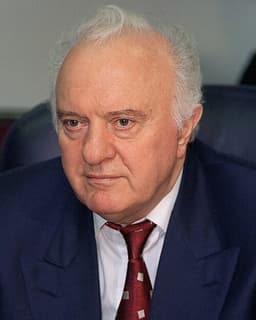
Eduard Shevardnadze
Politician · Modern
57.7Total
Basic Information
Born
1903
1928
Died
1995
—
Era
Modern
Modern
Nationality
United Kingdom
Georgia
Occupation
Politician
Politician
Civilization
Western
Western
Score Comparison
Military (10%)
48.3
50.0
Political (20%)
42.2
70.0
Influence (20%)
49.4
55.0
Legacy (20%)
40.0
56.0
Leadership (15%)
51.9
68.0
Strategy (15%)
42.0
42.1
TOTAL
45.5
57.7
Alec Douglas-Home — Complete Timeline
1963 AD
Appointed Prime MinisterPolitical Action
Douglas-Home succeeded Harold Macmillan as Prime Minister after a leadership contest. He was the last Prime Minister to be appointed from the House of Lords, renouncing his peerage to sit in the Commons.
Prime MinisterHouse of Lords
Impact: national
1964 AD
Lost 1964 General ElectionPolitical Action◆ Major
Douglas-Home led the Conservative Party to defeat in the 1964 general election, losing to Harold Wilson's Labour Party. The narrow loss ended 13 years of Conservative rule and his brief premiership.
ElectionDefeat
Impact: nationaldestructive
1965 AD
Resigned as Party LeaderPolitical Action◆ Major
Following the election defeat, Douglas-Home resigned as Conservative Party leader. He was succeeded by Edward Heath. His resignation marked the end of his active political leadership.
ResignationConservative Party
Impact: national
Eduard Shevardnadze — Complete Timeline
1985 AD
Appointed Soviet Foreign MinisterPolitical Action◆ Major
Mikhail Gorbachev appointed Shevardnadze as Soviet Foreign Minister. Shevardnadze played a key role in shaping the 'New Thinking' foreign policy, which emphasized de-escalation of the Cold War, arms reduction agreements, and improved relations with the West.
Cold WarSoviet UnionDiplomacy
Impact: globalconstructive
1987 AD
Signed the Intermediate-Range Nuclear Forces TreatyPolitical Action
Shevardnadze, as Soviet Foreign Minister, signed the INF Treaty with U.S. Secretary of State George Shultz. The treaty eliminated an entire class of nuclear missiles (500-5,500 km range) from Europe, marking a major step in ending the Cold War.
Nuclear Arms ControlCold WarTreaty
Impact: globalconstructive
1990 AD
Resigned as Soviet Foreign MinisterPolitical Action◆ Major
Shevardnadze resigned as Soviet Foreign Minister, warning of an impending dictatorship under Gorbachev. His resignation was a dramatic protest against the conservative backlash and the slow pace of reforms, highlighting the internal crisis of the Soviet Union.
Soviet UnionResignationPolitical Crisis
Impact: nationaltragic
1992 AD
Elected Chairman of the Georgian ParliamentPolitical Action◆ Major
After the ouster of President Zviad Gamsakhurdia, Shevardnadze returned to Georgia and was elected Chairman of the Parliament, effectively becoming the head of state. He was tasked with stabilizing the country amid civil war and economic collapse.
GeorgiaPost-SovietLeadership
Impact: national
1995 AD
Survived Assassination AttemptPolitical Action◆ Major
Shevardnadze survived a car bomb assassination attempt in Tbilisi. The attack, which killed several people, was widely attributed to opponents of his policies. It underscored the violent political struggles in post-Soviet Georgia.
Assassination AttemptGeorgiaViolence
Impact: nationaltragic
2003 AD
Rose RevolutionPolitical Action
Shevardnadze was forced to resign as President of Georgia following the Rose Revolution, a peaceful protest against disputed parliamentary elections. The revolution, led by Mikheil Saakashvili, ended Shevardnadze's rule and ushered in a new pro-Western government.
RevolutionGeorgiaRegime Change
Impact: national
Expert Analysis
Origins
Alec Douglas-Home was born on July 2, 1903, into the British aristocracy, the eldest son of the 13th Earl of Home. He was educated at Eton and Christ Church, Oxford, where he studied history. His family background in politics and landownership provided a privileged entry into public life. He entered the House of Commons in 1931 as a Conservative MP.
Eduard Shevardnadze was born on January 25, 1928, in Mamati, Georgia, into a peasant family. He joined the Communist Party in 1948 and rose through the ranks of the Georgian Komsomol and party apparatus. He studied at the Kutaisi Pedagogical Institute and later at the Higher Party School in Moscow. His background was Soviet bureaucratic, far from aristocratic privilege.
Rise to Power
Douglas-Home's rise was gradual and aristocratic. He served as Parliamentary Private Secretary to Neville Chamberlain in the late 1930s, then held junior ministerial posts. After a period in the House of Lords following his father's death, he returned to the Commons. In 1963, he emerged as the compromise candidate to succeed Harold Macmillan as Prime Minister, beating Rab Butler and Lord Hailsham. He became the last British PM to be appointed from the House of Lords, renouncing his peerage to sit in the Commons.
Shevardnadze's rise was within the Soviet system. He became First Secretary of the Georgian Communist Party in 1972, a position he held until 1985. He gained a reputation as an anti-corruption campaigner, though not entirely clean himself. In 1985, Mikhail Gorbachev appointed him Soviet Foreign Minister, a key role in the new leadership's reform agenda. He was a protégé of Gorbachev and a chief architect of 'New Thinking' in foreign policy.
Leadership & Governance
Douglas-Home's leadership style was traditional and cautious. As Prime Minister, he focused on domestic issues like housing and education, but his tenure was overshadowed by the Profumo affair and a stagnating economy. He scored 51.9 in leadership, reflecting his calm demeanor but limited impact. He lacked the flair of his predecessor or successor. His governance was reactive rather than proactive.
Shevardnadze, with a leadership score of 68.0, was more dynamic. As Soviet Foreign Minister, he pursued arms control treaties, notably the Intermediate-Range Nuclear Forces (INF) Treaty signed in 1987, which eliminated an entire class of nuclear weapons. He also withdrew Soviet troops from Afghanistan in 1989. As Georgian president (1995-2003), he attempted to build a democratic state but faced corruption and separatism. His governance was visionary in foreign policy but flawed domestically.
Triumph & Tragedy
Douglas-Home's greatest success was becoming Prime Minister against the odds, but his greatest failure was losing the 1964 general election, albeit narrowly, to Harold Wilson. He led the Conservatives to defeat after 13 years of power. His brief premiership (363 days) left no major policy legacy. He is remembered as a decent man out of his depth in modern politics.
Shevardnadze's triumph was his role in ending the Cold War. He co-architected the INF Treaty, reduced superpower tensions, and helped reunify Germany. He scored 56.0 in legacy for these achievements. However, his tragedy was the Rose Revolution in 2003, where he was forced to resign as Georgian president after disputed elections, amid allegations of corruption. He failed to establish a stable democracy in Georgia.
Character & Destiny
Douglas-Home was described as honorable, intelligent, but unambitious. He preferred the quiet life of a country gentleman. His character led him to be a caretaker PM, not a reformer. He accepted the leadership as a duty, not a desire. His destiny was to be the last aristocratic PM, a relic of a bygone era.
Shevardnadze was pragmatic, flexible, and shrewd. He was willing to abandon communist orthodoxy for new thinking. His character allowed him to navigate the treacherous waters of Soviet politics and emerge as a key reformer. However, his tolerance of corruption in Georgia ultimately led to his downfall. His destiny was to be a transitional figure, bridging the Soviet past and a democratic future.
Legacy
Douglas-Home's legacy is minimal. He is often forgotten as a footnote in British political history. His scores reflect this: political 42.2, legacy 40.0. He had no enduring impact on policy or institutions. The Conservative Party moved on quickly under Edward Heath.
Shevardnadze's legacy is substantial. He helped end the Cold War, a historic achievement. In Georgia, he is credited with stabilizing the country after civil war but criticized for failing to build strong institutions. His overall score of 57.7 reflects mixed but significant impact. The INF Treaty remains a landmark arms control agreement.
Conclusion
Eduard Shevardnadze had greater impact than Alec Douglas-Home. While Douglas-Home's brief premiership was inconsequential, Shevardnadze's role in ending the Cold War reshaped global politics. His political score of 70.0 vs. Douglas-Home's 42.2 and legacy score of 56.0 vs. 40.0 demonstrate this. Shevardnadze's actions affected millions, while Douglas-Home's were limited to a year of domestic management. History rightly judges Shevardnadze as a more significant figure.
Rankings
🥇
Eduard ShevardnadzeLeader
Mil: 50.0Pol: 70.0Inf: 55.0
57.7
🥈
Alec Douglas-Home
Mil: 48.3Pol: 42.2Inf: 49.4
45.5
+12.2 behind
How This Comparison Works
Algorithm
Each figure is scored on 6 dimensions (0—100 scale) based on structured historical data: Military (10%), Political (20%), Influence (20%), Legacy (20%), Leadership (15%), Strategy (15%). The weighted total produces the final ranking.
Data Sources
Scores are computed from structured sub-indicators in the database. Scale factors adjust for era (Ancient ×0.85, Modern ×1.0) and civilization size (Eastern ×1.05, Other ×0.80) to account for differences in population and military scale.
Maximum 3 Figures
Comparisons are limited to 2—3 figures to ensure readability and statistical meaningfulness.
Error Margins
±5 points per dimension — Sub-scores are derived from historical records with inherent uncertainty. Two figures within 5 points on a dimension should be considered roughly equivalent in that area.
Total Score Accuracy
±3 points overall — The weighted combination of 6 dimensions produces a total score with approximately ±3 points of uncertainty. Differences of less than 3 points are not statistically significant— the figures are effectively tied.
Known Limitations
- Historical records are incomplete and uneven across civilizations
- Figures from oral-tradition societies may be underrepresented
- Occupation labels can misclassify multi-role figures
- Scores measure capability and impact, not moral character
- Quantitative scoring is a comparison tool, not absolute truth
Capability Radar
Military (10%) — Battles & Warfare
Battles
27
26
Win Rate
34
31
Expansion
37
36
Political (20%) — Governance & Reform
Reform
20
80
Diplomacy
40
85
Economy
25
40
Influence (20%) — Cultural & Global Reach
Cultural
10
40
Global
15
65
Legacy (20%) — Historical Impact
Historical
20
70
Longevity
10
50
Leadership (15%) — Power & Stability
Tenure
15
75
Stability
30
30
Strategy (15%) — Tactics & Innovation
Strategy
38
35
Tactics
40
40
Reform
43
46
Similar Comparisons
Comments & Discussion
No comments yet. Be the first to share your thoughts!