Loading...
This comparison has not been analyzed yet.
One-time AI generation (~1 minute). Scores and timeline are already available below.
Alexander De Croo vs Farooq Abdullah
Farooq Abdullah leads by 2.6 pts · 2 figures compared
…
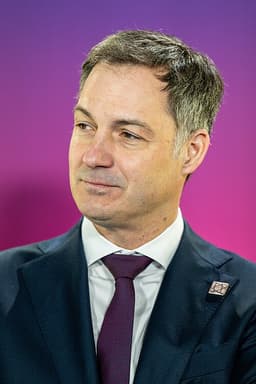
Alexander De Croo
Politician · Modern
48.3Total

Farooq Abdullah
Politician · Modern
50.9Total
Basic Information
Born
1975
1937
Died
—
—
Era
Modern
Modern
Nationality
Belgium
India
Occupation
Politician
Politician
Civilization
Western
Indian
Score Comparison
Military (10%)
14.0
40.0
Political (20%)
68.0
61.3
Influence (20%)
51.0
57.2
Legacy (20%)
37.5
45.8
Leadership (15%)
74.0
40.0
Strategy (15%)
34.7
60.0
TOTAL
48.3
50.9
Alexander De Croo — Complete Timeline
2012 AD
Appointed Deputy Prime Minister of BelgiumPolitical Action
Alexander De Croo became Deputy Prime Minister and Minister of Pensions in the Di Rupo government. He later served as Minister of Development Cooperation and Minister of Finance, gaining experience in coalition governance.
Belgian PoliticsCoalitionGovernment
Impact: nationalconstructive
2020 AD
Became Prime Minister of BelgiumPolitical Action◆ Major
De Croo became Prime Minister of Belgium, leading a seven-party coalition government. His appointment ended a 16-month political deadlock after the 2019 elections, with a focus on COVID-19 recovery and economic reforms.
Belgian PoliticsPrime MinisterCoalition
Impact: nationalconstructive
Led Belgium's COVID-19 ResponsePolitical Action◆ Major
De Croo's government managed the COVID-19 pandemic, including lockdowns, vaccination rollout, and economic support. Belgium faced high infection rates and criticism over hospital capacity, but the vaccination campaign eventually reached high coverage.
COVID-19Belgian PoliticsPublic Health
Impact: national
2021 AD
Hosted NATO Summit in BrusselsPolitical Action
De Croo hosted the NATO summit in Brussels, where leaders discussed defense spending, Afghanistan withdrawal, and relations with Russia. The summit reaffirmed NATO's collective defense commitments.
NATOSummitDefense
Impact: globalconstructive
2022 AD
Navigated Energy Crisis and InflationPolitical Action◆ Major
De Croo's government responded to the energy crisis caused by the Russia-Ukraine war, implementing price caps and subsidies for households. Belgium also faced high inflation, leading to social unrest and strikes.
Energy CrisisInflationBelgian Politics
Impact: national
Farooq Abdullah — Complete Timeline
1982 AD
Succeeded Sheikh Abdullah as National Conference leaderPolitical Action◆ Major
After his father Sheikh Abdullah's death, Farooq Abdullah became the president of the Jammu and Kashmir National Conference. He inherited the party's leadership and the complex political legacy of his father, including the demand for autonomy.
LeadershipKashmirNational Conference
Impact: regional
First term as Chief Minister of Jammu and KashmirPolitical Action◆ Major
Farooq Abdullah became Chief Minister of Jammu and Kashmir for the first time after his father's death. He formed a government with the National Conference. His tenure was marked by tensions with the central government and the rise of militancy.
Chief MinisterKashmirNational Conference
Impact: regional
1984 AD
Dismissed as Chief Minister (1984)Political Action◆ Major
Farooq Abdullah's government was dismissed by Governor Jagmohan under Article 356, with allegations of corruption and separatist sympathies. His dismissal sparked protests and deepened the alienation of Kashmiris. It was widely seen as a political move by the central government.
DismissalKashmirArticle 356
Impact: regionaldestructive
1986 AD
Returned as Chief Minister after accord (1986)Political Action◆ Major
Farooq Abdullah signed an accord with Prime Minister Rajiv Gandhi, leading to his return as Chief Minister after the 1986 election. The accord was criticized as a compromise of autonomy. His second term saw the rise of armed insurgency in Kashmir.
AccordKashmirRajiv Gandhi
Impact: regional
2002 AD
Led coalition government with Congress (2002-2005)Political Action
Farooq Abdullah's National Conference formed a coalition government with the Congress after the 2002 election, with Mufti Mohammad Sayeed as Chief Minister. Abdullah served as a Union Minister in the UPA government. This period saw a reduction in militancy.
CoalitionKashmirUPA
Impact: regionalconstructive
This comparison has not been analyzed yet.
One-time AI generation (~1 minute). Scores and timeline are already available below.
Rankings
🥇
Farooq AbdullahLeader
Mil: 40.0Pol: 61.3Inf: 57.2
50.9
🥈
Alexander De Croo
Mil: 14.0Pol: 68.0Inf: 51.0
48.3
+2.6 behind
How This Comparison Works
Algorithm
Each figure is scored on 6 dimensions (0—100 scale) based on structured historical data: Military (10%), Political (20%), Influence (20%), Legacy (20%), Leadership (15%), Strategy (15%). The weighted total produces the final ranking.
Data Sources
Scores are computed from structured sub-indicators in the database. Scale factors adjust for era (Ancient ×0.85, Modern ×1.0) and civilization size (Eastern ×1.05, Other ×0.80) to account for differences in population and military scale.
Maximum 3 Figures
Comparisons are limited to 2—3 figures to ensure readability and statistical meaningfulness.
Error Margins
±5 points per dimension — Sub-scores are derived from historical records with inherent uncertainty. Two figures within 5 points on a dimension should be considered roughly equivalent in that area.
Total Score Accuracy
±3 points overall — The weighted combination of 6 dimensions produces a total score with approximately ±3 points of uncertainty. Differences of less than 3 points are not statistically significant— the figures are effectively tied.
Known Limitations
- Historical records are incomplete and uneven across civilizations
- Figures from oral-tradition societies may be underrepresented
- Occupation labels can misclassify multi-role figures
- Scores measure capability and impact, not moral character
- Quantitative scoring is a comparison tool, not absolute truth
Capability Radar
Military (10%) — Battles & Warfare
Battles
20
46
Win Rate
24
44
Expansion
27
51
Political (20%) — Governance & Reform
Reform
45
40
Diplomacy
55
55
Economy
50
35
Influence (20%) — Cultural & Global Reach
Cultural
20
45
Global
25
30
Legacy (20%) — Historical Impact
Historical
20
40
Longevity
15
35
Leadership (15%) — Power & Stability
Tenure
40
65
Stability
45
30
Strategy (15%) — Tactics & Innovation
Strategy
34
52
Tactics
36
58
Reform
35
60
Similar Comparisons
Comments & Discussion
No comments yet. Be the first to share your thoughts!