Loading...
This comparison has not been analyzed yet.
One-time AI generation (~1 minute). Scores and timeline are already available below.
Alexandre Millerand vs Lazarus Salii
Alexandre Millerand leads by 16.2 pts · 2 figures compared
…
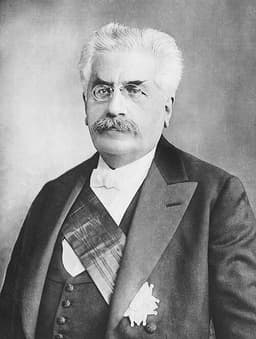
Alexandre Millerand
Politician · Modern
55.1Total

Lazarus Salii
Politician · Modern
38.9Total
Basic Information
Born
1859
1936
Died
1943
—
Era
Modern
Modern
Nationality
France
Palau
Occupation
Politician
Politician
Civilization
Western
Other
Score Comparison
Military (10%)
50.0
30.2
Political (20%)
68.0
32.2
Influence (20%)
54.9
46.3
Legacy (20%)
46.7
35.8
Leadership (15%)
68.0
41.5
Strategy (15%)
42.7
43.1
TOTAL
55.1
38.9
Alexandre Millerand — Complete Timeline
1920 AD
Served as Prime MinisterPolitical Action
Millerand served as Prime Minister of France from January to September 1920. His government focused on implementing the Treaty of Versailles and managing post-war reconstruction.
Prime MinisterPost-War
Impact: national
1924 AD
Elected President of FrancePolitical Action◆ Major
Alexandre Millerand was elected President of the French Republic, serving from 1924 to 1931. He sought to expand presidential powers, often clashing with the parliament over his active role in policy.
PresidencyExecutive Power
Impact: national
1931 AD
Resigned as PresidentPolitical Action◆ Major
Millerand resigned the presidency in 1931 after losing political support due to his controversial expansion of presidential authority. His resignation marked a return to a more ceremonial role for the French presidency.
Resignation
Impact: national
Lazarus Salii — Complete Timeline
1985 AD
Election as President of PalauPolitical Action◆ Major
Lazarus Salii was elected as the third President of Palau, succeeding Haruo Remeliik who had been assassinated. His election marked a period of political transition for the newly independent nation.
ElectionPresidencyPalau
Impact: national
1986 AD
Negotiation of the Compact of Free AssociationPolitical Action◆ Major
Salii negotiated the Compact of Free Association with the United States, which granted Palau financial aid and defense guarantees in exchange for U.S. military access. The compact was controversial due to provisions allowing nuclear-capable ships, conflicting with Palau's anti-nuclear constitution.
TreatyNuclear IssueU.S. Relations
Impact: national
1988 AD
Death in OfficeOther◆ Major
Lazarus Salii died by suicide while in office, reportedly due to stress from political scandals and the ongoing controversy over the Compact of Free Association. His death shocked the nation and led to a period of political instability.
DeathSuicidePolitical Crisis
Impact: nationaltragic
This comparison has not been analyzed yet.
One-time AI generation (~1 minute). Scores and timeline are already available below.
Rankings
🥇
Alexandre MillerandLeader
Mil: 50.0Pol: 68.0Inf: 54.9
55.1
🥈
Lazarus Salii
Mil: 30.2Pol: 32.2Inf: 46.3
38.9
+16.2 behind
How This Comparison Works
Algorithm
Each figure is scored on 6 dimensions (0—100 scale) based on structured historical data: Military (10%), Political (20%), Influence (20%), Legacy (20%), Leadership (15%), Strategy (15%). The weighted total produces the final ranking.
Data Sources
Scores are computed from structured sub-indicators in the database. Scale factors adjust for era (Ancient ×0.85, Modern ×1.0) and civilization size (Eastern ×1.05, Other ×0.80) to account for differences in population and military scale.
Maximum 3 Figures
Comparisons are limited to 2—3 figures to ensure readability and statistical meaningfulness.
Error Margins
±5 points per dimension — Sub-scores are derived from historical records with inherent uncertainty. Two figures within 5 points on a dimension should be considered roughly equivalent in that area.
Total Score Accuracy
±3 points overall — The weighted combination of 6 dimensions produces a total score with approximately ±3 points of uncertainty. Differences of less than 3 points are not statistically significant— the figures are effectively tied.
Known Limitations
- Historical records are incomplete and uneven across civilizations
- Figures from oral-tradition societies may be underrepresented
- Occupation labels can misclassify multi-role figures
- Scores measure capability and impact, not moral character
- Quantitative scoring is a comparison tool, not absolute truth
Capability Radar
Military (10%) — Battles & Warfare
Battles
27
21
Win Rate
31
22
Expansion
35
28
Political (20%) — Governance & Reform
Reform
55
20
Diplomacy
60
25
Economy
50
20
Influence (20%) — Cultural & Global Reach
Cultural
30
10
Global
30
5
Legacy (20%) — Historical Impact
Historical
40
10
Longevity
30
5
Leadership (15%) — Power & Stability
Tenure
60
15
Stability
45
15
Strategy (15%) — Tactics & Innovation
Strategy
41
28
Tactics
38
36
Reform
44
34
Similar Comparisons
Comments & Discussion
No comments yet. Be the first to share your thoughts!