Loading...
Alfonso XII vs Khalifa bin Said
Alfonso XII leads by 2.0 pts · 2 figures compared
…
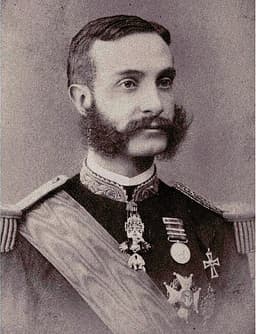
Alfonso XII
Emperor · Modern
51.2Total

Khalifa bin Said
Emperor · Modern
49.2Total
Basic Information
Born
1857
1852
Died
1885
1890
Era
Modern
Modern
Nationality
Spain
Zanzibar
Occupation
Emperor
Emperor
Civilization
Western
Other
Score Comparison
Military (10%)
21.2
43.3
Political (20%)
68.0
43.7
Influence (20%)
53.3
49.4
Legacy (20%)
43.3
37.5
Leadership (15%)
74.0
74.0
Strategy (15%)
36.8
54.6
TOTAL
51.2
49.2
Alfonso XII — Complete Timeline
1874 AD
Restoration of the Bourbon monarchyPolitical Action
Alfonso XII was proclaimed king after a military coup by General Mart
RestorationMonarchyBourbon
Impact: nationalconstructive
1876 AD
End of the Third Carlist WarWar◆ Major
Alfonso XII's forces defeated the Carlists, ending the Third Carlist War. The victory consolidated his rule and allowed for the implementation of the Restoration system.
Carlist WarsCivil WarVictory
Impact: nationalconstructive
Promulgation of the Constitution of 1876Reform◆ Major
Alfonso XII oversaw the adoption of the Constitution of 1876, which established a conservative liberal monarchy with a bicameral parliament. This constitution remained in force until 1923.
ConstitutionReformRestoration
Impact: nationalconstructive
1879 AD
Marriage to Maria Cristina of AustriaPolitical Action
Alfonso XII married Maria Cristina of Austria, who later served as regent after his death. The marriage produced Alfonso XIII and helped secure the dynasty.
MarriageDynastySuccession
Impact: national
Khalifa bin Said — Complete Timeline
1888 AD
Accession as Third Sultan of ZanzibarPolitical Action◆ Major
Khalifa bin Said became sultan after the death of his brother Barghash bin Said. His reign coincided with the intensifying Scramble for Africa, as European powers competed for control over East African territories.
SuccessionSultanateScramble for Africa
Granting of Concessions to the Imperial British East Africa CompanyPolitical Action◆ Major
Khalifa bin Said granted the Imperial British East Africa Company (IBEAC) administrative rights over the Kenyan coast. This concession effectively transferred control of mainland territories to British commercial interests, reducing Zanzibar's influence.
Colonial ConcessionIBEACLoss of Territory
Impact: regional
1890 AD
Signing of the Anglo-German Agreement of 1890Political Action◆ Major
Khalifa bin Said's government was party to the Anglo-German Agreement that defined colonial boundaries in East Africa. This treaty recognized Zanzibar as a British sphere of influence while Germany gained control over mainland Tanganyika.
Colonial TreatyAnglo-German AgreementBoundary Definition
Impact: regional
Expert Analysis
Origins
Alfonso XII was born on November 28, 1857, in Madrid, Spain, to Queen Isabella II and her husband, Francis of Assisi. His early life was marked by political turmoil: his mother's reign ended in the 1868 Glorious Revolution, forcing the royal family into exile. Alfonso studied at the Theresianum in Vienna and later at the Royal Military Academy Sandhurst in Britain, where he received a conservative military education. His upbringing was shaped by the desire to restore the Bourbon monarchy.
Khalifa bin Said was born around 1852 in Zanzibar, the son of Sultan Said bin Sultan and a Circassian concubine. He was part of the Al Busaid dynasty, which ruled Oman and Zanzibar. His early life was spent in the royal court, where he was groomed for administration but not initially for succession. He was educated in Islamic law and Swahili customs, with little exposure to European ideas.
Rise to Power
Alfonso XII's rise began with the collapse of the First Spanish Republic. On December 29, 1874, General Arsenio Martínez Campos led a coup in Sagunto, proclaiming Alfonso as king. Alfonso returned to Spain in January 1875 and was crowned. His legitimacy was challenged by Carlist rebels, who supported a rival Bourbon claimant. He quickly consolidated power by ending the Third Carlist War in 1876, defeating the Carlist forces under Don Carlos. Key allies included the conservative politician Cánovas del Castillo, who became his chief minister.
Khalifa bin Said ascended to the sultanate on March 27, 1888, after the death of his brother Barghash bin Said. Unlike Alfonso, his rise was peaceful, following the hereditary succession of the Al Busaid dynasty. However, his reign began during the Scramble for Africa, when European powers were carving up the continent. He had limited allies; his primary support came from the Arab elite and Indian merchants, but he faced pressure from Britain and Germany.
Leadership & Governance
Alfonso XII's leadership style was constitutional but conservative. He oversaw the Constitution of 1876, which established a bicameral parliament (Cortes) with a restricted electorate. He promoted the turno pacífico, a system where two major parties alternated power through managed elections. His governance focused on stability and centralization, suppressing regionalist movements. For example, he signed the Pact of El Pardo in 1885 to ensure peaceful succession. His political score of 68.0 reflects his ability to stabilize Spain after years of instability.
Khalifa bin Said governed as an absolute monarch but with diminishing authority. He maintained traditional structures, relying on viziers and local governors. However, he granted extensive concessions to European powers: in 1888, he gave the Imperial British East Africa Company administrative rights over the Kenyan coast, and in 1890, he signed the Anglo-German Agreement, which recognized Zanzibar as a British protectorate. His political score of 43.7 indicates his constrained agency. He attempted to modernize the economy by promoting clove plantations, but revenues declined.
Triumph & Tragedy
Alfonso XII's greatest triumph was the restoration of the Bourbon monarchy and the end of the Carlist Wars, bringing peace to Spain. He also oversaw a period of economic recovery and infrastructure development. However, his greatest failure was the inability to address social and regional tensions, which would resurface after his death. His early death from tuberculosis at age 27 in 1885 left a power vacuum, leading to his wife's regency.
Khalifa bin Said's success was maintaining Zanzibar's independence during the early Scramble, albeit as a protectorate. He preserved the sultanate's formal sovereignty until his death. His tragedy was the loss of territorial control: the Anglo-German Agreement stripped Zanzibar of its mainland possessions, reducing its economic base. He also failed to modernize the military or diversify the economy, leaving Zanzibar vulnerable. He died in 1890, just months after signing the agreement.
Character & Destiny
Alfonso XII was pragmatic and disciplined, shaped by his military training. He was known for his charm and diplomatic skills, which helped him navigate political factions. Historians describe him as a stabilizing force, but his early death cut short his potential. His character led to a restoration that lasted until 1931, but his reliance on the turno pacífico sowed seeds of later instability.
Khalifa bin Said was cautious and conservative, perhaps overly deferential to European powers. He lacked the assertiveness of his brother Barghash, who had resisted British pressure. His decisions were driven by a desire to preserve his dynasty, but they ultimately accelerated Zanzibar's decline. His leadership score of 74.0 matches Alfonso's, but his strategic score of 54.6 reflects his inability to navigate imperial pressures effectively.
Legacy
Alfonso XII's legacy is the Bourbon Restoration, which provided Spain with a stable constitutional monarchy for decades. The Constitution of 1876 remained in force until 1923. He is remembered as 'El Pacificador' (the Peacemaker) for ending the Carlist Wars. However, his system excluded working classes and regional nationalists, contributing to later conflicts. His total score of 51.2 places him as a moderately impactful monarch.
Khalifa bin Said's legacy is more ambiguous. He is often seen as a weak ruler who surrendered Zanzibar's independence. The Anglo-German Agreement of 1890 is a landmark in colonial history, but it marked the end of Zanzibar's sovereignty. His reign is overshadowed by the subsequent British protectorate and the 1896 Anglo-Zanzibar War, the shortest war in history. His total score of 49.2 reflects his limited impact.
Conclusion
Alfonso XII had a greater impact than Khalifa bin Said, with a total score of 51.2 versus 49.2. While both faced external pressures, Alfonso actively shaped Spain's political structure, ending civil wars and establishing a constitutional monarchy that lasted 46 years. Khalifa, by contrast, reacted to European imperialism, preserving his throne but losing his country's independence. Alfonso's leadership score of 74.0 matches Khalifa's, but his political score of 68.0 far exceeds Khalifa's 43.7, reflecting his ability to govern effectively. Alfonso's legacy is more tangible: the Constitution of 1876 and the Bourbon Restoration. Khalifa's legacy is one of decline. Therefore, Alfonso XII had a greater historical impact.
Rankings
🥇
Alfonso XIILeader
Mil: 21.2Pol: 68.0Inf: 53.3
51.2
🥈
Khalifa bin Said
Mil: 43.3Pol: 43.7Inf: 49.4
49.2
+2.0 behind
How This Comparison Works
Algorithm
Each figure is scored on 6 dimensions (0—100 scale) based on structured historical data: Military (10%), Political (20%), Influence (20%), Legacy (20%), Leadership (15%), Strategy (15%). The weighted total produces the final ranking.
Data Sources
Scores are computed from structured sub-indicators in the database. Scale factors adjust for era (Ancient ×0.85, Modern ×1.0) and civilization size (Eastern ×1.05, Other ×0.80) to account for differences in population and military scale.
Maximum 3 Figures
Comparisons are limited to 2—3 figures to ensure readability and statistical meaningfulness.
Error Margins
±5 points per dimension — Sub-scores are derived from historical records with inherent uncertainty. Two figures within 5 points on a dimension should be considered roughly equivalent in that area.
Total Score Accuracy
±3 points overall — The weighted combination of 6 dimensions produces a total score with approximately ±3 points of uncertainty. Differences of less than 3 points are not statistically significant— the figures are effectively tied.
Known Limitations
- Historical records are incomplete and uneven across civilizations
- Figures from oral-tradition societies may be underrepresented
- Occupation labels can misclassify multi-role figures
- Scores measure capability and impact, not moral character
- Quantitative scoring is a comparison tool, not absolute truth
Capability Radar
Military (10%) — Battles & Warfare
Battles
10
5
Win Rate
15
5
Expansion
5
5
Political (20%) — Governance & Reform
Reform
50
30
Diplomacy
55
40
Economy
40
35
Influence (20%) — Cultural & Global Reach
Cultural
30
20
Global
20
15
Legacy (20%) — Historical Impact
Historical
35
20
Longevity
25
15
Leadership (15%) — Power & Stability
Tenure
40
60
Stability
45
25
Strategy (15%) — Tactics & Innovation
Strategy
15
5
Tactics
10
5
Reform
20
10
Similar Comparisons
Comments & Discussion
No comments yet. Be the first to share your thoughts!