Loading...
Amadou Toumani Toure vs Romeo Lucas Garcia
Amadou Toumani Toure leads by 8.5 pts · 2 figures compared
…

Amadou Toumani Toure
General · Modern
45.9Total
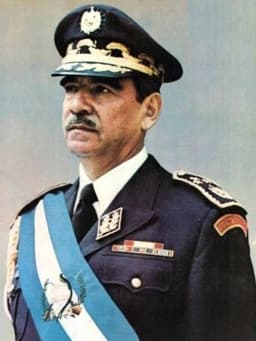
Romeo Lucas Garcia
General · Modern
37.4Total
Basic Information
Born
1948
1924
Died
—
—
Era
Modern
Modern
Nationality
Mali
Guatemala
Occupation
General
General
Civilization
Other
Western
Score Comparison
Military (10%)
10.2
22.6
Political (20%)
68.0
27.9
Influence (20%)
51.0
47.1
Legacy (20%)
39.2
37.5
Leadership (15%)
64.0
45.0
Strategy (15%)
25.0
30.3
TOTAL
45.9
37.4
Amadou Toumani Toure — Complete Timeline
1991 AD
Led the 1991 Coup d'ÉtatPolitical Action
Amadou Toumani Tour
CoupDemocracy
Impact: nationalconstructive
2002 AD
Elected President of MaliPolitical Action◆ Major
Touré won the presidential election as an independent candidate, defeating the ruling party. His election marked a return to civilian rule after a period of political instability.
ElectionCivilian Rule
Impact: nationalconstructive
2006 AD
Mediated the Algiers AccordsPolitical Action◆ Major
Touré mediated the Algiers Accords between the Malian government and Tuareg rebels, aiming to end a rebellion in the north. The accords brought temporary peace but failed to address underlying grievances.
Peace AgreementTuareg Rebellion
Impact: regionalconstructive
2012 AD
Overthrown in a Coup d'ÉtatPolitical Action
Touré was overthrown by mutinous soldiers led by Captain Amadou Sanogo, just months before his scheduled retirement. The coup plunged Mali into chaos and led to a Tuareg rebellion in the north.
CoupInstability
Impact: nationaldestructive
Romeo Lucas Garcia — Complete Timeline
1978 AD
Became President of GuatemalaPolitical Action◆ Major
Romeo Lucas Garc
PresidencyGuatemalaMilitary Rule
Impact: national
1979 AD
Oversaw Escalation of State TerrorPolitical Action◆ Major
Lucas García's regime intensified the use of death squads, forced disappearances, and massacres against political opponents and indigenous communities. The violence peaked during his tenure, with thousands killed or 'disappeared'.
State TerrorHuman RightsCivil War
Impact: nationaldestructive
1982 AD
Overthrown by Coup and ExiledPolitical Action◆ Major
Lucas García was overthrown in a military coup led by General Efraín Ríos Montt. He went into exile, and his ouster marked the end of the last military ruler before Ríos Montt's brief but brutal regime.
CoupExileGuatemala
Impact: nationaldestructive
Expert Analysis
Origins
Amadou Toumani Touré was born on November 4, 1948, in Mopti, Mali. He trained as a paratrooper and rose through the ranks of the Malian military. His early career was shaped by the authoritarian rule of Moussa Traoré, which he would later help overthrow. Touré's background was modest, and he was known for his calm demeanor and pragmatic approach.
Romeo Lucas García was born on July 27, 1924, in San Juan Chamelco, Guatemala. He entered the military and became a general. His rise was tied to the repressive structures of the Guatemalan state, which had been dominated by military rulers since the 1954 coup. Lucas García was a product of a system that prioritized control and suppression of dissent.
Rise to Power
Touré's rise to prominence came on March 26, 1991, when he led a bloodless coup that overthrew President Moussa Traoré. Instead of seizing power, Touré handed authority to a civilian government within 10 months, earning him the nickname "Soldier of Democracy." He then retired from the military and worked as a mediator, including in the Algiers Accords (1996) between the Malian government and Tuareg rebels. In 2002, he ran for president as an independent and won, defeating the ruling party. His electoral victory was seen as a consolidation of Mali's democratic transition.
Lucas García came to power through a fraudulent election in 1978, succeeding General Kjell Laugerud. His presidency was marked by a dramatic escalation of state terror. He oversaw the expansion of death squads and military operations targeting leftist guerrillas and indigenous communities. The regime was responsible for massacres, such as the Panzós massacre in 1978, where security forces killed over 100 indigenous protesters. Lucas García's rule was characterized by corruption and human rights abuses, with the military acting with impunity.
Leadership & Governance
Touré's leadership style was consensual and inclusive. He governed as a "consensus builder," often consulting opposition parties and civil society. His administration focused on economic reforms, decentralization, and education. Mali experienced relative stability and democratic consolidation under his tenure, with peaceful elections in 2007. However, his approach was criticized for being too passive, especially in addressing corruption and growing security threats in the north.
In contrast, Lucas García's governance was authoritarian and brutal. He relied on military force and state-sponsored violence to maintain control. His regime's counterinsurgency strategy targeted not only armed groups but also entire communities, leading to thousands of deaths and disappearances. The state terror under Lucas García was systematic, with the military and police acting as instruments of repression. The economy suffered due to capital flight and international isolation.
Triumph & Tragedy
Touré's greatest triumph was facilitating Mali's transition to democracy. His 1991 coup and subsequent handover of power set a precedent in West Africa. As president, he maintained stability and oversaw economic growth. However, his tragic failure was his inability to prevent the 2012 coup that overthrew him. Despite warnings about mutinous soldiers, Touré did not act decisively. The coup led to a crisis that allowed Islamist militants to seize northern Mali. His legacy was shattered by the collapse of the state he helped build.
Lucas García's regime achieved short-term military gains against guerrilla groups, but at an immense human cost. The tragedy of his rule was the widespread atrocities committed under his command. His presidency ended in 1982 when he was overthrown by General Efraín Ríos Montt, who then launched an even more brutal campaign. Lucas García was exiled to Venezuela, where he died in 2006. He left behind a legacy of violence and division.
Character & Destiny
Touré was known for his humility and commitment to democracy. He often said, "I am a soldier who loves peace." His character as a mediator and democrat shaped his destiny: he was respected internationally but struggled to assert authority over ambitious subordinates. His unwillingness to use force to quell dissent ultimately led to his downfall. Historians note that his leadership scored 64.0, but his military score was only 10.2, reflecting his aversion to coercion.
Lucas García was a product of Guatemala's repressive military culture. He was described as authoritarian and intolerant of opposition. His character led him to escalate violence, believing that only terror could maintain order. His destiny was to be overthrown by a more ruthless general, Ríos Montt, who scored 43.8 overall. Lucas García's political score of 27.9 reflects his inability to build legitimate governance.
Legacy
Touré's legacy is mixed. He is remembered as a democrat who helped end dictatorship in Mali, but also as a leader whose weaknesses contributed to the state's collapse. His influence score of 51.0 reflects his role as a model for African democratic transitions, though this model proved fragile. The institutions he built did not survive the 2012 crisis. Today, Mali is under military rule, and Touré's achievements are often overshadowed by the subsequent chaos.
Lucas García's legacy is overwhelmingly negative. He is remembered as one of Guatemala's most repressive rulers, responsible for some of the worst human rights violations during the civil war. His regime's actions contributed to the genocide charges later brought against Ríos Montt. Lucas García's total score of 37.4 places him among the lowest in our database. He is a symbol of the brutality of Latin American military dictatorships.
Conclusion
Amadou Toumani Touré had a greater positive impact than Romeo Lucas García. Despite his failures, Touré's role in establishing democracy in Mali and his peaceful handover of power in 1991 represent significant achievements. Lucas García, by contrast, left a legacy of terror and state-sponsored murder. Touré's total score of 45.9 is 8.5 points higher than Lucas García's 37.4, reflecting his superior political skill and leadership. While both were overthrown, Touré's democratic ideals contrast sharply with Lucas García's authoritarian brutality. The data supports that Touré's contributions to peace and democracy outweigh Lucas García's destructive rule.
Rankings
🥇
Amadou Toumani ToureLeader
Mil: 10.2Pol: 68.0Inf: 51.0
45.9
🥈
Romeo Lucas Garcia
Mil: 22.6Pol: 27.9Inf: 47.1
37.4
+8.5 behind
How This Comparison Works
Algorithm
Each figure is scored on 6 dimensions (0—100 scale) based on structured historical data: Military (10%), Political (20%), Influence (20%), Legacy (20%), Leadership (15%), Strategy (15%). The weighted total produces the final ranking.
Data Sources
Scores are computed from structured sub-indicators in the database. Scale factors adjust for era (Ancient ×0.85, Modern ×1.0) and civilization size (Eastern ×1.05, Other ×0.80) to account for differences in population and military scale.
Maximum 3 Figures
Comparisons are limited to 2—3 figures to ensure readability and statistical meaningfulness.
Error Margins
±5 points per dimension — Sub-scores are derived from historical records with inherent uncertainty. Two figures within 5 points on a dimension should be considered roughly equivalent in that area.
Total Score Accuracy
±3 points overall — The weighted combination of 6 dimensions produces a total score with approximately ±3 points of uncertainty. Differences of less than 3 points are not statistically significant— the figures are effectively tied.
Known Limitations
- Historical records are incomplete and uneven across civilizations
- Figures from oral-tradition societies may be underrepresented
- Occupation labels can misclassify multi-role figures
- Scores measure capability and impact, not moral character
- Quantitative scoring is a comparison tool, not absolute truth
Capability Radar
Military (10%) — Battles & Warfare
Battles
5
10
Win Rate
5
10
Expansion
5
5
Political (20%) — Governance & Reform
Reform
40
10
Diplomacy
50
15
Economy
35
10
Influence (20%) — Cultural & Global Reach
Cultural
20
5
Global
15
5
Legacy (20%) — Historical Impact
Historical
20
10
Longevity
15
5
Leadership (15%) — Power & Stability
Tenure
55
30
Stability
20
5
Strategy (15%) — Tactics & Innovation
Strategy
10
15
Tactics
10
15
Reform
15
10
Similar Comparisons
Comments & Discussion
No comments yet. Be the first to share your thoughts!