Loading...
This comparison has not been analyzed yet.
One-time AI generation (~1 minute). Scores and timeline are already available below.
Amir Sjarifuddin vs Ed Broadbent
Ed Broadbent leads by 11.2 pts · 2 figures compared
…

Amir Sjarifuddin
Politician · Modern
45.3Total
Ed Broadbent
Politician · Modern
56.5Total
Basic Information
Born
1907
1936
Died
1948
—
Era
Modern
Modern
Nationality
Indonesia
Canada
Occupation
Politician
Politician
Civilization
Eastern
Western
Score Comparison
Military (10%)
33.4
50.0
Political (20%)
40.8
60.0
Influence (20%)
49.4
59.0
Legacy (20%)
40.0
47.5
Leadership (15%)
51.9
78.0
Strategy (15%)
57.4
42.0
TOTAL
45.3
56.5
Amir Sjarifuddin — Complete Timeline
1947 AD
Appointed Prime Minister of IndonesiaPolitical Action◆ Major
Amir Sjarifuddin became Prime Minister of Indonesia, succeeding Sutan Sjahrir. His cabinet continued the struggle for independence, but faced internal challenges and military setbacks against the Dutch.
Prime MinisterRevolutionGovernment
Impact: national
1948 AD
Signed the Renville AgreementPolitical Action◆ Major
As Prime Minister, Sjarifuddin signed the Renville Agreement with the Netherlands, which recognized Dutch sovereignty over areas they occupied. The agreement was highly unpopular and led to his government's fall.
RenvilleDiplomacyUnpopular
Impact: nationaldestructive
Executed by the Indonesian ArmyPolitical Action◆ Major
Amir Sjarifuddin was captured and executed by the Indonesian Army for his alleged involvement in the Madiun Affair, a leftist uprising against the Republican government. His execution marked a violent suppression of the left during the revolution.
ExecutionMadiun AffairLeftist
Impact: nationaltragic
Ed Broadbent — Complete Timeline
1975 AD
Elected Leader of the New Democratic PartyPolitical Action◆ Major
Ed Broadbent was elected federal leader of the NDP at the party's convention in Winnipeg. He succeeded David Lewis and led the party through a period of growth, becoming a prominent voice for social democracy in Canada.
NDPLeadershipCanadian Politics
Impact: nationalconstructive
1988 AD
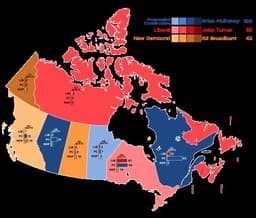
NDP Achieves Best Electoral Result Under BroadbentPolitical Action◆ Major
In the 1988 federal election, the NDP under Broadbent won 43 seats and 20.4% of the popular vote, its highest share at that time. The election was dominated by the free trade debate with the United States, and the NDP opposed the Canada-U.S. Free Trade Agreement.
ElectionNDPFree Trade
Impact: nationalconstructive
1989 AD
Resigned as NDP LeaderPolitical Action◆ Major
Broadbent resigned as NDP leader after 14 years, citing a desire to step down while the party was in a strong position. He was succeeded by Audrey McLaughlin, the first woman to lead a major federal party in Canada.
ResignationNDPLeadership
Impact: national
2001 AD
Appointed to the Order of CanadaCultural
Broadbent was appointed as a Companion of the Order of Canada, the country's highest civilian honor, in recognition of his contributions to Canadian politics and social justice. He continued to advocate for democratic reform and human rights.
HonorOrder of Canada
Impact: nationalconstructive
This comparison has not been analyzed yet.
One-time AI generation (~1 minute). Scores and timeline are already available below.
Rankings
🥇
Ed BroadbentLeader
Mil: 50.0Pol: 60.0Inf: 59.0
56.5
🥈
Amir Sjarifuddin
Mil: 33.4Pol: 40.8Inf: 49.4
45.3
+11.2 behind
How This Comparison Works
Algorithm
Each figure is scored on 6 dimensions (0—100 scale) based on structured historical data: Military (10%), Political (20%), Influence (20%), Legacy (20%), Leadership (15%), Strategy (15%). The weighted total produces the final ranking.
Data Sources
Scores are computed from structured sub-indicators in the database. Scale factors adjust for era (Ancient ×0.85, Modern ×1.0) and civilization size (Eastern ×1.05, Other ×0.80) to account for differences in population and military scale.
Maximum 3 Figures
Comparisons are limited to 2—3 figures to ensure readability and statistical meaningfulness.
Error Margins
±5 points per dimension — Sub-scores are derived from historical records with inherent uncertainty. Two figures within 5 points on a dimension should be considered roughly equivalent in that area.
Total Score Accuracy
±3 points overall — The weighted combination of 6 dimensions produces a total score with approximately ±3 points of uncertainty. Differences of less than 3 points are not statistically significant— the figures are effectively tied.
Known Limitations
- Historical records are incomplete and uneven across civilizations
- Figures from oral-tradition societies may be underrepresented
- Occupation labels can misclassify multi-role figures
- Scores measure capability and impact, not moral character
- Quantitative scoring is a comparison tool, not absolute truth
Capability Radar
Military (10%) — Battles & Warfare
Battles
50
30
Win Rate
54
31
Expansion
59
32
Political (20%) — Governance & Reform
Reform
40
60
Diplomacy
35
55
Economy
20
50
Influence (20%) — Cultural & Global Reach
Cultural
20
45
Global
15
40
Legacy (20%) — Historical Impact
Historical
25
45
Longevity
15
40
Leadership (15%) — Power & Stability
Tenure
30
65
Stability
15
55
Strategy (15%) — Tactics & Innovation
Strategy
59
39
Tactics
64
39
Reform
67
43
Similar Comparisons
Comments & Discussion
No comments yet. Be the first to share your thoughts!