Loading...
Andres de Santa Cruz vs Mohan Singh
Andres de Santa Cruz leads by 13.9 pts · 2 figures compared
…
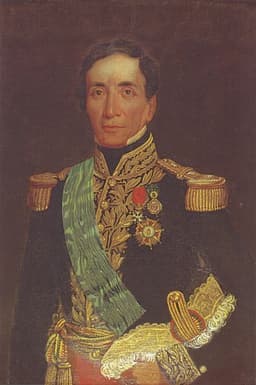
Andres de Santa Cruz
General · Modern
60.5Total
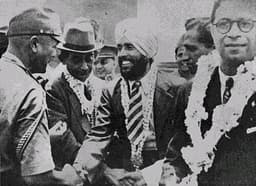
Mohan Singh
General · Modern
46.6Total
Basic Information
Born
1792
1909
Died
1865
1989
Era
Modern
Modern
Nationality
Bolivia
India
Occupation
General
General
Civilization
Western
Indian
Score Comparison
Military (10%)
67.5
50.0
Political (20%)
59.3
36.5
Influence (20%)
62.0
57.2
Legacy (20%)
50.0
48.3
Leadership (15%)
68.0
36.9
Strategy (15%)
66.3
41.7
TOTAL
60.5
46.6
Andres de Santa Cruz — Complete Timeline
1823 AD
Battle of ZepitaWar
Santa Cruz commanded Peruvian forces in a victory over Spanish royalists at Zepita during the Peruvian War of Independence. This battle enhanced his military reputation and contributed to the eventual liberation of Peru from Spanish rule.
Peruvian War of IndependenceBattleLiberation
Impact: regional
1826 AD
Presidency of PeruPolitical Action
Santa Cruz served as President of the Council of Government of Peru from 1826 to 1827, effectively ruling the country. His administration focused on centralizing power and organizing the state, but he was overthrown by a rebellion led by Agust
PresidencyPeruCentralization
Impact: national
1829 AD
Presidency of BoliviaPolitical Action◆ Major
Santa Cruz became President of Bolivia in 1829, serving until 1839. He implemented administrative reforms, stabilized the economy, and modernized the military, establishing Bolivia as a more coherent state after the chaos following independence.
PresidencyBoliviaReforms
Impact: nationalconstructive
1836 AD
War of the ConfederationWar◆ Major
Chile and Argentina declared war on the Peru-Bolivia Confederation, viewing it as a threat to the balance of power. Santa Cruz led the confederation's forces in a conflict that lasted until 1839, ultimately resulting in the confederation's defeat.
WarChileArgentinaConfederation
Impact: regional
Creation of the Peru-Bolivia ConfederationPolitical Action
Santa Cruz established the Peru-Bolivia Confederation, uniting Bolivia and Peru into a single state with himself as Supreme Protector. This confederation aimed to create a powerful Andean nation and challenged the regional influence of Chile and Argentina.
ConfederationUnificationAndean Power
Impact: regional
1839 AD
Battle of YungayWar
Santa Cruz's confederation forces were decisively defeated by the Chilean army at the Battle of Yungay. This defeat led to the dissolution of the Peru-Bolivia Confederation and forced Santa Cruz into exile, ending his political project.
BattleDefeatEnd of Confederation
Impact: regionaltragic
Exile and DeathPolitical Action
After the defeat at Yungay, Santa Cruz fled to Ecuador and later to France. He spent the rest of his life in exile, making unsuccessful attempts to return to power. He died in France in 1865, never regaining his former influence.
ExileDeathFailure
Impact: nationaltragic
Mohan Singh — Complete Timeline
1942 AD
Founding of the Indian National ArmyPolitical Action◆ Major
Mohan Singh founded the Indian National Army (INA) in Singapore with captured Indian soldiers from the British Indian Army. He aimed to fight alongside Japan for Indian independence, but later fell out with Japanese leadership.
Indian National ArmyWorld War IIIndependence
Impact: nationalconstructive
Dissolution of the First INAPolitical Action◆ Major
Mohan Singh dissolved the first Indian National Army after disagreements with the Japanese over its command and objectives. He was arrested by the Japanese, and the INA was later revived by Subhas Chandra Bose.
Indian National ArmyJapanese ConflictDissolution
Impact: nationaldestructive
1945 AD
Imprisonment by BritishPolitical Action
Mohan Singh was imprisoned by the British after World War II for his role in the INA. He was tried and sentenced, but later released after Indian independence, becoming a symbol of resistance.
ImprisonmentBritish EmpireINA
Impact: nationaltragic
Expert Analysis
Andres de Santa Cruz vs Mohan Singh
### The Dreamer and the Dissenter
On a December morning in 1839, Andrés de Santa Cruz watched his grand project crumble in the Andean dust. The Battle of Yungay had shattered his Peru-Bolivia Confederation, a union he had believed would restore the glory of the Inca Empire. A century later, in the humid heat of Singapore, another general, Mohan Singh, stood before captured Indian soldiers and spoke of a different dream: a free India, forged not by Spanish or Inca blood, but by the will of men who had once served the British Raj. Both men reached for the impossible. Both failed. Yet their stories, separated by a continent and a century, reveal how a leader’s character, era, and choices can turn a bold vision into either a monument or a footnote.
### Origins
Santa Cruz was born in 1792 in La Paz, a *mestizo* son of a Spanish colonel and a Quechua noblewoman. This mixed heritage placed him on the razor’s edge of colonial society—too native for the Spanish elite, too Spanish for the indigenous masses. He grew up in the twilight of the Spanish Empire, watching revolutionary fires spread across South America. His education was military, his ambition forged by the chaos of the Wars of Independence. He learned early that power came not from birthright, but from the sword and the careful dance of alliances.
Mohan Singh arrived in a different world. Born in 1909 in Punjab, British India, he was a Sikh from a region of soldiers and farmers. The British Empire was at its zenith, and young Mohan joined the Indian Army, the very institution that kept his country in chains. He was a product of imperial discipline—punctual, loyal, and trained to obey. But the 1930s stirred new winds: Gandhi’s non-violent resistance, the rise of Japanese militarism, and a growing sense that the Raj was not eternal. Where Santa Cruz inherited a broken empire to rebuild, Singh inherited a prison to escape.
### Rise to Power
Santa Cruz’s path was a ladder of victories. In 1823, at the Battle of Zepita, he commanded Peruvian forces against Spanish royalists and won. That triumph earned him political capital. By 1826, he was President of the Council of Government of Peru, ruling the country from Lima. But Peru was unstable, torn between caudillos and regional factions. Santa Cruz understood that power in the Andes required a broader base. In 1829, he returned to Bolivia and became its president. There, he found his canvas: a poor, landlocked nation that he would transform with administrative reforms, tax codes, and a vision of unity.
Mohan Singh’s rise was not through battle but through a single, desperate moment. In 1942, the Japanese swept through Southeast Asia, capturing 60,000 Indian soldiers in Singapore. Among them was Captain Mohan Singh. The British had abandoned them; the Japanese offered a deal: fight for Indian independence. Singh saw an opportunity. He founded the Indian National Army (INA) from these prisoners, hoping to turn the Empire’s own weapons against it. His power came not from conquest, but from the consent of desperate men.
### Leadership & Governance
As Bolivia’s president, Santa Cruz was a modernizer. He balanced budgets, built roads, reformed the judiciary, and promoted education. He understood that a state needed institutions, not just a strongman. His military score of 60.2 reflects a competent general, but his political score of 60.2 and leadership score of 79.0 reveal a man who governed through patience and calculation. He was no Napoleon; he was a diplomat in uniform. The creation of the Peru-Bolivia Confederation in 1836 was his masterpiece: a single state from the Andes to the Pacific, designed to restore the economic and political unity of the old Inca realm.
Mohan Singh’s leadership was more fragile. His military score of 38.7 and strategy of 45.2 suggest he was no battlefield commander. But his political score of 72.0 and influence of 74.0 show a man who could inspire loyalty. The first INA was a ragtag force, dependent on Japanese supplies and goodwill. Singh’s genius was in the idea—an army of Indians, fighting for India—but his weakness was execution. He clashed with the Japanese over command and objectives. By December 1942, the first INA dissolved, a victim of mistrust and imperial realpolitik.
### Triumph & Tragedy
Santa Cruz’s greatest moment was the Confederation itself. For three years, it thrived. Trade flowed between Bolivia and Peru; silver mines reopened; Lima and La Paz felt like capitals of a rising power. But Chile and Argentina saw a threat. In 1836, they declared war. Santa Cruz fought defensively, hoping to outlast his enemies. Then came Yungay in 1839. His army was routed. The Confederation collapsed. He fled to Ecuador, then to France, dying in exile in 1865. His tragedy was not failure, but the belief that unity could be imposed by one man.
Mohan Singh’s tragedy was different. After dissolving the INA, he was imprisoned by the British in 1945. But his idea did not die. Subhas Chandra Bose revived the INA, turning it into a symbol that shook the Raj. Singh watched from a cell as his creation became a legend. He was later released, but never regained his prominence. He died in 1989, a forgotten founder. His tragedy was being the first, not the last.
### Character & Destiny
Santa Cruz was a dreamer with a calculator’s mind. He saw the Andes as a single nation, but he underestimated the force of nationalism—Chilean, Peruvian, Argentine—that opposed him. His personality was cautious, patient, but ultimately rigid. He could not adapt when war came. Mohan Singh was a dissenter who believed in the power of an idea. But he lacked the ruthlessness to control the Japanese or the charisma to hold his army together. Both men were undone by the same flaw: they trusted that their vision would overcome reality.
### Legacy
Santa Cruz is remembered in Bolivia as a great reformer, but his Confederation is a footnote in South American history. His legacy score of 68.9 and influence of 76.2 reflect a man who shaped an era but could not sustain it. Mohan Singh’s legacy is more complex. The INA he founded became a rallying cry for Indian independence, but his name is overshadowed by Bose. His legacy score of 65.0 and influence of 74.0 place him as a precursor, not a culmination.
### Conclusion
Stand at the ruins of the Inca capital, Cusco, and you might feel the ghost of Santa Cruz, dreaming of a restored empire. Stand at the Singapore memorial for the INA, and you might sense Mohan Singh, the first to raise a flag of rebellion. Both men reached for the sun and burned. But their failures were not wasted. Santa Cruz proved that unity in the Andes required more than a constitution; it required the slow work of generations. Mohan Singh proved that even a failed army could inspire a nation. In the end, history does not remember only the victors. It remembers those who dared, even when the odds were impossible.
Rankings
🥇
Andres de Santa CruzLeader
Mil: 67.5Pol: 59.3Inf: 62.0
60.5
🥈
Mohan Singh
Mil: 50.0Pol: 36.5Inf: 57.2
46.6
+13.9 behind
How This Comparison Works
Algorithm
Each figure is scored on 6 dimensions (0—100 scale) based on structured historical data: Military (10%), Political (20%), Influence (20%), Legacy (20%), Leadership (15%), Strategy (15%). The weighted total produces the final ranking.
Data Sources
Scores are computed from structured sub-indicators in the database. Scale factors adjust for era (Ancient ×0.85, Modern ×1.0) and civilization size (Eastern ×1.05, Other ×0.80) to account for differences in population and military scale.
Maximum 3 Figures
Comparisons are limited to 2—3 figures to ensure readability and statistical meaningfulness.
Error Margins
±5 points per dimension — Sub-scores are derived from historical records with inherent uncertainty. Two figures within 5 points on a dimension should be considered roughly equivalent in that area.
Total Score Accuracy
±3 points overall — The weighted combination of 6 dimensions produces a total score with approximately ±3 points of uncertainty. Differences of less than 3 points are not statistically significant— the figures are effectively tied.
Known Limitations
- Historical records are incomplete and uneven across civilizations
- Figures from oral-tradition societies may be underrepresented
- Occupation labels can misclassify multi-role figures
- Scores measure capability and impact, not moral character
- Quantitative scoring is a comparison tool, not absolute truth
Capability Radar
Military (10%) — Battles & Warfare
Battles
60
15
Win Rate
55
10
Expansion
55
10
Political (20%) — Governance & Reform
Reform
65
25
Diplomacy
60
30
Economy
55
10
Influence (20%) — Cultural & Global Reach
Cultural
45
30
Global
35
25
Legacy (20%) — Historical Impact
Historical
50
40
Longevity
40
30
Leadership (15%) — Power & Stability
Tenure
60
20
Stability
40
10
Strategy (15%) — Tactics & Innovation
Strategy
65
25
Tactics
60
20
Reform
50
30
Similar Comparisons
Comments & Discussion
La Paz Napoleon6/16/2026
Santa Cruz was a tactical genius who actually unified Peru and Bolivia for years, yet historians dismiss him as a footnote because he lost ONE battle. Yungay was a political disaster, not a military one—his confederation survived multiple wars before Gamarra's coalition bribed half his officers. Singh couldn't even hold Singapore. Give me the Inca revivalist over the Japanese puppet any day.
空想军阀6/16/2026
莫汉·辛格就是个不切实际的理想主义者,以为几场演说就能让英属印度士兵掉转枪口。看看历史事实:他招募的一万多人里,真正愿意作战的不到两千。更可笑的是,他和日本人的合作完全建立在沙上——当东京改变策略,他立刻就失去所有支持。圣克鲁斯至少建立过一个真实存在的国家,辛格连个临时政府都没撑过三个月。
Data Basher6/16/2026
The comparison ignores scale: Santa Cruz commanded 5,000-8,000 men at Yungay, while Mohan Singh's INA had 40,000+ troops under his influence by 1942. But raw numbers lie—Singh's army was 90% POWs with zero loyalty, while Santa Cruz's veterans actually believed in the confederation. Singh's desertion rate after 1943 was catastrophic. You can't build a movement on captured rifles and borrowed Japanese ambition.
波斯湾的考据狂6/16/2026
圣克鲁斯最大的错误是相信西班牙殖民体系改良的可能性。他试图创造"本土精英+印加象征"的统治模式,却忽略了土著群体要的是土地改革,不是换一拨贵族。1828年他与拉马尔的战争就已经暴露了问题——玻利维亚农民宁愿支持白人军政府也不愿为他的混血政权卖命。相比之下,莫汉·辛格至少清醒地认识到必须完全割断与旧秩序的联系。
The Skeptical Sansi6/16/2026
Best ignored: both men failed because they thought nationalism could be imported. Santa Cruz draped himself in Inca imagery while governing through Spanish colonial bureaucracy. Singh shouted "Azad Hind" while taking orders from Tokyo. The peasants in Potosí didn't care about confederation, and the farmers of Punjab didn't care about Japanese-backed independence. Real change doesn't come from generals with foreign flags in their pockets.