Loading...
Andres de Santa Cruz vs Napoleon Bonaparte
Napoleon Bonaparte leads by 10.4 pts · 2 figures compared
…
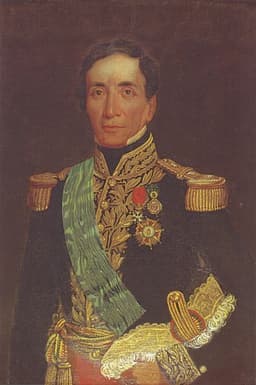
Andres de Santa Cruz
General · Modern
60.5Total

Napoleon Bonaparte
General · Modern
70.9Total
Basic Information
Born
1792
1769
Died
1865
1821
Era
Modern
Modern
Nationality
Bolivia
France
Occupation
General
General
Civilization
Western
Western
Score Comparison
Military (10%)
67.5
94.0
Political (20%)
59.3
72.0
Influence (20%)
62.0
40.0
Legacy (20%)
50.0
80.0
Leadership (15%)
68.0
78.0
Strategy (15%)
66.3
90.0
TOTAL
60.5
70.9
Andres de Santa Cruz — Complete Timeline
1823 AD
Battle of ZepitaWar
Santa Cruz commanded Peruvian forces in a victory over Spanish royalists at Zepita during the Peruvian War of Independence. This battle enhanced his military reputation and contributed to the eventual liberation of Peru from Spanish rule.
Peruvian War of IndependenceBattleLiberation
Impact: regional
1826 AD
Presidency of PeruPolitical Action
Santa Cruz served as President of the Council of Government of Peru from 1826 to 1827, effectively ruling the country. His administration focused on centralizing power and organizing the state, but he was overthrown by a rebellion led by Agust
PresidencyPeruCentralization
Impact: national
1829 AD
Presidency of BoliviaPolitical Action◆ Major
Santa Cruz became President of Bolivia in 1829, serving until 1839. He implemented administrative reforms, stabilized the economy, and modernized the military, establishing Bolivia as a more coherent state after the chaos following independence.
PresidencyBoliviaReforms
Impact: nationalconstructive
1836 AD
War of the ConfederationWar◆ Major
Chile and Argentina declared war on the Peru-Bolivia Confederation, viewing it as a threat to the balance of power. Santa Cruz led the confederation's forces in a conflict that lasted until 1839, ultimately resulting in the confederation's defeat.
WarChileArgentinaConfederation
Impact: regional
Creation of the Peru-Bolivia ConfederationPolitical Action
Santa Cruz established the Peru-Bolivia Confederation, uniting Bolivia and Peru into a single state with himself as Supreme Protector. This confederation aimed to create a powerful Andean nation and challenged the regional influence of Chile and Argentina.
ConfederationUnificationAndean Power
Impact: regional
1839 AD
Battle of YungayWar
Santa Cruz's confederation forces were decisively defeated by the Chilean army at the Battle of Yungay. This defeat led to the dissolution of the Peru-Bolivia Confederation and forced Santa Cruz into exile, ending his political project.
BattleDefeatEnd of Confederation
Impact: regionaltragic
Exile and DeathPolitical Action
After the defeat at Yungay, Santa Cruz fled to Ecuador and later to France. He spent the rest of his life in exile, making unsuccessful attempts to return to power. He died in France in 1865, never regaining his former influence.
ExileDeathFailure
Impact: nationaltragic
Napoleon Bonaparte — Complete Timeline
1799 AD
Coup of 18 BrumaireOther◆ Major
Napoleon Bonaparte, with support from his brother Lucien and key political figures, overthrew the Directory in a bloodless coup. He established the Consulate with himself as First Consul, effectively becoming the ruler of France. This event ended the French Revolution's most unstable period.
French RevolutionCoupRise to Power
Impact: regional
1804 AD
Promulgation of the Napoleonic CodeOther◆ Major
Napoleon enacted the Civil Code of the French, known as the Napoleonic Code, a comprehensive set of laws that replaced the fragmented feudal legal systems. The code established legal equality, protected property rights, and secularized law. It became the basis for legal systems in many European and world countries.
Legal ReformNapoleonic CodeCivil Law
Impact: globalconstructive
1805 AD
Battle of AusterlitzWar◆ Major
Napoleon's Grande Arm
Napoleonic WarsBattleDecisive Victory
Impact: global
1812 AD
Invasion of RussiaWar◆ Major
Napoleon led the Grande Arm
Napoleonic WarsInvasionDisaster
Impact: globaldestructive
1815 AD
Battle of WaterlooWar◆ Major
Napoleon's French army was defeated by the combined forces of the Duke of Wellington's Anglo-Allied army and Gebhard Leberecht von Bl
Napoleonic WarsBattleFinal Defeat
Impact: globaldestructive
Expert Analysis
andres-de-santa-cruz-vs-napoleon-bonaparte
# The Emperor and the Confederationist
In the winter of 1839, two men faced very different ends. One, Napoleon Bonaparte, had died eighteen years earlier on a remote island in the South Atlantic, a prisoner of the British after his final gamble at Waterloo had failed. The other, Andrés de Santa Cruz, stood on a muddy battlefield in Peru, watching his dream of a unified Andean state shatter under Chilean artillery at Yungay. Both were generals who redrew maps. Both believed in the power of a single will to shape nations. But while one man’s name became synonymous with ambition and genius, the other’s faded into a footnote, remembered only in the highlands he tried to unite. Why did one conquer an empire and the other lose a confederation? The answer lies not merely in talent, but in the soil from which they grew.
Origins
Napoleon Bonaparte was born in 1769 on Corsica, an island that had only become French the year before. He grew up speaking Italian, resentful of French authority, and fiercely proud of his marginal origins. This outsider’s hunger drove him: he had to prove himself in a world that did not owe him a place. France in the 1780s was a powder keg of revolution, offering unprecedented opportunity for a young artillery officer of modest nobility. The old order was dying, and Napoleon seized its corpse.
Andrés de Santa Cruz, born in 1792 in La Paz, Bolivia, was the son of a Spanish colonial administrator and a Quechua noblewoman. He straddled two worlds: the Spanish bureaucracy and the indigenous aristocracy that had once ruled the Inca Empire. Bolivia in the early 1800s was a colony in convulsion, torn between royalist loyalty and revolutionary fervor. Santa Cruz learned early that survival meant navigating contradictions—a skill that would both serve and betray him.
The difference in their eras was profound. Napoleon rose amid the chaos of a revolution that had already shattered the old regime; he needed only to impose order. Santa Cruz rose amid wars of independence that left no stable foundation; he had to build a nation where none had existed.
Rise to Power
Napoleon’s ascent was meteoric. At age 24, he drove the British from Toulon in 1793, earning promotion to brigadier general. By 1796, he commanded the Army of Italy, where his lightning campaigns humiliated the Austrians. The Directory, France’s corrupt ruling body, saw him as both a savior and a threat. In 1799, he staged the coup of 18 Brumaire, making himself First Consul. He was 30 years old. His path was a straight line of ambition, violence, and luck.
Santa Cruz’s rise was more circuitous. He fought for Spain against the Argentine rebels in 1811, then switched sides in 1820 to join the independence cause. At the Battle of Zepita in 1823, he defeated Spanish royalists, but the victory was ambiguous—Peruvian forces soon fractured. He became President of Peru in 1826, but only briefly; he was overthrown and exiled. In 1829, he returned to become President of Bolivia, where he finally found a base. His path was a zigzag of shifting allegiances, a man trying to find a moment that would hold still.
Leadership & Governance
Napoleon ruled with an iron clarity. He centralized France, created the Napoleonic Code—a legal framework that still shapes Europe—and reformed education, finance, and administration. His military genius was unmatched: at Austerlitz in 1805, he destroyed a Russian-Austrian army with a feint that remains a textbook maneuver. He governed through charisma, fear, and a relentless drive for efficiency. He was a modernizer who believed that the state was an extension of his will.
Santa Cruz governed differently. In Bolivia, he stabilized the economy, reformed taxes, and built roads and schools. He respected indigenous communities, integrating them into his administration—a rare gesture in a continent ruled by creole elites. In 1836, he created the Peru-Bolivia Confederation, uniting two nations under a single federal system. He was not a conqueror but a builder, trying to forge unity from diversity. His military record was competent but not brilliant: his strategy score of 59.3, compared to Napoleon’s 93, reflects a man who won battles but never mastered war.
Napoleon’s political score of 75.0 reflects his ultimate failure: he could conquer but not consolidate. Santa Cruz’s political score of 60.2 shows a man who could administer but not inspire. Both were limited, but in opposite directions.
Triumph & Tragedy
Napoleon’s greatest moment was Austerlitz in 1805, where he crushed the Third Coalition and crowned himself master of Europe. His worst was the invasion of Russia in 1812, a catastrophic miscalculation that cost half a million men. He was exiled to Elba in 1814, returned in 1815, and was finally defeated at Waterloo. His tragedy was hubris: he could not stop, could not compromise, could not accept that even genius has limits.
Santa Cruz’s triumph was the Confederation itself—a peaceful union achieved through diplomacy and patience. His tragedy was the War of the Confederation (1836-1839), when Chile and Argentina attacked, fearing a powerful neighbor. At the Battle of Yungay in 1839, his forces were routed. He fled to Ecuador, then to France, where he died in 1865, still dreaming of return. His tragedy was that his vision was too fragile for a world of jealous rivals.
Character & Destiny
Napoleon was restless, arrogant, and utterly convinced of his own destiny. He once said, “Impossible is a word to be found only in the dictionary of fools.” This confidence made him unstoppable—and doomed him. He could not delegate, could not share power, could not accept defeat. His personality was a force of nature, but nature is indifferent to survival.
Santa Cruz was patient, pragmatic, and cautious. He sought balance, not glory. He was a man of the middle, trying to hold together what history was tearing apart. His mixed heritage gave him insight but also isolation: he was never fully trusted by either the Spanish or the indigenous. He lacked Napoleon’s charisma, but also his recklessness. He was a survivor, not a conqueror—and survival, in the end, is less remembered.
Legacy
Napoleon’s legacy is global. The Napoleonic Code, the metric system, the modern concept of meritocracy—all bear his imprint. He is remembered as a military genius, a tyrant, a liberator, a cautionary tale. His name is a shorthand for ambition.
Santa Cruz’s legacy is regional. In Bolivia and Peru, he is honored as a unifier and reformer, but his confederation is a footnote. His influence score of 76.2 is respectable, but his total score of 67.8 places him far below Napoleon’s 82.4. He is studied by historians, not celebrated by the world.
Conclusion
Standing at the edge of the Pacific, the waves that carried Napoleon to St. Helena also carried Santa Cruz to exile. Both men tried to remake the world in their image. One succeeded so completely that his failure became a legend. The other failed so quietly that his success is almost forgotten. The difference was not talent—it was timing, luck, and the brutal arithmetic of power. Napoleon had a continent to conquer; Santa Cruz had a highland to hold. History writes its epics on the largest canvases, but it is the smaller, quieter dreams that often teach us more about the cost of ambition.
Rankings
🥇
Napoleon BonaparteLeader
Mil: 94.0Pol: 72.0Inf: 40.0
70.9
🥈
Andres de Santa Cruz
Mil: 67.5Pol: 59.3Inf: 62.0
60.5
+10.4 behind
How This Comparison Works
Algorithm
Each figure is scored on 6 dimensions (0—100 scale) based on structured historical data: Military (10%), Political (20%), Influence (20%), Legacy (20%), Leadership (15%), Strategy (15%). The weighted total produces the final ranking.
Data Sources
Scores are computed from structured sub-indicators in the database. Scale factors adjust for era (Ancient ×0.85, Modern ×1.0) and civilization size (Eastern ×1.05, Other ×0.80) to account for differences in population and military scale.
Maximum 3 Figures
Comparisons are limited to 2—3 figures to ensure readability and statistical meaningfulness.
Error Margins
±5 points per dimension — Sub-scores are derived from historical records with inherent uncertainty. Two figures within 5 points on a dimension should be considered roughly equivalent in that area.
Total Score Accuracy
±3 points overall — The weighted combination of 6 dimensions produces a total score with approximately ±3 points of uncertainty. Differences of less than 3 points are not statistically significant— the figures are effectively tied.
Known Limitations
- Historical records are incomplete and uneven across civilizations
- Figures from oral-tradition societies may be underrepresented
- Occupation labels can misclassify multi-role figures
- Scores measure capability and impact, not moral character
- Quantitative scoring is a comparison tool, not absolute truth
Capability Radar
Military (10%) — Battles & Warfare
Battles
60
95
Win Rate
55
90
Expansion
55
95
Political (20%) — Governance & Reform
Reform
65
95
Diplomacy
60
80
Economy
55
85
Influence (20%) — Cultural & Global Reach
Cultural
45
85
Global
35
90
Legacy (20%) — Historical Impact
Historical
50
95
Longevity
40
90
Leadership (15%) — Power & Stability
Tenure
60
85
Stability
40
70
Strategy (15%) — Tactics & Innovation
Strategy
65
95
Tactics
60
98
Reform
50
92
Similar Comparisons
Comments & Discussion
CORSICAN THUNDER6/17/2026
Napoleon didn’t just win battles—he wrote the rulebook modern generals still crib from. Waterloo wasn’t his fault; it was Grouchy’s. Santa Cruz? He lost Yungay because he couldn’t coordinate his forces across the Andes. Napoleon crushed Austria at Austerlitz with a single decisive stroke. Santa Cruz’s Peru-Bolivia Confederation was a fragile patchwork, not an empire. One man built a system; the other just borrowed one.
高原雪豹6/17/2026
拿破仑是欧洲火药桶里炸出的彗星,而圣克鲁斯是安第斯山脉上的土皇帝。说真的,圣克鲁斯连玻利维亚都没统一过,他的“联邦”是西班牙殖民残余和原住民贵族的缝合怪。拿破仑在耶拿战役里十分钟击溃普鲁士军队,圣克鲁斯却让智利人用火炮轰碎了他的梦。别拿战术天才和边疆政客比,立场摆这儿了。
NUMBERS GUY6/17/2026
Look at the raw facts: Napoleon commanded over 600,000 men for the 1812 Russian campaign and still lost. Santa Cruz never had more than 15,000 troops at peak. You can’t compare a continent-sweeping emperor to a regional confederation leader. Napoleon’s total battles: over 60, won 50-something. Santa Cruz: maybe 12 battles, half losses. Bigger stage, bigger stakes, bigger failures. Napoleon’s ambition was global; Santa Cruz’s was just local.
秘鲁的灰烬6/17/2026
圣克鲁斯是个被低估的悲剧英雄。他试图恢复印加文明的联邦理想,却输给了欧洲来的智利海军。拿破仑踩着小国尸骨上位,圣克鲁斯却想用外交和制度整合安第斯。卡塔赫纳之战后,拿破仑流放自己;圣克鲁斯在战败后却继续流亡,活到1877年。谁更坚韧?拿破仑的荣耀是血铸的,圣克鲁斯的失败是地理的诅咒。别只因赢家写历史就吹拿破仑。
CLASSICS SCHOLAR6/17/2026
Napoleon read Caesar’s Commentaries and Plutarch like scripture—he copied their ambition and their fall. Santa Cruz read indigenous governance and Spanish bureaucracy; his model was the Inca’s mit’a system, not Alexandrian conquest. Napoleon’s Corsican rage drove him across Europe; Santa Cruz’s Quechua heritage made him seek unity, not domination. Compare apples and oranges: one wanted to be Rome, the other wanted to rebuild Tawantinsuyu. Different maps, different legacies.