Loading...
This comparison has not been analyzed yet.
One-time AI generation (~1 minute). Scores and timeline are already available below.
Antonio Carlos Ribeiro de Andrada vs Franklin Pierce
Antonio Carlos Ribeiro de Andrada leads by 7.1 pts · 2 figures compared
…
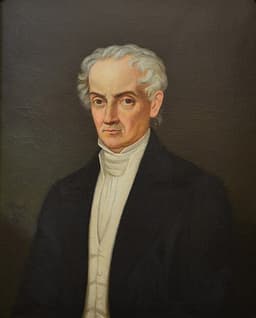
Antonio Carlos Ribeiro de Andrada
Politician · Modern
53.3Total

Franklin Pierce
Politician · Modern
46.2Total
Basic Information
Born
1870
1804
Died
1946
1869
Era
Modern
Modern
Nationality
Brazil
United States
Occupation
Politician
Politician
Civilization
Western
Western
Score Comparison
Military (10%)
49.9
50.0
Political (20%)
68.0
30.8
Influence (20%)
55.7
48.6
Legacy (20%)
48.3
41.7
Leadership (15%)
53.2
65.7
Strategy (15%)
41.6
41.6
TOTAL
53.3
46.2
Antonio Carlos Ribeiro de Andrada — Complete Timeline
1926 AD
President of Minas GeraisPolitical Action◆ Major
Antonio Carlos was elected President of the state of Minas Gerais. He implemented administrative reforms, modernized the state's finances, and built a strong political base that would be crucial in the 1930 Revolution.
State GovernmentMinas GeraisReform
Impact: regionalconstructive
1929 AD
Led the Liberal AlliancePolitical Action
Antonio Carlos, as President of Minas Gerais, led the formation of the Liberal Alliance, a political coalition that opposed the S
Political Alliance1930 RevolutionVargas
Impact: nationalconstructive
1930 AD
Supported the 1930 RevolutionPolitical Action
Antonio Carlos was a key strategist of the 1930 Revolution. He coordinated the political and military uprising that overthrew President Washington Lu
RevolutionCoupEnd of Republic
Impact: national
1933 AD
Elected to the Constituent AssemblyPolitical Action◆ Major
Antonio Carlos was elected to the Constituent Assembly that drafted the 1934 Constitution. He played a leading role in the assembly, advocating for federalism and civil liberties, though his influence waned under the subsequent Estado Novo.
ConstitutionConstituent AssemblyPolitics
Impact: nationalconstructive
Franklin Pierce — Complete Timeline
1852 AD
Elected President of the United StatesPolitical Action◆ Major
Pierce won the 1852 presidential election as a dark horse Democratic candidate, defeating Whig Winfield Scott. He carried all but four states, benefiting from the Whig Party's collapse.
PresidencyElectionDemocratic Party
Impact: national
1853 AD
Gadsden PurchasePolitical Action
Pierce authorized the Gadsden Purchase, acquiring 29,670 square miles from Mexico for $10 million. The land in present-day Arizona and New Mexico was intended for a southern transcontinental railroad route.
Territorial ExpansionGadsden PurchaseRailroad
Impact: regional
1854 AD
Signed the Kansas-Nebraska ActPolitical Action◆ Major
Pierce signed the Kansas-Nebraska Act, which repealed the Missouri Compromise and allowed popular sovereignty on slavery in Kansas and Nebraska. This led to violent conflict in 'Bleeding Kansas'.
Kansas-Nebraska ActSlaveryBleeding Kansas
Impact: nationaldestructive
Ostend ManifestoPolitical Action
Pierce's administration supported the Ostend Manifesto, a secret document advocating U.S. acquisition of Cuba by force if Spain refused to sell. The leak caused a diplomatic scandal and damaged Pierce's reputation.
CubaImperialismScandal
Impact: nationaldestructive
1856 AD
Lost 1856 Democratic NominationPolitical Action◆ Major
Pierce sought the Democratic nomination for a second term but was defeated by James Buchanan. His support for the Kansas-Nebraska Act and the resulting violence made him unelectable.
ElectionDemocratic PartyKansas-Nebraska Act
Impact: nationaltragic
This comparison has not been analyzed yet.
One-time AI generation (~1 minute). Scores and timeline are already available below.
Rankings
🥇
Antonio Carlos Ribeiro de AndradaLeader
Mil: 49.9Pol: 68.0Inf: 55.7
53.3
🥈
Franklin Pierce
Mil: 50.0Pol: 30.8Inf: 48.6
46.2
+7.1 behind
How This Comparison Works
Algorithm
Each figure is scored on 6 dimensions (0—100 scale) based on structured historical data: Military (10%), Political (20%), Influence (20%), Legacy (20%), Leadership (15%), Strategy (15%). The weighted total produces the final ranking.
Data Sources
Scores are computed from structured sub-indicators in the database. Scale factors adjust for era (Ancient ×0.85, Modern ×1.0) and civilization size (Eastern ×1.05, Other ×0.80) to account for differences in population and military scale.
Maximum 3 Figures
Comparisons are limited to 2—3 figures to ensure readability and statistical meaningfulness.
Error Margins
±5 points per dimension — Sub-scores are derived from historical records with inherent uncertainty. Two figures within 5 points on a dimension should be considered roughly equivalent in that area.
Total Score Accuracy
±3 points overall — The weighted combination of 6 dimensions produces a total score with approximately ±3 points of uncertainty. Differences of less than 3 points are not statistically significant— the figures are effectively tied.
Known Limitations
- Historical records are incomplete and uneven across civilizations
- Figures from oral-tradition societies may be underrepresented
- Occupation labels can misclassify multi-role figures
- Scores measure capability and impact, not moral character
- Quantitative scoring is a comparison tool, not absolute truth
Capability Radar
Military (10%) — Battles & Warfare
Battles
28
28
Win Rate
34
32
Expansion
34
33
Political (20%) — Governance & Reform
Reform
60
10
Diplomacy
65
20
Economy
40
15
Influence (20%) — Cultural & Global Reach
Cultural
30
10
Global
35
10
Legacy (20%) — Historical Impact
Historical
50
30
Longevity
40
20
Leadership (15%) — Power & Stability
Tenure
55
60
Stability
45
5
Strategy (15%) — Tactics & Innovation
Strategy
35
39
Tactics
42
40
Reform
43
41
Similar Comparisons
Comments & Discussion
No comments yet. Be the first to share your thoughts!