Loading...
Antonio Lopez de Santa Anna vs Tadeusz Kosciuszko
Tadeusz Kosciuszko leads by 5.2 pts · 2 figures compared
…
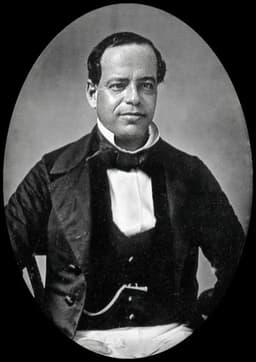
Antonio Lopez de Santa Anna
General · Modern
58.9Total
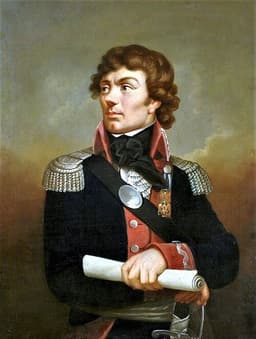
Tadeusz Kosciuszko
General · Modern
64.1Total
Basic Information
Born
1794
1746
Died
1876
1817
Era
Modern
Modern
Nationality
Mexico
Poland
Occupation
General
General
Civilization
Western
Western
Score Comparison
Military (10%)
70.0
47.5
Political (20%)
46.6
68.0
Influence (20%)
56.7
68.0
Legacy (20%)
58.0
68.0
Leadership (15%)
68.0
64.5
Strategy (15%)
60.0
55.0
TOTAL
58.9
64.1
Antonio Lopez de Santa Anna — Complete Timeline
1823 AD
Led the Plan of Casa Mata rebellionPolitical Action
Santa Anna, then a general, issued the Plan of Casa Mata on February 1, 1823, calling for the overthrow of Emperor Agust
RebellionOverthrowRepublic
Impact: nationalconstructive
1829 AD
Defended Mexico at the Battle of TampicoWar◆ Major
Santa Anna commanded Mexican forces that defeated a Spanish invasion force at Tampico on September 11, 1829. The victory ended Spain's last attempt to reconquer Mexico and made Santa Anna a national hero. He was hailed as the 'Hero of Tampico' and used this fame to advance politically.
VictorySpanish InvasionNational Hero
Impact: nationalconstructive
1833 AD
Became President of Mexico for the first timePolitical Action◆ Major
Santa Anna was elected President of Mexico in 1833. He quickly delegated power to Vice President Valent
PresidencyPolitical InstabilityPower
Impact: national
1836 AD
Commanded at the Siege of the AlamoWar◆ Major
Santa Anna personally led the Mexican army in the siege of the Alamo mission in San Antonio, Texas. After a 13-day siege, Mexican forces stormed the fort on March 6, 1836, killing all 180-250 Texan defenders. The battle became a symbol of Texan resistance and a rallying cry for independence.
BattleTexas RevolutionAlamo
Impact: regionaldestructive
Defeated and captured at the Battle of San JacintoWar
Santa Anna's army was surprised and routed by Texan forces under Sam Houston at the Battle of San Jacinto on April 21, 1836. Santa Anna was captured the next day. He was forced to sign the Treaties of Velasco, recognizing Texan independence, though Mexico later repudiated them.
DefeatCaptureTexas Independence
Impact: regionaltragic
1847 AD
Lost the Mexican-American WarWar
Santa Anna returned from exile to command Mexican forces during the Mexican-American War. Despite initial efforts, his army was defeated at the Battle of Cerro Gordo and later at the Battle of Chapultepec. US forces captured Mexico City on September 14, 1847, leading to the Treaty of Guadalupe Hidalgo and massive territorial losses.
Mexican-American WarDefeatTerritorial Loss
Impact: globaltragic
1853 AD
Sold La Mesilla to the United StatesPolitical Action◆ Major
During his final presidency, Santa Anna agreed to the Gadsden Purchase, selling 29,670 square miles of territory (La Mesilla) to the United States for $10 million. The sale was widely condemned in Mexico as a betrayal. This act further damaged his reputation and led to his overthrow.
Territorial CessionGadsden PurchaseBetrayal
Impact: nationaldestructive
1855 AD
Overthrown and exiled for the final timePolitical Action◆ Major
The Plan of Ayutla, led by Juan
OverthrowExileEnd of Career
Impact: nationaltragic
Tadeusz Kosciuszko — Complete Timeline
1777 AD
Battle of Saratoga (engineering contributions)War◆ Major
Kosciuszko designed fortifications and selected defensive positions for the American army at Saratoga. His work contributed to the American victory, a turning point in the Revolutionary War.
American RevolutionSaratogaEngineering
Impact: regional
1778 AD
Fortification of West PointWar◆ Major
Kosciuszko was assigned to fortify West Point on the Hudson River. He designed and supervised the construction of fortifications that made the site a key American stronghold for the remainder of the war.
American RevolutionWest PointFortifications
Impact: regionalconstructive
1794 AD
Kosciuszko UprisingWar
Kosciuszko led a national uprising in Poland against Russian and Prussian occupation. He proclaimed the Act of Insurrection and won the Battle of Rac
Polish UprisingIndependenceDefeat
Impact: nationaltragic
Battle of RacławiceWar◆ Major
Kosciuszko led Polish forces, including peasant scythemen, to victory over a larger Russian army at Rac
Kosciuszko UprisingBattlePeasants
Impact: national
Capture and imprisonment at the Battle of MaciejowiceWar◆ Major
Kosciuszko was wounded and captured by Russian forces at the Battle of Maciejowice. His capture effectively ended the uprising, and he was imprisoned in St. Petersburg until 1796.
Kosciuszko UprisingCaptureImprisonment
Impact: nationaltragic
Expert Analysis
Antonio Lopez de Santa Anna vs Tadeusz Kosciuszko
# The General and the Caudillo
On a spring morning in 1836, a Polish engineer who had once helped forge American independence lay dying in Switzerland, his revolutionary dreams buried under the snows of his defeated homeland. Half a world away, a Mexican general stood victorious among the smoking ruins of the Alamo, believing he had crushed a rebellion forever. Tadeusz Kosciuszko and Antonio Lopez de Santa Anna—two men who took up arms for their nations, two generals who shaped history across continents, yet whose names evoke opposite meanings: one synonymous with selfless sacrifice, the other with betrayal and loss. What made their paths diverge so sharply?
Origins
Kosciuszko was born in 1746 into the Polish-Lithuanian Commonwealth, a vast but crumbling republic where noble democracy had degenerated into chaos. His family belonged to the minor gentry—impoverished but proud, steeped in the chivalric ideals of honor and duty. When he left for Paris to study military engineering, he absorbed Enlightenment ideas about liberty and natural rights, returning to a Poland already being carved up by Russia, Prussia, and Austria. For Kosciuszko, the cause was always larger than himself: freedom, not power.
Santa Anna, born in 1794 in Veracruz, came of age in a very different world. Mexico was bleeding from a decade of war for independence, and the Spanish Empire was collapsing into a void where ambition filled every vacuum. His family was Spanish-born, of modest means, but young Antonio saw that in the chaos, a man with a sword and no scruples could rise. While Kosciuszko studied fortifications, Santa Anna studied power—how to seize it, how to hold it, how to cloak himself in the people's will while serving only himself.
Rise to Power
Kosciuszko's path to prominence came through service to a cause not his own. In 1776, he sailed for America, offering his engineering skills to the Continental Army. At the Battle of Saratoga in 1777, his fortifications turned a swampy battlefield into a death trap for the British. At West Point in 1778, he designed the fortress that would guard the Hudson for the rest of the war. He was a craftsman of victory, not a seeker of fame—and when the American Revolution succeeded, he returned to Poland with nothing but a pension and a reputation.
Santa Anna's rise followed the opposite logic. In 1823, he issued the Plan of Casa Mata, overthrowing Emperor Agustín de Iturbide with a stroke of political genius that made him kingmaker. By 1829, when he defeated a Spanish invasion at Tampico, he was hailed as the "Hero of Tampico," the savior of the nation. Yet each victory was a stepping stone to personal power, not national unity. He became president in 1833, then promptly abandoned the office to his vice president, only to reclaim it when the country descended into chaos—a pattern he would repeat eleven times.
Leadership & Governance
As a commander, Kosciuszko was a revolutionary in the truest sense. At the Battle of Racławice in 1794, he led peasant scythemen—men with no training, no guns, only their farming tools—to victory over a larger Russian army. He understood that the people's will could overcome any army, and he proved it. But his genius was engineering, not strategy; his military score of 79.2 reflects a man who could build a fortress but struggled to win a campaign. His political wisdom, however, was extraordinary: he proclaimed the Act of Insurrection, freeing serfs and promising land reform, knowing that only a nation of free citizens could fight for its own liberation.
Santa Anna was a different kind of leader entirely. His military score of 66.3 and strategy of 59.4 reveal a general who won through audacity and luck, not discipline. At the Alamo in 1836, he stormed the mission with overwhelming force, but his cruelty—executing prisoners—turned a tactical victory into a rallying cry for the enemy. At San Jacinto weeks later, he was caught napping while Sam Houston's men overran his camp. He escaped by disguising himself as a common soldier, then negotiated Texas's independence in exchange for his freedom. His political score of 81.1 reflects not statesmanship but survival: he sold Mexican territory in the Gadsden Purchase of 1853, betrayed every ally, and changed sides so often that "Santa Anna" became a synonym for treachery.
Triumph & Tragedy
Kosciuszko's greatest moment was also his most devastating. The 1794 Kosciuszko Uprising was a blaze of national hope—peasants and nobles fighting side by side, a republic reborn. But at the Battle of Maciejowice that October, he was wounded and captured. The uprising collapsed, and Poland was erased from the map for 123 years. When he was released from prison, he traveled to America, then to Switzerland, dying in 1817 with a broken heart. His tragedy was not personal failure but the failure of his nation to survive.
Santa Anna's tragedy was the opposite: he succeeded too often. He dominated Mexican politics for three decades, but each victory hollowed out his country. The Mexican-American War of 1846-1847 was his final disaster—he returned from exile to command, but his incompetence lost half of Mexico's territory. By the time he was overthrown for the last time in 1855, he had sold his country piece by piece, leaving it bankrupt and broken.
Character & Destiny
Kosciuszko's character was his destiny. He believed in liberty so deeply that he freed his own serfs, donated his American pension to buy their freedom, and wrote his will stipulating that his American estate be used to educate Black children. He was a man without personal ambition, and that nobility made him a symbol—but also a poor politician in a world of wolves.
Santa Anna was the wolf. He saw every crisis as an opportunity, every office as a prize, every betrayal as a tool. He called himself the "Napoleon of the West," but he lacked Napoleon's vision. His character was a hunger that consumed everything—including his country.
Legacy
Today, Kosciuszko is a monument: bridges, streets, and a mountain bear his name in Poland and America. He is remembered as a hero who fought for freedom everywhere, a man whose defeat was more honorable than most victories. His legacy score of 75.0 understates his moral weight.
Santa Anna is a cautionary tale. In Mexico, he is remembered as the man who lost Texas, who sold the Mesilla Valley, who sacrificed a nation to his ego. His name appears in history books as a warning: "the man who was his country's misfortune." His legacy score of 65.2 reflects the judgment of history.
Conclusion
Two generals, two revolutions, two nations. Kosciuszko gave everything for a cause that failed, and became immortal. Santa Anna gave nothing for a cause that succeeded—and became a ghost. Their stories remind us that history judges not by victories alone, but by what a man fights for. Kosciuszko fought for liberty and lost; Santa Anna fought for himself and won. Which is the greater tragedy?
Rankings
🥇
Tadeusz KosciuszkoLeader
Mil: 47.5Pol: 68.0Inf: 68.0
64.1
🥈
Antonio Lopez de Santa Anna
Mil: 70.0Pol: 46.6Inf: 56.7
58.9
+5.2 behind
How This Comparison Works
Algorithm
Each figure is scored on 6 dimensions (0—100 scale) based on structured historical data: Military (10%), Political (20%), Influence (20%), Legacy (20%), Leadership (15%), Strategy (15%). The weighted total produces the final ranking.
Data Sources
Scores are computed from structured sub-indicators in the database. Scale factors adjust for era (Ancient ×0.85, Modern ×1.0) and civilization size (Eastern ×1.05, Other ×0.80) to account for differences in population and military scale.
Maximum 3 Figures
Comparisons are limited to 2—3 figures to ensure readability and statistical meaningfulness.
Error Margins
±5 points per dimension — Sub-scores are derived from historical records with inherent uncertainty. Two figures within 5 points on a dimension should be considered roughly equivalent in that area.
Total Score Accuracy
±3 points overall — The weighted combination of 6 dimensions produces a total score with approximately ±3 points of uncertainty. Differences of less than 3 points are not statistically significant— the figures are effectively tied.
Known Limitations
- Historical records are incomplete and uneven across civilizations
- Figures from oral-tradition societies may be underrepresented
- Occupation labels can misclassify multi-role figures
- Scores measure capability and impact, not moral character
- Quantitative scoring is a comparison tool, not absolute truth
Capability Radar
Military (10%) — Battles & Warfare
Battles
65
55
Win Rate
40
60
Expansion
50
30
Political (20%) — Governance & Reform
Reform
20
45
Diplomacy
35
55
Economy
15
35
Influence (20%) — Cultural & Global Reach
Cultural
55
65
Global
50
55
Legacy (20%) — Historical Impact
Historical
60
70
Longevity
55
60
Leadership (15%) — Power & Stability
Tenure
75
40
Stability
10
30
Strategy (15%) — Tactics & Innovation
Strategy
45
65
Tactics
60
70
Reform
30
50
Similar Comparisons
Comments & Discussion
The Butcher of the Alamo6/16/2026
Comparing Santa Anna to Kosciuszko is like comparing a wildfire to a lighthouse. One burned everything for personal glory, the other guided nations toward liberty. Kosciuszko freed slaves with his own fortune, designed West Point, and refused Catherine the Great's bribes. Santa Anna sold a third of Mexico for personal profit and called himself the "Napoleon of the West." No moral equivalence here—one is a revolutionary saint, the other a self-serving caudillo.
自由之锤6/16/2026
军事工程才是真正的差距!科希丘什科设计西点军校防御工事,萨拉托加战役中用浮桥救过大陆军。圣安纳呢?他在阿拉莫赢了战役却输了战争,马斯战争中被山姆·休斯顿用800人打败4000人。一个建桥铺路,一个烧杀抢掠,工程师和暴君的区别就在这里。
The Enlightenment Eraser6/16/2026
Here's the uncomfortable truth: Kosciuszko died poor in exile because he refused to compromise his ideals. Santa Anna died rich in Mexico City after selling out his nation eleven times. The Polish engineer freed his serfs, fought for Polish and American independence, and left a will freeing his slaves. Santa Anna signed the Treaty of Guadalupe Hidalgo, then blamed everyone but himself. Character isn't complicated—it's a choice, and they chose differently every time.
布衣将军vs绣花枕头6/16/2026
圣安纳那些华而不实的军装和勋章,在科希丘什科面前就是个笑话。波兰人穿农民服装指挥起义,亲手挖战壕,和士兵同吃同住。墨西哥独裁者却用黄金装饰战马,逃命时连假腿都丢了。真正的人民将领不需要华丽外表,那些自称拿破仑的人往往连个战役都赢不了。
Data Don't Lie6/16/2026
Let's look at the numbers: Kosciuszko led the 1794 Kościuszko Uprising against 100,000 Russian troops with only 20,000 Polish forces. He won at Racławice using peasant scythes against bayonets. Santa Anna's record? Lost Texas, lost the Mexican-American War, lost half his country's territory. His only "victories" were against civilians at the Alamo and unarmed protesters in the Pastry War. The spreadsheet doesn't lie—one general protected his people, the other destroyed them.