Loading...
Arthur Meighen vs Edouard Philippe
Edouard Philippe leads by 5.3 pts · 2 figures compared
…
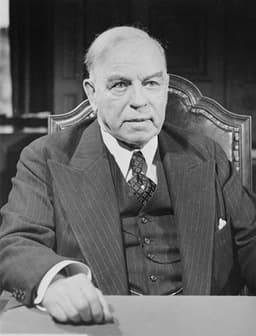
Arthur Meighen
Politician · Modern
43.0Total

Edouard Philippe
Politician · Modern
48.3Total
Basic Information
Born
1874
1970
Died
1960
—
Era
Modern
Modern
Nationality
Canada
France
Occupation
Politician
Politician
Civilization
Western
Western
Score Comparison
Military (10%)
49.8
23.5
Political (20%)
33.6
54.7
Influence (20%)
47.9
50.2
Legacy (20%)
38.3
37.5
Leadership (15%)
48.4
65.7
Strategy (15%)
41.4
60.0
TOTAL
43.0
48.3
Arthur Meighen — Complete Timeline
1917 AD
Led the Unionist Government During World War IPolitical Action◆ Major
As a senior minister in Borden's Unionist government, Meighen played a key role in implementing conscription and the War Measures Act. His actions were controversial and deeply divided the country along linguistic lines.
Canadian PoliticsWorld War IConscription
Impact: nationaldestructive
1920 AD
Elected Prime Minister of CanadaPolitical Action◆ Major
Meighen became Prime Minister of Canada after the resignation of Sir Robert Borden. His first term lasted only until 1921, as his Conservative government was defeated in the general election by Mackenzie King's Liberals.
Canadian PoliticsElectionGovernment
Impact: national
1923 AD
Passed the Chinese Immigration Act of 1923Political Action◆ Major
As Prime Minister, Meighen's government passed the Chinese Immigration Act, which effectively banned all Chinese immigration to Canada. The act was a major piece of discriminatory legislation that remained in force until 1947.
Canadian PoliticsImmigrationDiscrimination
Impact: nationaldestructive
1926 AD
Second Term as Prime MinisterPolitical Action◆ Major
Meighen served a second brief term as Prime Minister after the King-Byng Affair, when Governor General Lord Byng refused Prime Minister Mackenzie King's request for a dissolution of parliament. Meighen's government lasted only three months before being defeated in the House of Commons.
Canadian PoliticsConstitutional CrisisGovernment
Impact: national
Edouard Philippe — Complete Timeline
2017 AD
Implementation of Labor Market Reforms (Ordonnances Travail)Reform◆ Major
Philippe's government enacted labor code reforms by executive order, aiming to increase flexibility for employers. The reforms reduced collective bargaining power and simplified rules for hiring and firing, sparking protests from unions.
Labor ReformEconomic PolicyProtests
Impact: nationalconstructive
Appointment as Prime Minister of FrancePolitical Action◆ Major
Edouard Philippe was appointed Prime Minister by President Emmanuel Macron. He led the government of the newly formed La R
Prime MinisterMacronGovernment Formation
Impact: nationalconstructive
2020 AD
Resignation over COVID-19 ManagementPolitical Action
Edouard Philippe resigned as Prime Minister, replaced by Jean Castex. His resignation followed a government reshuffle and was partly attributed to the handling of the COVID-19 pandemic, though he remained a close ally of Macron.
ResignationCOVID-19Government Reshuffle
Impact: national
Election as Mayor of Le HavrePolitical Action
Philippe was elected Mayor of Le Havre, a position he had previously held. He won the municipal election, solidifying his local political base after leaving the prime minister's office.
MayorLocal PoliticsLe Havre
constructive
Expert Analysis
Origins
Arthur Meighen was born on June 16, 1874, in Anderson, Ontario, to a farming family. He studied mathematics at the University of Toronto and later law at Osgoode Hall. After moving to Manitoba, he practiced law and entered politics in 1908 as a Conservative MP. His background in law and oratory shaped his career.
Edouard Philippe was born on November 28, 1970, in Rouen, France. He studied at Sciences Po and the École Nationale d'Administration (ENA), the elite French civil service school. He worked as a senior civil servant and later entered politics, serving as mayor of Le Havre from 2010. His education and administrative experience prepared him for high office.
Rise to Power
Meighen rose quickly within the Conservative Party due to his debating skills. He became Solicitor General in 1913 and later Minister of the Interior and Superintendent of Indian Affairs. During World War I, he championed conscription and the War Measures Act, gaining influence. In 1920, he succeeded Robert Borden as Prime Minister, but his government fell in 1921. He returned briefly in 1926 after the King-Byng Affair, but again lost power.
Philippe rose as a protégé of Alain Juppé, serving as a deputy and mayor. In 2017, President Emmanuel Macron appointed him Prime Minister, though Philippe was not a member of Macron's party. He led the government through controversial reforms, including labor code changes. His tenure lasted until 2020, when he resigned amid COVID-19 management reshuffles.
Leadership & Governance
Meighen's leadership was defined by his rigid adherence to principle and strong oratory. He defended the British connection and centralised power. His governance included passing the Chinese Immigration Act of 1923, which banned Chinese immigration, reflecting his restrictive immigration policies. He also supported tariffs and railway nationalisation. His style was confrontational, leading to short-lived governments.
Philippe governed as a pragmatic technocrat. He implemented Macron's agenda, notably the Ordonnances Travail (labor reforms) in 2017, which reduced collective bargaining power and increased employer flexibility. He faced protests but pushed through. His management of the COVID-19 pandemic involved a national lockdown, but his resignation in 2020 was partly due to perceived mishandling. He scored 65.7 in leadership vs Meighen's 48.4.
Triumph & Tragedy
Meighen's triumphs include his effective role in World War I as a minister, ensuring conscription. However, his tragedy was the Chinese Immigration Act, a discriminatory legacy. His brief terms (total less than 2 years) limited his achievements. He scored 38.3 in legacy.
Philippe's triumph was passing labor reforms that modernized the French economy. His tragedy was the COVID-19 resignation, which tarnished his record. He scored 37.5 in legacy, slightly lower than Meighen, but his political score (54.7) exceeded Meighen's (33.6).
Character & Destiny
Meighen was principled but inflexible. His oratory won debates but alienated allies. His destiny was to be a footnote in Canadian history, overshadowed by Mackenzie King.
Philippe was pragmatic and loyal to Macron. His technocratic style allowed him to implement unpopular reforms but limited his independent power. His destiny was to be a competent but transitional figure.
Legacy
Meighen's legacy is negative due to the Chinese Immigration Act, which remained law until 1947. He is remembered as a failed PM. His total score is 43.0.
Philippe's legacy is mixed: his labor reforms are enduring, but his resignation over COVID-19 management reduced his impact. He scored 48.3 overall.
Conclusion
Edouard Philippe had a greater impact due to his higher total score (48.3 vs 43.0) and more significant reforms. While Meighen's oratory was notable, his policies were regressive. Philippe's labor reforms reshaped France's economy, and his leadership score (65.7) was substantially higher. Therefore, Philippe is the more influential figure.
Rankings
🥇
Edouard PhilippeLeader
Mil: 23.5Pol: 54.7Inf: 50.2
48.3
🥈
Arthur Meighen
Mil: 49.8Pol: 33.6Inf: 47.9
43.0
+5.3 behind
How This Comparison Works
Algorithm
Each figure is scored on 6 dimensions (0—100 scale) based on structured historical data: Military (10%), Political (20%), Influence (20%), Legacy (20%), Leadership (15%), Strategy (15%). The weighted total produces the final ranking.
Data Sources
Scores are computed from structured sub-indicators in the database. Scale factors adjust for era (Ancient ×0.85, Modern ×1.0) and civilization size (Eastern ×1.05, Other ×0.80) to account for differences in population and military scale.
Maximum 3 Figures
Comparisons are limited to 2—3 figures to ensure readability and statistical meaningfulness.
Error Margins
±5 points per dimension — Sub-scores are derived from historical records with inherent uncertainty. Two figures within 5 points on a dimension should be considered roughly equivalent in that area.
Total Score Accuracy
±3 points overall — The weighted combination of 6 dimensions produces a total score with approximately ±3 points of uncertainty. Differences of less than 3 points are not statistically significant— the figures are effectively tied.
Known Limitations
- Historical records are incomplete and uneven across civilizations
- Figures from oral-tradition societies may be underrepresented
- Occupation labels can misclassify multi-role figures
- Scores measure capability and impact, not moral character
- Quantitative scoring is a comparison tool, not absolute truth
Capability Radar
Military (10%) — Battles & Warfare
Battles
30
48
Win Rate
33
53
Expansion
33
55
Political (20%) — Governance & Reform
Reform
20
40
Diplomacy
30
45
Economy
20
40
Influence (20%) — Cultural & Global Reach
Cultural
15
10
Global
10
20
Legacy (20%) — Historical Impact
Historical
20
15
Longevity
10
10
Leadership (15%) — Power & Stability
Tenure
25
30
Stability
15
35
Strategy (15%) — Tactics & Innovation
Strategy
36
54
Tactics
40
60
Reform
43
60
Similar Comparisons
Comments & Discussion
No comments yet. Be the first to share your thoughts!