Loading...
Arturo Umberto Illia vs Zulfikar Ali Bhutto
Zulfikar Ali Bhutto leads by 7.7 pts · 2 figures compared
…

Arturo Umberto Illia
Politician · Modern
43.5Total
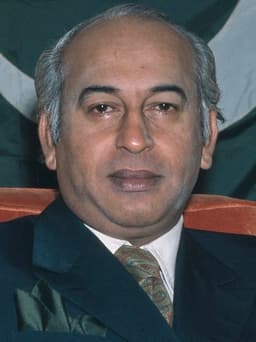
Zulfikar Ali Bhutto
Politician · Modern
51.2Total
Basic Information
Born
1900
1928
Died
1983
—
Era
Modern
Modern
Nationality
Argentina
Pakistan
Occupation
Politician
Politician
Civilization
Western
Indian
Score Comparison
Military (10%)
48.2
32.0
Political (20%)
43.7
55.0
Influence (20%)
47.9
61.0
Legacy (20%)
36.7
50.0
Leadership (15%)
45.0
40.0
Strategy (15%)
42.4
60.0
TOTAL
43.5
51.2
Arturo Umberto Illia — Complete Timeline
1963 AD
Election as President of ArgentinaPolitical Action◆ Major
Arturo Umberto Illia was elected President of Argentina on July 7, 1963, representing the Uni
ElectionPresidencyArgentina
Impact: national
Annulment of oil contracts with foreign companiesPolitical Action◆ Major
In November 1963, President Illia annulled oil contracts signed with foreign companies under the previous government of Arturo Frondizi. This decision asserted national sovereignty over oil resources but strained relations with foreign investors and the United States.
Oil PolicyNationalismEconomic Policy
Impact: national
1964 AD
Implementation of the Ley de Salario Mínimo, Vital y MóvilReform◆ Major
Illia's government implemented the Ley de Salario M
Labor ReformMinimum WageSocial Policy
Impact: nationalconstructive
1966 AD
Overthrow in the 1966 Argentine coup d'étatPolitical Action◆ Major
On June 28, 1966, President Illia was overthrown in a military coup led by General Juan Carlos Ongan
Coup d'étatMilitary DictatorshipDemocracy
Impact: nationaldestructive
Return to civilian life and political exilePolitical Action
After his overthrow, Illia went into political exile, living quietly in Buenos Aires. He remained a symbol of democratic resistance against the military regime, though he did not actively lead opposition movements. He returned to public life only after the restoration of democracy.
ExileDemocracyResistance
Impact: nationaldestructive
Zulfikar Ali Bhutto — Complete Timeline
1971 AD
Became President of PakistanPolitical Action◆ Major
After the secession of East Pakistan (Bangladesh), Zulfikar Ali Bhutto took over as President of Pakistan. He inherited a defeated and dismembered nation.
PresidentPost-WarPakistan
Impact: national
1972 AD
Nationalized IndustriesReform◆ Major
Bhutto's government nationalized major industries, including steel, banking, and oil. This policy aimed to reduce economic inequality but led to inefficiencies and a decline in private investment.
NationalizationEconomic PolicySocialism
Impact: national
Simla AgreementPolitical Action◆ Major
Bhutto signed the Simla Agreement with Indian Prime Minister Indira Gandhi. The agreement established a Line of Control in Kashmir and committed both nations to bilateral resolution of disputes.
Peace TreatyKashmirIndia
Impact: regional
1973 AD
Constitution of 1973Reform
Bhutto oversaw the drafting and adoption of Pakistan's current constitution, which established a parliamentary system and declared Pakistan an Islamic republic. It remains the country's supreme law.
ConstitutionParliamentary SystemIslamic Republic
Impact: nationalconstructive
1979 AD
Executed by HangingPolitical Action
Bhutto was executed by hanging after being convicted of conspiracy to murder a political opponent. The trial was widely criticized as politically motivated by General Zia-ul-Haq's military regime.
ExecutionControversial TrialZia-ul-Haq
Impact: nationaltragic
Expert Analysis
Origins
Arturo Umberto Illia was born on August 4, 1900, in Pergamino, Buenos Aires Province, Argentina, to Italian immigrants. He studied medicine at the University of Buenos Aires, graduating in 1927, and worked as a physician in rural areas. His early exposure to social inequalities shaped his moderate progressive views. Illia joined the Radical Civic Union (UCR) and held minor local offices before being elected to the Chamber of Deputies in 1948.
Zulfikar Ali Bhutto was born on January 5, 1928, in Larkana, Sindh, British India, into a wealthy landowning family. He studied at the University of Southern California and the University of California, Berkeley, then earned a law degree from Christ Church, Oxford. Bhutto entered politics in 1958 under President Iskander Mirza, serving as Minister of Commerce, and later as Foreign Minister under General Ayub Khan.
Rise to Power
Illia rose to prominence as a loyal member of the UCR, winning the presidency in 1963 with only 25% of the vote due to a divided electorate and the proscription of Peronism. His victory was seen as a return to constitutional order after the military ousted Arturo Frondizi in 1962. Illia's presidency began with limited popular mandate and constant pressure from the military and Peronist unions.
Bhutto's rise was meteoric. He became Foreign Minister in 1963 and gained fame for his assertive foreign policy, including the 1965 war with India. After the 1970 elections and the secession of East Pakistan, Bhutto took over as President in 1971, inheriting a defeated and dismembered nation. He then consolidated power, becoming Prime Minister after the 1973 constitution.
Leadership & Governance
Illia governed with a focus on democratic integrity and social justice. He annulled oil contracts with foreign companies in 1963, a move that boosted nationalist sentiment but alienated international investors. He implemented a minimum wage law (Salario Mínimo, Vital y Móvil) in 1964 and expanded public health programs. However, his government was seen as indecisive and weak, failing to curb inflation or address labor unrest. Illia's leadership style was consensus-driven and legalistic, scoring 45.0 in Leadership.
Bhutto adopted a more authoritarian style. He nationalized major industries (steel, banking, oil) in the early 1970s, aiming to reduce inequality but causing inefficiency and capital flight. He oversaw the 1973 Constitution, which established a parliamentary system but concentrated power in the prime minister's office. Bhutto's government cracked down on political opposition, particularly in Balochistan, and he manipulated elections to maintain control. His Strategy score of 60.0 reflects his tactical maneuvering, but his Political score of 55.0 was marred by increasing autocracy.
Triumph & Tragedy
Illia's greatest triumph was maintaining democratic rule amid military hostility. His annulment of oil contracts asserted national sovereignty. His greatest tragedy was his overthrow in the 1966 coup led by General Juan Carlos Onganía. Illia's failure to address economic crises and his inability to build broad coalitions left him vulnerable. His Legacy score of 36.7 reflects his status as a democratic martyr but ineffective ruler.
Bhutto's triumph was the 1973 Constitution and Simla Agreement (1972), which established the Line of Control in Kashmir. He also rebuilt Pakistan's morale after the 1971 defeat. His tragedy was his execution in 1979 after a controversial trial for conspiracy to murder a political opponent. Bhutto's legacy is deeply polarizing: he is credited with empowering the poor but blamed for undermining institutions. His Influence score of 61.0 is high, but his Military score of 32.0 reflects his poor handling of the military.
Character & Destiny
Illia was known for his honesty, modesty, and commitment to democratic norms. He was a physician by training, which influenced his paternalistic approach. His indecisiveness and lack of charisma contributed to his downfall. Historical assessments view him as a well-meaning but ineffective leader in a turbulent era.
Bhutto was charismatic, ambitious, and ruthless. He was a skilled orator and strategist but increasingly authoritarian. His character—combining charm with a willingness to use force—led to both his rise and his fall. The execution of Bhutto remains a symbol of judicial murder in Pakistan.
Legacy
Illia's legacy is as a symbol of democratic resistance in Argentina. His overthrow ushered in a military dictatorship that lasted until 1973. He is remembered by some as a principled leader, but his policies had limited long-term impact. His overall score of 43.5 reflects his minor influence.
Bhutto's legacy is transformative. The 1973 Constitution remains Pakistan's supreme law. His nationalization policies shifted the economy, though many were later reversed. He also founded the Pakistan Peoples Party, a major political force. Bhutto's execution made him a martyr for democracy, but his authoritarian excesses tarnish his reputation. With a total score of 51.2, Bhutto had greater impact than Illia.
Conclusion
Zulfikar Ali Bhutto had a greater historical impact than Arturo Umberto Illia. Bhutto's actions reshaped Pakistan's constitution, economy, and political landscape, despite his authoritarian turn and tragic end. Illia, while a democratic figure, failed to enact lasting change and was easily ousted. The score gap of 7.7 points reflects Bhutto's greater influence and legacy. Bhutto's complex legacy—both as a democrat and authoritarian—makes him a more significant figure in world history.
Rankings
🥇
Zulfikar Ali BhuttoLeader
Mil: 32.0Pol: 55.0Inf: 61.0
51.2
🥈
Arturo Umberto Illia
Mil: 48.2Pol: 43.7Inf: 47.9
43.5
+7.7 behind
How This Comparison Works
Algorithm
Each figure is scored on 6 dimensions (0—100 scale) based on structured historical data: Military (10%), Political (20%), Influence (20%), Legacy (20%), Leadership (15%), Strategy (15%). The weighted total produces the final ranking.
Data Sources
Scores are computed from structured sub-indicators in the database. Scale factors adjust for era (Ancient ×0.85, Modern ×1.0) and civilization size (Eastern ×1.05, Other ×0.80) to account for differences in population and military scale.
Maximum 3 Figures
Comparisons are limited to 2—3 figures to ensure readability and statistical meaningfulness.
Error Margins
±5 points per dimension — Sub-scores are derived from historical records with inherent uncertainty. Two figures within 5 points on a dimension should be considered roughly equivalent in that area.
Total Score Accuracy
±3 points overall — The weighted combination of 6 dimensions produces a total score with approximately ±3 points of uncertainty. Differences of less than 3 points are not statistically significant— the figures are effectively tied.
Known Limitations
- Historical records are incomplete and uneven across civilizations
- Figures from oral-tradition societies may be underrepresented
- Occupation labels can misclassify multi-role figures
- Scores measure capability and impact, not moral character
- Quantitative scoring is a comparison tool, not absolute truth
Capability Radar
Military (10%) — Battles & Warfare
Battles
29
41
Win Rate
34
45
Expansion
36
49
Political (20%) — Governance & Reform
Reform
35
70
Diplomacy
40
60
Economy
30
55
Influence (20%) — Cultural & Global Reach
Cultural
15
50
Global
10
55
Legacy (20%) — Historical Impact
Historical
20
60
Longevity
10
40
Leadership (15%) — Power & Stability
Tenure
20
65
Stability
15
30
Strategy (15%) — Tactics & Innovation
Strategy
39
55
Tactics
40
58
Reform
43
57
Similar Comparisons
Comments & Discussion
No comments yet. Be the first to share your thoughts!