Loading...
Atal Bihari Vajpayee vs Yevgeny Primakov
Atal Bihari Vajpayee leads by 4.6 pts · 2 figures compared
…
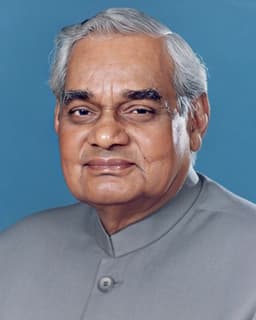
Atal Bihari Vajpayee
Politician · Modern
56.8Total

Yevgeny Primakov
Politician · Modern
52.2Total
Basic Information
Born
1924
1929
Died
—
—
Era
Modern
Modern
Nationality
India
Russia
Occupation
Politician
Politician
Civilization
Indian
Western
Score Comparison
Military (10%)
36.7
48.4
Political (20%)
55.0
45.0
Influence (20%)
58.3
57.2
Legacy (20%)
54.0
45.0
Leadership (15%)
72.0
72.0
Strategy (15%)
60.0
42.3
TOTAL
56.8
52.2
Atal Bihari Vajpayee — Complete Timeline
1996 AD
Appointed Prime Minister of India (First Term)Political Action◆ Major
Atal Bihari Vajpayee became Prime Minister for the first time, leading a BJP-led coalition government. His first term lasted only 13 days as the government failed to secure a majority in the Lok Sabha.
Indian PoliticsCoalition GovernmentShort Tenure
Impact: national
1998 AD
Conducted Nuclear Tests at Pokhran (Operation Shakti)War
Vajpayee's government conducted five underground nuclear tests at Pokhran, Rajasthan, making India a declared nuclear weapons state. The tests were met with international sanctions but boosted national pride and strategic autonomy.
Nuclear WeaponsPokhranStrategic Policy
Impact: global
Appointed Prime Minister of India (Full Term)Political Action◆ Major
Vajpayee became Prime Minister for a second time, leading the National Democratic Alliance (NDA) coalition. His government lasted 13 months before losing a confidence vote by one vote in 1999.
Indian PoliticsNDACoalition
Impact: national
1999 AD
Led India During Kargil WarWar◆ Major
Vajpayee's government oversaw the Indian military response to the Kargil infiltration by Pakistani forces and militants. India successfully recaptured the occupied peaks, but the conflict resulted in heavy casualties on both sides.
Kargil WarMilitary ConflictIndia-Pakistan
Impact: regional
Launched Delhi-Lahore Bus ServicePolitical Action◆ Major
Vajpayee inaugurated the Delhi-Lahore bus service as a peace initiative with Pakistan. He traveled to Lahore and signed the Lahore Declaration with Prime Minister Nawaz Sharif, aiming to reduce bilateral tensions.
Peace InitiativeIndia-PakistanDiplomacy
Impact: regionalconstructive
Yevgeny Primakov — Complete Timeline
1991 AD
Director of the Foreign Intelligence ServicePolitical Action◆ Major
Primakov was appointed Director of the Russian Foreign Intelligence Service (SVR) after the collapse of the USSR. He reorganized the agency and maintained its capabilities during the chaotic transition.
IntelligencePost-Soviet
Impact: national
1996 AD
Minister of Foreign AffairsPolitical Action◆ Major
Primakov became Russian Foreign Minister under President Yeltsin. He pursued a multi-vector foreign policy, opposing NATO expansion and strengthening ties with China and India.
Foreign PolicyNATO
Impact: global
1998 AD
Appointed Prime Minister of RussiaPolitical Action◆ Major
Primakov was appointed Prime Minister during the 1998 financial crisis. He stabilized the economy and restored public confidence, but was dismissed in 1999 by Yeltsin.
Financial CrisisEconomic Stabilization
Impact: nationalconstructive
1999 AD
Turned Plane Around Over AtlanticPolitical Action◆ Major
While flying to the US for a meeting, Primakov learned of NATO's bombing of Yugoslavia. He ordered his plane to turn back over the Atlantic, a dramatic protest against the intervention.
NATOYugoslaviaDiplomacy
Impact: global
Expert Analysis
Origins
Atal Bihari Vajpayee was born on December 25, 1924, in Gwalior, British India, into a middle-class Brahmin family. He completed a bachelor's degree in Hindi, English, and Sanskrit, then earned a master's in political science. His early involvement with the Rashtriya Swayamsevak Sangh (RSS) shaped his political ideology. He became a founding member of the Bharatiya Jana Sangh in 1951 and was first elected to the Lok Sabha in 1957.
Yevgeny Primakov was born on October 29, 1929, in Kyiv, Soviet Ukraine, to a Jewish father and a Georgian mother. He graduated from the Moscow Institute of Oriental Studies in 1953 and later earned a doctorate in economics. He worked as a journalist for Pravda and the State Committee for Science and Technology, specializing in the Middle East. His intelligence career began in the late 1980s when he was appointed to the Central Committee of the Communist Party.
Rise to Power
Vajpayee rose through the ranks of the Jana Sangh and later the Bharatiya Janata Party (BJP). He became the party's first president in 1968. His political ascent was gradual, marked by his role as a moderate face of Hindu nationalism. He became Prime Minister for 13 days in May 1996, then again for 13 months in 1998-1999, before finally leading a full term from 1999 to 2004. The turning point was the 1998 nuclear tests, which solidified his leadership and India's strategic posture.
Primakov's rise was rooted in the Soviet intelligence establishment. He became Director of the Foreign Intelligence Service (SVR) in 1991, succeeding the KGB's foreign branch. His appointment as Foreign Minister in 1996 under President Yeltsin marked his entry into high politics. He became Prime Minister in September 1998 during the Russian financial crisis, a position he held until May 1999. His dramatic plane-turn over the Atlantic in March 1999, when he learned of NATO's bombing of Yugoslavia, became a defining moment of his career.
Leadership & Governance
Vajpayee's leadership style was coalition-oriented and consensus-building. He headed the National Democratic Alliance (NDA), a coalition of over 20 parties. He pursued economic reforms, including privatization and infrastructure development (e.g., the Golden Quadrilateral highway project). On foreign policy, he initiated the Lahore peace process with Pakistan in February 1999, but the Kargil War in May-July 1999 tested his resolve. He authorized the nuclear tests, scoring 72.0 in leadership and 60.0 in strategy.
Primakov's governance focused on economic stabilization and foreign policy assertiveness. As Prime Minister, he appointed Yevgeny Yasin as economic minister and implemented measures to curb inflation and restore confidence. His foreign policy was multi-vector: he opposed NATO expansion, strengthened ties with China and India, and advocated for a multipolar world. His leadership score is 72.0, but his strategy score is 42.3, reflecting the chaotic Yeltsin-era context.
Triumph & Tragedy
Vajpayee's greatest triumph was the successful nuclear tests on May 11-13, 1998 (Operation Shakti), which made India a declared nuclear power and enhanced its global standing. His peace initiative with Pakistan through the Lahore Bus journey and the Lahore Declaration was a diplomatic success. However, the Kargil War, while militarily successful, exposed ongoing tensions. His failure to achieve a final peace with Pakistan and the 2002 Gujarat riots under his watch marred his legacy.
Primakov's triumph was stabilizing Russia's economy after the 1998 default. He restored pensions and wages, and his government negotiated a restructuring of foreign debt. His plane-turn incident symbolized Russian defiance of NATO. His tragedy was his dismissal by Yeltsin in May 1999, just as his popularity peaked. He also failed to prevent NATO's eastward expansion, though he slowed it temporarily.
Character & Destiny
Vajpayee was known as a moderate and a poet, with a conciliatory demeanor. His character allowed him to hold together a fractious coalition. He avoided extreme rhetoric and sought dialogue. His destiny was shaped by timing: he led India during a period of economic liberalization and nuclear ambiguity. His decision to test in 1998 was a calculated risk that paid off.
Primakov was a pragmatic realist, deeply suspicious of Western intentions. His background in intelligence made him cautious and strategic. His turn-around move was impulsive but effective as a signal. His destiny was tied to Russia's decline in the 1990s; he could not reverse it but managed to stabilize the ship. Historians view him as a competent crisis manager.
Legacy
Vajpayee's legacy includes India's nuclear weapons program, the NDA coalition model, and infrastructure projects. He is remembered as one of India's most popular prime ministers. His scores: military 36.7, political 55.0, influence 58.3, legacy 54.0. The BJP's subsequent rise owes much to his tenure.
Primakov's legacy is his multi-vector foreign policy and economic stabilization. He is respected as a Russian patriot who stood up to the West. His scores: military 48.4, political 45.0, influence 57.2, legacy 45.0. The Primakov Doctrine influenced Russian foreign policy under Putin.
Conclusion
Atal Bihari Vajpayee had a greater impact than Yevgeny Primakov, reflected in his total score of 56.8 vs 52.2. Vajpayee's nuclear tests fundamentally altered India's strategic position and global status, while Primakov's achievements were largely reactive and short-lived. Vajpayee's leadership during the Kargil War and his coalition management left a lasting political model. Primakov's stabilization of Russia was crucial but temporary, and his foreign policy assertiveness did not prevent NATO expansion. The 4.6-point gap underscores Vajpayee's more enduring influence on world affairs.
Rankings
🥇
Atal Bihari VajpayeeLeader
Mil: 36.7Pol: 55.0Inf: 58.3
56.8
🥈
Yevgeny Primakov
Mil: 48.4Pol: 45.0Inf: 57.2
52.2
+4.6 behind
How This Comparison Works
Algorithm
Each figure is scored on 6 dimensions (0—100 scale) based on structured historical data: Military (10%), Political (20%), Influence (20%), Legacy (20%), Leadership (15%), Strategy (15%). The weighted total produces the final ranking.
Data Sources
Scores are computed from structured sub-indicators in the database. Scale factors adjust for era (Ancient ×0.85, Modern ×1.0) and civilization size (Eastern ×1.05, Other ×0.80) to account for differences in population and military scale.
Maximum 3 Figures
Comparisons are limited to 2—3 figures to ensure readability and statistical meaningfulness.
Error Margins
±5 points per dimension — Sub-scores are derived from historical records with inherent uncertainty. Two figures within 5 points on a dimension should be considered roughly equivalent in that area.
Total Score Accuracy
±3 points overall — The weighted combination of 6 dimensions produces a total score with approximately ±3 points of uncertainty. Differences of less than 3 points are not statistically significant— the figures are effectively tied.
Known Limitations
- Historical records are incomplete and uneven across civilizations
- Figures from oral-tradition societies may be underrepresented
- Occupation labels can misclassify multi-role figures
- Scores measure capability and impact, not moral character
- Quantitative scoring is a comparison tool, not absolute truth
Capability Radar
Military (10%) — Battles & Warfare
Battles
43
31
Win Rate
46
33
Expansion
52
34
Political (20%) — Governance & Reform
Reform
60
55
Diplomacy
70
75
Economy
55
50
Influence (20%) — Cultural & Global Reach
Cultural
50
30
Global
60
45
Legacy (20%) — Historical Impact
Historical
65
40
Longevity
50
20
Leadership (15%) — Power & Stability
Tenure
65
65
Stability
60
45
Strategy (15%) — Tactics & Innovation
Strategy
55
39
Tactics
57
41
Reform
57
42
Similar Comparisons
Comments & Discussion
No comments yet. Be the first to share your thoughts!