Loading...
This comparison has not been analyzed yet.
One-time AI generation (~1 minute). Scores and timeline are already available below.
Augustus II the Strong vs Mkwawa
Augustus II the Strong leads by 7.3 pts · 2 figures compared
…
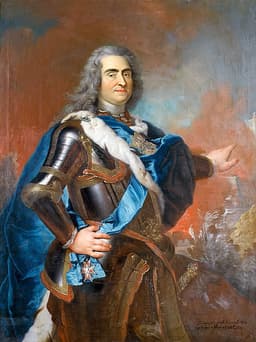
Augustus II the Strong
Emperor · Modern
54.8Total

Mkwawa
Emperor · Modern
47.5Total
Basic Information
Born
1670
1855
Died
1733
1898
Era
Modern
Modern
Nationality
Poland
Tanzania
Occupation
Emperor
Emperor
Civilization
Western
Other
Score Comparison
Military (10%)
25.0
10.0
Political (20%)
72.0
39.4
Influence (20%)
58.0
54.9
Legacy (20%)
46.7
45.0
Leadership (15%)
62.0
64.0
Strategy (15%)
60.0
60.0
TOTAL
54.8
47.5
Augustus II the Strong — Complete Timeline
1697 AD
Election as King of PolandPolitical Action◆ Major
Augustus II was elected King of Poland and Grand Duke of Lithuania after converting to Catholicism. His election was supported by Russia and Austria, marking the beginning of his reign over the Polish-Lithuanian Commonwealth.
ElectionPolish-Lithuanian CommonwealthConversion
Impact: regional
Establishment of the Saxon-Polish UnionPolitical Action◆ Major
Augustus II created a personal union between Saxony and Poland, ruling both territories. This union lasted intermittently until 1763, linking the German electorate with the Polish-Lithuanian Commonwealth.
Personal UnionSaxonyPoland
Impact: regional
1700 AD
Alliance with Russia in the Great Northern WarWar◆ Major
Augustus II allied with Peter the Great of Russia and Frederick IV of Denmark against Sweden. This alliance initiated the Great Northern War, aiming to reduce Swedish dominance in the Baltic region.
Great Northern WarAllianceSweden
Impact: regional
1706 AD
Deposition from the Polish ThronePolitical Action◆ Major
Following Swedish King Charles XII's invasion of Poland, Augustus II was deposed by the Swedish-backed Stanis
DepositionTreaty of AltranstädtSwedish Invasion
Impact: regionaltragic
1709 AD
Restoration to the Polish ThronePolitical Action◆ Major
After the Swedish defeat at the Battle of Poltava, Augustus II was restored as King of Poland with Russian support. He returned to power but with diminished authority, effectively becoming a Russian client.
RestorationRussian InfluencePoltava
Impact: regional
Mkwawa — Complete Timeline
1891 AD
Beginning of the Hehe resistance against German colonizationWar◆ Major
Mkwawa led the Hehe people in armed resistance against German colonial forces in German East Africa. He refused to submit to German authority, organizing guerrilla attacks on German outposts and caravans.
Anti-Colonial ResistanceTanzaniaWar
Impact: regional
Ambush and defeat of German forces at LugaloWar◆ Major
Mkwawa's forces ambushed and defeated a German military expedition at Lugalo, killing German commander Emil von Zelewski. This victory boosted Hehe morale and demonstrated the effectiveness of guerrilla tactics against colonial troops.
BattleTanzaniaVictory
Impact: regional
1894 AD
German capture of the Hehe fortress at KalengaWar◆ Major
German forces under Tom von Prince captured the Hehe fortress at Kalenga after a fierce battle. Mkwawa escaped but lost his stronghold and much of his army. The Germans destroyed the fortress and occupied Hehe territory.
BattleTanzaniaDefeat
Impact: regionaltragic
1898 AD
Suicide to avoid captureOther◆ Major
Mkwawa committed suicide by shooting himself when surrounded by German troops near Kalenga. His death ended the seven-year Hehe resistance. German authorities later recovered his skull, which was returned to Tanzania in 1954.
DeathTanzaniaResistance
Impact: regionaltragic
This comparison has not been analyzed yet.
One-time AI generation (~1 minute). Scores and timeline are already available below.
Rankings
🥇
Augustus II the StrongLeader
Mil: 25.0Pol: 72.0Inf: 58.0
54.8
🥈
Mkwawa
Mil: 10.0Pol: 39.4Inf: 54.9
47.5
+7.3 behind
How This Comparison Works
Algorithm
Each figure is scored on 6 dimensions (0—100 scale) based on structured historical data: Military (10%), Political (20%), Influence (20%), Legacy (20%), Leadership (15%), Strategy (15%). The weighted total produces the final ranking.
Data Sources
Scores are computed from structured sub-indicators in the database. Scale factors adjust for era (Ancient ×0.85, Modern ×1.0) and civilization size (Eastern ×1.05, Other ×0.80) to account for differences in population and military scale.
Maximum 3 Figures
Comparisons are limited to 2—3 figures to ensure readability and statistical meaningfulness.
Error Margins
±5 points per dimension — Sub-scores are derived from historical records with inherent uncertainty. Two figures within 5 points on a dimension should be considered roughly equivalent in that area.
Total Score Accuracy
±3 points overall — The weighted combination of 6 dimensions produces a total score with approximately ±3 points of uncertainty. Differences of less than 3 points are not statistically significant— the figures are effectively tied.
Known Limitations
- Historical records are incomplete and uneven across civilizations
- Figures from oral-tradition societies may be underrepresented
- Occupation labels can misclassify multi-role figures
- Scores measure capability and impact, not moral character
- Quantitative scoring is a comparison tool, not absolute truth
Capability Radar
Military (10%) — Battles & Warfare
Battles
40
45
Win Rate
30
40
Expansion
35
35
Political (20%) — Governance & Reform
Reform
50
25
Diplomacy
55
30
Economy
50
20
Influence (20%) — Cultural & Global Reach
Cultural
55
40
Global
45
30
Legacy (20%) — Historical Impact
Historical
50
45
Longevity
40
35
Leadership (15%) — Power & Stability
Tenure
60
40
Stability
30
35
Strategy (15%) — Tactics & Innovation
Strategy
40
50
Tactics
35
55
Reform
45
30
Similar Comparisons
Comments & Discussion
No comments yet. Be the first to share your thoughts!