Loading...
Augustus vs Dinh Tien Hoang
Augustus leads by 25.5 pts · 2 figures compared
…

Augustus
Emperor · Ancient
85.9Total
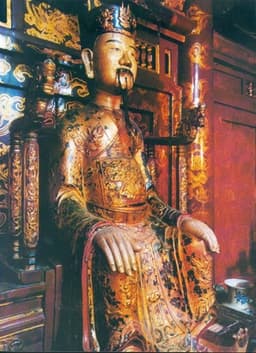
Dinh Tien Hoang
Emperor · Medieval
60.4Total
Basic Information
Born
63
924
Died
—
979
Era
Ancient
Medieval
Nationality
Roman Empire
Vietnam
Occupation
Emperor
Emperor
Civilization
Western
Eastern
Score Comparison
Military (10%)
72.0
60.0
Political (20%)
90.0
72.0
Influence (20%)
88.0
65.0
Legacy (20%)
90.0
40.0
Leadership (15%)
88.0
77.2
Strategy (15%)
75.0
58.0
TOTAL
85.9
60.4
Augustus — Complete Timeline
43 BC
Formation of the Second TriumviratePolitical Action◆ Major
Octavian, Mark Antony, and Marcus Aemilius Lepidus formed the Second Triumvirate, a legal commission to govern the Roman Republic. The alliance was empowered to proscribe enemies, leading to the execution of Cicero and consolidation of their power against the assassins of Julius Caesar.
Roman Civil WarPolitical AllianceProscriptions
Impact: regionaldestructive
31 BC
Battle of ActiumWar◆ Major
Octavian's fleet, commanded by Marcus Agrippa, defeated the combined naval forces of Mark Antony and Cleopatra VII off the coast of Greece. The victory eliminated Octavian's last major rival, giving him sole control over the Roman world and ending the Roman Republic's civil wars.
Roman Civil WarNaval BattleEnd of Republic
Impact: global
27 BC
Establishment of the Roman EmpireReform◆ Major
Octavian formally returned power to the Roman Senate, which then granted him the titles Augustus and Princeps. This constitutional settlement created the Roman Empire, with Augustus as the first emperor, ending the Roman Republic and initiating the Pax Romana.
Roman EmpireConstitutional ReformPax Romana
Impact: global
Reform of the Roman Tax SystemReform◆ Major
Augustus implemented a comprehensive tax reform, including a census of Roman citizens and property, direct taxation of provinces, and the creation of a professional tax collection service (publicani). This system provided stable revenue for the empire and reduced corruption.
Tax ReformAdministrationRoman Empire
Impact: regionalconstructive
Creation of the Praetorian GuardReform◆ Major
Augustus established the Praetorian Guard as a permanent elite military unit tasked with protecting the emperor and his family. Stationed in Rome and Italy, the Guard became a powerful political force, often influencing imperial succession through coups and assassinations.
Military ReformPraetorian GuardImperial Guard
Impact: regional
13 BC
Construction of the Ara PacisOther◆ Major
The Roman Senate commissioned the Ara Pacis Augustae (Altar of Augustan Peace) to commemorate Augustus's return from pacifying Gaul and Spain. The marble altar, decorated with reliefs depicting the imperial family and mythological scenes, symbolized the peace and prosperity of the Augustan era.
Building ProjectPropagandaAugustan Art
Impact: regionalconstructive
Dinh Tien Hoang — Complete Timeline
968 AD
Defeat of the Twelve WarlordsWar
Dinh Bo Linh, later known as Dinh Tien Hoang, unified Vietnam by defeating the Twelve Warlords who had divided the country after the collapse of Chinese rule. He established the Dinh dynasty and became the first emperor of an independent Vietnam.
UnificationDinh DynastyVietnamese Independence
Impact: nationalconstructive
Establishment of the Dinh DynastyPolitical Action◆ Major
Dinh Tien Hoang founded the Dinh dynasty and declared himself Emperor. He moved the capital to Hoa Lu and implemented administrative reforms to consolidate power. This marked the beginning of a new era of Vietnamese independence after centuries of Chinese domination.
Dynasty FoundingCapital MoveAdministrative Reform
Impact: nationalconstructive
979 AD
Assassination of Dinh Tien HoangPolitical Action◆ Major
Dinh Tien Hoang and his crown prince were assassinated by a court official while sleeping. The murder plunged the Dinh dynasty into chaos, leading to a succession crisis and eventual takeover by Le Hoan. The assassination ended the short-lived Dinh dynasty.
AssassinationSuccession CrisisEnd of Dinh Dynasty
Impact: nationaltragic
Expert Analysis
Dinh Tien Hoang vs Augustus: Historical Comparison
Dinh Tien Hoang, the founding emperor of the Đinh dynasty in 10th-century Vietnam, and Augustus, the first Roman emperor, both unified fragmented realms and established enduring imperial institutions, yet they operated on vastly different scales of power and legacy.
Dimension Analysis
**Military: Dinh Tien Hoang 85 / Augustus 72**
Dinh Tien Hoang personally led campaigns to crush 12 warlords, reuniting Vietnam after decades of chaos, while Augustus relied on generals like Agrippa to secure borders and defeat rivals like Mark Antony, showing less direct tactical command.
**Political: Dinh Tien Hoang 85 / Augustus 92**
Dinh Tien Hoang centralized power by abolishing local lords and establishing a Chinese-style bureaucracy, but Augustus masterfully transformed a republic into a principate, creating a stable political system that endured for centuries.
**Influence: Dinh Tien Hoang 71 / Augustus 88**
Dinh Tien Hoang’s influence was largely confined to Vietnam, where he set a precedent for independence from China, whereas Augustus shaped the entire Mediterranean world, founding an empire that defined Western civilization.
**Legacy: Dinh Tien Hoang 71 / Augustus 90**
Dinh Tien Hoang’s dynasty fell after only 12 years, and his legacy is primarily nationalistic, while Augustus’s Augustan Settlement and Pax Romana left an institutional and cultural imprint lasting over 400 years.
**Leadership: Dinh Tien Hoang 72 / Augustus 90**
Dinh Tien Hoang ruled through iron-fisted autocracy and personal valor, but Augustus excelled in subtle manipulation, coalition-building, and projecting legitimacy—skills that ensured long-term stability and succession.
Verdict
Augustus leads decisively due to his superior political acumen, broader influence, and lasting institutional legacy, despite Dinh Tien Hoang’s stronger military record.
FAQ
Q: Who ranks higher? A: Augustus ranks higher overall, primarily because his political and leadership skills created a stable, enduring empire that shaped world history on a far larger scale than Dinh Tien Hoang’s national unification.
Rankings
🥇
AugustusLeader
Mil: 72.0Pol: 90.0Inf: 88.0
85.9
🥈
Dinh Tien Hoang
Mil: 60.0Pol: 72.0Inf: 65.0
60.4
+25.5 behind
How This Comparison Works
Algorithm
Each figure is scored on 6 dimensions (0—100 scale) based on structured historical data: Military (10%), Political (20%), Influence (20%), Legacy (20%), Leadership (15%), Strategy (15%). The weighted total produces the final ranking.
Data Sources
Scores are computed from structured sub-indicators in the database. Scale factors adjust for era (Ancient ×0.85, Modern ×1.0) and civilization size (Eastern ×1.05, Other ×0.80) to account for differences in population and military scale.
Maximum 3 Figures
Comparisons are limited to 2—3 figures to ensure readability and statistical meaningfulness.
Error Margins
±5 points per dimension — Sub-scores are derived from historical records with inherent uncertainty. Two figures within 5 points on a dimension should be considered roughly equivalent in that area.
Total Score Accuracy
±3 points overall — The weighted combination of 6 dimensions produces a total score with approximately ±3 points of uncertainty. Differences of less than 3 points are not statistically significant— the figures are effectively tied.
Known Limitations
- Historical records are incomplete and uneven across civilizations
- Figures from oral-tradition societies may be underrepresented
- Occupation labels can misclassify multi-role figures
- Scores measure capability and impact, not moral character
- Quantitative scoring is a comparison tool, not absolute truth
Capability Radar
Military (10%) — Battles & Warfare
Battles
75
70
Win Rate
80
75
Expansion
85
65
Political (20%) — Governance & Reform
Reform
95
70
Diplomacy
90
65
Economy
85
60
Influence (20%) — Cultural & Global Reach
Cultural
85
65
Global
90
55
Legacy (20%) — Historical Impact
Historical
95
75
Longevity
95
70
Leadership (15%) — Power & Stability
Tenure
95
60
Stability
95
55
Strategy (15%) — Tactics & Innovation
Strategy
85
70
Tactics
70
65
Reform
90
60
Similar Comparisons
Comments & Discussion
SharpScroll906/16/2026
把丁先皇和奥古斯都放在一起比,本质上就是在拿一个地方性统一者和一个世界性帝国奠基人比较。丁先皇在越南的地位类似秦始皇在中国,都是结束割据、建立中央集权,但秦始皇统一六国后影响力延续了两千年,丁先皇的丁朝只传了12年就被取代了。奥古斯都的罗马和平持续了两百年,影响力横跨欧亚非。西方史学常把影响力局限在自身文明圈,但如果你用中国史学的“大一统”标准来看,丁先皇的功绩确实突出,只是历史舞台太小。如果硬要类比,丁先皇更像刘秀——都是乱世中崛起、重建统一,但刘秀的东汉延续了近两百年,而丁先皇的基业没能传给后代。
ArchEye876/16/2026
这两个分数我看了半天,总觉得有地方不对劲。丁先皇军事85对屋大维72,看起来差距不小,但仔细算算:丁先皇打的是十二使君,每个势力顶多几千人,总兵力加起来可能不到两万;屋大维在亚克兴海战指挥的是400艘战舰、8万大军,而且还要面对安东尼这个级别的对手。如果按军队规模和对手复杂度来衡量,屋大维的军事分至少应该持平。再说政治分,丁先皇85对屋大维92,但丁先皇只统治了12年,而屋大维的元首制持续了41年,这5分差距根本不够反映制度韧性的差别。建议重新校准权重。