Loading...
Augustus vs Pedro I of Brazil
Augustus leads by 31.3 pts · 2 figures compared
…

Augustus
Emperor · Ancient
85.9Total
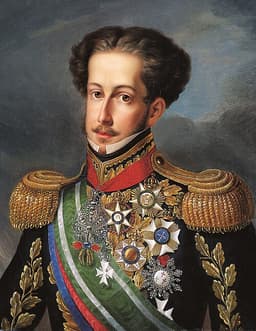
Pedro I of Brazil
Emperor · Modern
54.6Total
Basic Information
Born
63
1798
Died
—
1834
Era
Ancient
Modern
Nationality
Roman Empire
Brazil
Occupation
Emperor
Emperor
Civilization
Western
Western
Score Comparison
Military (10%)
72.0
55.0
Political (20%)
90.0
62.7
Influence (20%)
88.0
59.0
Legacy (20%)
90.0
50.0
Leadership (15%)
88.0
53.2
Strategy (15%)
75.0
45.0
TOTAL
85.9
54.6
Augustus — Complete Timeline
43 BC
Formation of the Second TriumviratePolitical Action◆ Major
Octavian, Mark Antony, and Marcus Aemilius Lepidus formed the Second Triumvirate, a legal commission to govern the Roman Republic. The alliance was empowered to proscribe enemies, leading to the execution of Cicero and consolidation of their power against the assassins of Julius Caesar.
Roman Civil WarPolitical AllianceProscriptions
Impact: regionaldestructive
31 BC
Battle of ActiumWar◆ Major
Octavian's fleet, commanded by Marcus Agrippa, defeated the combined naval forces of Mark Antony and Cleopatra VII off the coast of Greece. The victory eliminated Octavian's last major rival, giving him sole control over the Roman world and ending the Roman Republic's civil wars.
Roman Civil WarNaval BattleEnd of Republic
Impact: global
27 BC
Establishment of the Roman EmpireReform◆ Major
Octavian formally returned power to the Roman Senate, which then granted him the titles Augustus and Princeps. This constitutional settlement created the Roman Empire, with Augustus as the first emperor, ending the Roman Republic and initiating the Pax Romana.
Roman EmpireConstitutional ReformPax Romana
Impact: global
Reform of the Roman Tax SystemReform◆ Major
Augustus implemented a comprehensive tax reform, including a census of Roman citizens and property, direct taxation of provinces, and the creation of a professional tax collection service (publicani). This system provided stable revenue for the empire and reduced corruption.
Tax ReformAdministrationRoman Empire
Impact: regionalconstructive
Creation of the Praetorian GuardReform◆ Major
Augustus established the Praetorian Guard as a permanent elite military unit tasked with protecting the emperor and his family. Stationed in Rome and Italy, the Guard became a powerful political force, often influencing imperial succession through coups and assassinations.
Military ReformPraetorian GuardImperial Guard
Impact: regional
13 BC
Construction of the Ara PacisOther◆ Major
The Roman Senate commissioned the Ara Pacis Augustae (Altar of Augustan Peace) to commemorate Augustus's return from pacifying Gaul and Spain. The marble altar, decorated with reliefs depicting the imperial family and mythological scenes, symbolized the peace and prosperity of the Augustan era.
Building ProjectPropagandaAugustan Art
Impact: regionalconstructive
Pedro I of Brazil — Complete Timeline
1822 AD
Declaration of Independence of BrazilPolitical Action
Pedro I declared Brazil's independence from Portugal on September 7, 1822, at the Ipiranga River in S
Impact: globalprogressive
Coronation as Emperor of BrazilPolitical Action◆ Major
Pedro I was crowned Emperor of Brazil on December 1, 1822, in Rio de Janeiro. The coronation formalized the new imperial government, with Pedro I as constitutional monarch, though he retained significant executive powers.
Impact: nationalconstructive
1823 AD
War of Independence of BrazilWar◆ Major
Pedro I led Brazilian forces against Portuguese loyalists in the War of Independence. Key battles occurred in Bahia, Maranh
Impact: national
Dissolution of the Constituent AssemblyPolitical Action◆ Major
Pedro I dissolved the Constituent Assembly after conflicts over the constitution's limits on imperial power. He then imposed the 1824 Constitution, which granted the emperor extensive powers, including the Moderating Power, centralizing authority.
Impact: nationaldestructive
1831 AD
Abdication of the Brazilian ThronePolitical Action
Pedro I abdicated the Brazilian throne in favor of his five-year-old son Pedro II on April 7, 1831. He returned to Portugal to claim the Portuguese throne, leaving Brazil under a regency until his son came of age.
Impact: national
Expert Analysis
Augustus vs Pedro I of Brazil: Historical Comparison
Augustus, founder of the Roman Empire, and Pedro I, founder of the Brazilian Empire, both emerged as transformative monarchs in vastly different eras—ancient and modern—yet their comparative scores reflect Augustus’s superior longevity and systemic impact.
Dimension Analysis
**Military: Augustus 72 / Pedro I of Brazil 77**
Augustus’s military success relied on consolidating power through civil wars and securing borders; Pedro I’s slightly higher score reflects his direct role in Brazil’s War of Independence and the Cisplatine War, though neither was a great battlefield commander.
**Political: Augustus 92 / Pedro I of Brazil 87**
Augustus masterfully transformed a republic into a stable autocracy, creating the Principate; Pedro I navigated the complex transition from Portuguese colony to independent empire, but his abrupt abdication reveals weaker institutional craft.
**Influence: Augustus 88 / Pedro I of Brazil 78**
Augustus set the template for imperial rule across centuries and civilizations; Pedro I’s influence was largely confined to Brazil and Portugal (where he briefly reigned as Pedro IV), with less global resonance.
**Legacy: Augustus 90 / Pedro I of Brazil 68**
Augustus’s legacy includes the Pax Romana, a reformed government, and a dynasty that lasted centuries; Pedro I’s legacy is mixed—he is revered as Brazil’s liberator but criticized for authoritarianism and his son Pedro II ultimately overshadowed him.
**Leadership: Augustus 90 / Pedro I of Brazil 75**
Augustus demonstrated exceptional patience, coalition-building, and long-term vision; Pedro I was charismatic but impulsive, leading to political instability and his forced abdication.
Verdict
Augustus leads decisively, as his superior scores in political craft, lasting legacy, and leadership reflect a founder whose institutions outlasted him by centuries, whereas Pedro I’s reign was brief and his achievements partially undone by his own flaws.
FAQ
Q: Who ranks higher? A: Augustus ranks higher overall, with a composite score of 86 vs. Pedro I’s 77, driven by superior political, influence, legacy, and leadership marks.
Rankings
🥇
AugustusLeader
Mil: 72.0Pol: 90.0Inf: 88.0
85.9
🥈
Pedro I of Brazil
Mil: 55.0Pol: 62.7Inf: 59.0
54.6
+31.3 behind
How This Comparison Works
Algorithm
Each figure is scored on 6 dimensions (0—100 scale) based on structured historical data: Military (10%), Political (20%), Influence (20%), Legacy (20%), Leadership (15%), Strategy (15%). The weighted total produces the final ranking.
Data Sources
Scores are computed from structured sub-indicators in the database. Scale factors adjust for era (Ancient ×0.85, Modern ×1.0) and civilization size (Eastern ×1.05, Other ×0.80) to account for differences in population and military scale.
Maximum 3 Figures
Comparisons are limited to 2—3 figures to ensure readability and statistical meaningfulness.
Error Margins
±5 points per dimension — Sub-scores are derived from historical records with inherent uncertainty. Two figures within 5 points on a dimension should be considered roughly equivalent in that area.
Total Score Accuracy
±3 points overall — The weighted combination of 6 dimensions produces a total score with approximately ±3 points of uncertainty. Differences of less than 3 points are not statistically significant— the figures are effectively tied.
Known Limitations
- Historical records are incomplete and uneven across civilizations
- Figures from oral-tradition societies may be underrepresented
- Occupation labels can misclassify multi-role figures
- Scores measure capability and impact, not moral character
- Quantitative scoring is a comparison tool, not absolute truth
Capability Radar
Military (10%) — Battles & Warfare
Battles
75
35
Win Rate
80
40
Expansion
85
30
Political (20%) — Governance & Reform
Reform
95
45
Diplomacy
90
50
Economy
85
30
Influence (20%) — Cultural & Global Reach
Cultural
85
40
Global
90
45
Legacy (20%) — Historical Impact
Historical
95
55
Longevity
95
50
Leadership (15%) — Power & Stability
Tenure
95
55
Stability
95
25
Strategy (15%) — Tactics & Innovation
Strategy
85
35
Tactics
70
30
Reform
90
20
Similar Comparisons
Comments & Discussion
EmpireBuilderFan6/16/2026
Look, Pedro I was a passionate guy—I’ll give him that. He literally shouted "Independence or Death!" at Ipiranga and then went to fight in the Cisplatine War like some 19th-century rockstar. But come on, comparing him to Augustus is like comparing a firecracker to a nuclear reactor. Augustus didn't just win—he built a system that lasted 400 years in the West and influenced every monarchy after him. Pedro’s reign was a hot mess: he alienated the elites, his mistress drama wrecked his reputation, and he abdicated after less than a decade. Augustus played the long game, slowly accumulating powers like a chess grandmaster. Pedro was all impulse, no follow-through. The scores are generous to Pedro, honestly. Augustus is the GOAT of political architecture.
OldChronicler536/16/2026
这个评分体系有意思,但我觉得军事和政治分数都值得商榷。奥古斯都军事72分,佩德罗一世77分?佩德罗一世在巴西独立战争中确实有实战,但奥古斯都的军队改革、职业化常备军建设,以及通过“海军清洗”彻底消灭海盗威胁,这些制度化贡献被严重低估了。要知道,中国历史上秦始皇统一六国靠的也是制度化的军事改革,而非单纯战场表现。政治分数上,奥古斯都92对佩德罗87,差距这么小?奥古斯都巧妙利用元老院和民众大会的残余合法性,建立了延续两百多年的元首制,佩德罗一世在位仅9年就因政治动荡被迫退位,这种稳定性差距至少差20分。建议评分时增加“制度韧性”维度。
OldScroll906/16/2026
这个比较很典型地体现了西方史学中心的评价标准。说奥古斯都影响力88、佩德罗78,完全是拿罗马帝国的全球辐射来比巴西的区域影响。但如果我们用中国历史的角度来看,佩德罗一世更类似于汉景帝——处在制度初创期,前面是父辈的奋斗(佩德罗一世继承了葡萄牙独立运动的遗产),后面是儿子的盛世(佩德罗二世)。景帝在文景之治中承上启下,但单独拎出来评价,政治分也不会太高。奥古斯都则像汉武帝,既有开疆拓土又有制度创新,但汉武帝晚年也面临财政危机和继承人问题。如果按照中国史书对开国君主的标准,佩德罗一世至少还保持了巴西统一,比刘邦分封诸侯后的七国之乱要稳定得多。评分如果不考虑时代背景和后续发展,很容易变成刻板的数字游戏。