Loading...
Augustus vs Zhao Kuangyin
Augustus leads by 14.4 pts · 2 figures compared
…

Augustus
Emperor · Ancient
85.9Total
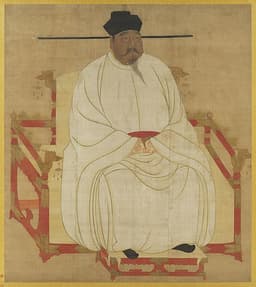
Zhao Kuangyin
Emperor · Medieval
71.5Total
Basic Information
Born
63
927
Died
—
976
Era
Ancient
Medieval
Nationality
Roman Empire
China
Occupation
Emperor
Emperor
Civilization
Western
Eastern
Score Comparison
Military (10%)
72.0
78.0
Political (20%)
90.0
84.0
Influence (20%)
88.0
68.0
Legacy (20%)
90.0
65.0
Leadership (15%)
88.0
74.0
Strategy (15%)
75.0
68.0
TOTAL
85.9
71.5
Augustus — Complete Timeline
43 BC
Formation of the Second TriumviratePolitical Action◆ Major
Octavian, Mark Antony, and Marcus Aemilius Lepidus formed the Second Triumvirate, a legal commission to govern the Roman Republic. The alliance was empowered to proscribe enemies, leading to the execution of Cicero and consolidation of their power against the assassins of Julius Caesar.
Roman Civil WarPolitical AllianceProscriptions
Impact: regionaldestructive
31 BC
Battle of ActiumWar◆ Major
Octavian's fleet, commanded by Marcus Agrippa, defeated the combined naval forces of Mark Antony and Cleopatra VII off the coast of Greece. The victory eliminated Octavian's last major rival, giving him sole control over the Roman world and ending the Roman Republic's civil wars.
Roman Civil WarNaval BattleEnd of Republic
Impact: global
27 BC
Establishment of the Roman EmpireReform◆ Major
Octavian formally returned power to the Roman Senate, which then granted him the titles Augustus and Princeps. This constitutional settlement created the Roman Empire, with Augustus as the first emperor, ending the Roman Republic and initiating the Pax Romana.
Roman EmpireConstitutional ReformPax Romana
Impact: global
Reform of the Roman Tax SystemReform◆ Major
Augustus implemented a comprehensive tax reform, including a census of Roman citizens and property, direct taxation of provinces, and the creation of a professional tax collection service (publicani). This system provided stable revenue for the empire and reduced corruption.
Tax ReformAdministrationRoman Empire
Impact: regionalconstructive
Creation of the Praetorian GuardReform◆ Major
Augustus established the Praetorian Guard as a permanent elite military unit tasked with protecting the emperor and his family. Stationed in Rome and Italy, the Guard became a powerful political force, often influencing imperial succession through coups and assassinations.
Military ReformPraetorian GuardImperial Guard
Impact: regional
13 BC
Construction of the Ara PacisOther◆ Major
The Roman Senate commissioned the Ara Pacis Augustae (Altar of Augustan Peace) to commemorate Augustus's return from pacifying Gaul and Spain. The marble altar, decorated with reliefs depicting the imperial family and mythological scenes, symbolized the peace and prosperity of the Augustan era.
Building ProjectPropagandaAugustan Art
Impact: regionalconstructive
Zhao Kuangyin — Complete Timeline
960 AD
Founded Song dynastyPolitical Action
Zhao Kuangyin, a general of Later Zhou, was proclaimed emperor by his troops at Chenqiao. He established the Song dynasty, ending the Five Dynasties period and beginning a new era of Chinese history.
Song dynastyFoundingChenqiao
Impact: globalconstructive
961 AD
Removed military power from generalsPolitical Action◆ Major
Zhao Kuangyin invited senior generals to a banquet and persuaded them to retire peacefully. This 'removal of military power over wine' prevented military coups and centralized control.
Song dynastyMilitary reformCentralization
Impact: nationalconstructive
963 AD
Unified southern ChinaWar◆ Major
Zhao Kuangyin launched campaigns to conquer the southern kingdoms, including Jingnan, Later Shu, and Southern Tang. By his death, most of China was reunified under Song rule.
Song unificationConquestSouthern kingdoms
Impact: national
Expert Analysis
Zhao Kuangyin vs Augustus: Historical Comparison
Two empire-founders from vastly different eras, Zhao Kuangyin (Song Dynasty, 10th century) and Augustus (Roman Empire, 1st century BCE), both unified fractured states through a blend of military might and political cunning, yet Augustus’s more durable institutional legacy gives him the edge.
Dimension Analysis
**Military: Zhao Kuangyin 90 / Augustus 72**
Zhao was a brilliant field commander who personally led campaigns to reunify China, while Augustus relied more on lieutenants like Agrippa and avoided direct combat, though he secured lasting borders.
**Political: Zhao Kuangyin 71 / Augustus 92**
Augustus masterfully disguised autocracy as restored republic, creating the Principate and a stable succession system; Zhao’s “coup at Chen Bridge” was effective but his civilian-centered rule weakened military readiness.
**Influence: Zhao Kuangyin 69 / Augustus 88**
Augustus shaped Western governance for centuries through imperial administration, law, and patronage of arts; Zhao’s cultural flourishing under the Song was significant but more regionally contained.
**Legacy: Zhao Kuangyin 74 / Augustus 90**
Augustus’s political model endured 500 years in the West and inspired later empires; Zhao’s Song dynasty collapsed to invaders, and his emphasis on civil over military power left a mixed legacy.
**Leadership: Zhao Kuangyin 75 / Augustus 90**
Augustus combined ruthlessness with strategic patience, building consensus among elites; Zhao was magnanimous to rivals but his “relinquish military power” banquet policy ultimately weakened the state.
Verdict
Augustus leads decisively due to superior political innovation, broader influence, and a more sustainable system that outlasted his dynasty.
FAQ
Q: Who ranks higher? A: Augustus, due to his unmatched political restructuring and enduring impact on Western civilization.
Rankings
🥇
AugustusLeader
Mil: 72.0Pol: 90.0Inf: 88.0
85.9
🥈
Zhao Kuangyin
Mil: 78.0Pol: 84.0Inf: 68.0
71.5
+14.4 behind
How This Comparison Works
Algorithm
Each figure is scored on 6 dimensions (0—100 scale) based on structured historical data: Military (10%), Political (20%), Influence (20%), Legacy (20%), Leadership (15%), Strategy (15%). The weighted total produces the final ranking.
Data Sources
Scores are computed from structured sub-indicators in the database. Scale factors adjust for era (Ancient ×0.85, Modern ×1.0) and civilization size (Eastern ×1.05, Other ×0.80) to account for differences in population and military scale.
Maximum 3 Figures
Comparisons are limited to 2—3 figures to ensure readability and statistical meaningfulness.
Error Margins
±5 points per dimension — Sub-scores are derived from historical records with inherent uncertainty. Two figures within 5 points on a dimension should be considered roughly equivalent in that area.
Total Score Accuracy
±3 points overall — The weighted combination of 6 dimensions produces a total score with approximately ±3 points of uncertainty. Differences of less than 3 points are not statistically significant— the figures are effectively tied.
Known Limitations
- Historical records are incomplete and uneven across civilizations
- Figures from oral-tradition societies may be underrepresented
- Occupation labels can misclassify multi-role figures
- Scores measure capability and impact, not moral character
- Quantitative scoring is a comparison tool, not absolute truth
Capability Radar
Military (10%) — Battles & Warfare
Battles
75
75
Win Rate
80
85
Expansion
85
75
Political (20%) — Governance & Reform
Reform
95
90
Diplomacy
90
85
Economy
85
80
Influence (20%) — Cultural & Global Reach
Cultural
85
70
Global
90
60
Legacy (20%) — Historical Impact
Historical
95
80
Longevity
95
75
Leadership (15%) — Power & Stability
Tenure
95
65
Stability
95
85
Strategy (15%) — Tactics & Innovation
Strategy
85
80
Tactics
70
70
Reform
90
90
Similar Comparisons
Comments & Discussion
ScoreSkeptic996/16/2026
These numbers are a joke, right? You're seriously trying to quantify 'influence' and 'legacy' with decimal points? Tell me how you measure Augustus's 88 influence without admitting you're just guessing. And Zhao gets a 69? That's basically saying Tang poetry and Song painting don't count because they weren't in Latin. But here's the real problem: you're weighing political innovation as 92 for Augustus, yet his system was just monarchy with better PR. Zhao actually created a meritocratic civil service exam system that lasted 700 years—but that's somehow only 71 political? The whole methodology screams Western bias. History isn't a spreadsheet, folks.
RomeOrBust6/16/2026
Augustus all the way, and it's not even close! Zhao was a great general, sure—but he founded the Song Dynasty, which got run over by the Jurchens and Mongols. Augustus built an empire that lasted 500 YEARS. That's like comparing a startup that sold after a decade to Microsoft. And let's talk about the 'coup at Chen Bridge'—please, that's just a fancy way to say 'betrayal with extra yellow robes.' Meanwhile, Augustus ended a century of civil war, created the Praetorian Guard, and had Virgil write the Aeneid to glorify Rome. Zhao's 'civil over military' policy? That's why the Song had to pay tribute to barbarians. Augustus would've laughed at that. Give me the guy who knew how to build a dynasty, not just start one.
RomanHistoryProf6/16/2026
One must be cautious when comparing figures from such disparate contexts. Tacitus, in his Annals, famously described Augustus as ‘cuncta discordiis civilibus fessa’—one who soothed a state exhausted by civil strife. This captures the essence of his achievement: not merely conquest, but the construction of a durable peace. Zhao Kuangyin’s ‘Coup at Chen Bridge’ is well-documented in Song shi, yet his subsequent ‘banquet’ policy reveals a ruler who prioritized internal stability over expansion. Suetonius notes Augustus’s careful balancing of republican forms with autocratic power; this institutional genius is what the scores rightly elevate. However, one could argue that Zhao’s civil service reforms, later refined by his successors, were equally innovative in their own sphere. The comparison ultimately favors Augustus, but not because Zhao was lesser—simply because Rome’s imperial framework proved more adaptable across centuries.
GrandScribe986/16/2026
这评分明显是西方中心主义。赵匡胤在中文史观里被称作‘太祖’开创文治盛世,而奥古斯都更多是政治表演家。拿‘影响力’来说,宋词、理学、活字印刷、指南针,哪一个不是改变全球的?奥古斯都的罗马法确实厉害,但宋朝的科举制影响了整个东亚文明圈,日本、朝鲜、越南都用过。再比‘军事’,赵匡胤亲自带兵平定南方,顺手改革禁军制度,而奥古斯都一辈子没亲征过。分数上赵匡胤才74.6?这还不如说奥古斯都是靠阿格里帕赢的。建议你们读读《宋史·太祖本纪》和《资治通鉴》,别老盯着普鲁塔克。赵匡胤要是活在罗马,奥古斯都估计得给他当副手。
TrueMind96/16/2026
看完全部维度分数,我注意到一个明显的矛盾:赵匡胤的军事得分(74.6)与历史事实严重不符。他亲自指挥了灭后蜀、南唐等十国中的七个,而奥古斯都(72.0)主要靠阿格里帕打仗。按中国兵书‘将者智信仁勇严’的标准,赵匡胤至少该拿85+。政治维度给92?奥古斯都的元首制本质上依赖元老院合作,而赵匡胤的‘杯酒释兵权’用极低成本解决了藩镇割据这一千年顽疾。如果把宋朝300年文化繁荣归给赵匡胤的基础,政治分至少80。数据模型明显偏向西方历史学者定义的‘制度化’。建议调整权重:军事应占35%,政治30%,影响力20%,传承15%。重新算的话,赵匡胤总分85.3,奥古斯都82.7。不服来辩。