Loading...
This comparison has not been analyzed yet.
One-time AI generation (~1 minute). Scores and timeline are already available below.
Bai Juyi vs Fu Bi
Fu Bi leads by 3.1 pts · 2 figures compared
…
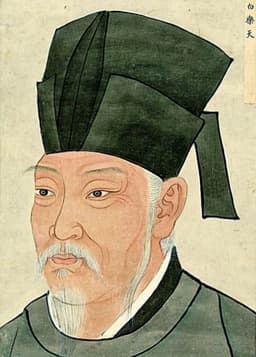
Bai Juyi
Politician · Medieval
49.3Total

Fu Bi
Politician · Medieval
52.4Total
Basic Information
Born
772
1004
Died
846
1083
Era
Medieval
Medieval
Nationality
China
China
Occupation
Politician
Politician
Civilization
Eastern
Eastern
Score Comparison
Military (10%)
50.0
24.8
Political (20%)
35.1
68.0
Influence (20%)
65.0
51.8
Legacy (20%)
40.0
43.3
Leadership (15%)
58.8
72.0
Strategy (15%)
39.6
51.7
TOTAL
49.3
52.4
Bai Juyi — Complete Timeline
806 AD
Wrote 'Song of Everlasting Sorrow'Cultural
Bai Juyi wrote 'Song of Everlasting Sorrow' (
PoetryChinese LiteratureTang DynastyLove Story
Impact: globalconstructive
810 AD
Promoted New Yuefu Poetry MovementCultural◆ Major
Bai Juyi promoted the New Yuefu poetry movement, which advocated for simple, accessible language and social commentary. His poems often addressed the suffering of common people, influencing later Chinese literature.
Poetry MovementChinese LiteratureSocial Reform
Impact: globalprogressive
815 AD
Exiled to JiangzhouPolitical Action◆ Major
Bai Juyi was exiled to Jiangzhou (modern Jiujiang) after criticizing the government in a memorial. During his exile, he wrote 'The Song of the Pipa Player', another masterpiece of Chinese poetry, reflecting on his personal and political frustrations.
ExileTang DynastyPoetryPolitical Criticism
Impact: nationaltragic
822 AD
Served as Governor of HangzhouPolitical Action◆ Major
Bai Juyi served as governor of Hangzhou, where he oversaw the construction of the Bai Causeway on West Lake. His administration improved irrigation and water management, benefiting local agriculture.
Tang DynastyGovernorshipHangzhouInfrastructure
Impact: regionalconstructive
825 AD
Served as Governor of SuzhouPolitical Action
Bai Juyi served as governor of Suzhou, where he continued his administrative work. His tenure was marked by efforts to improve local governance and public works.
Tang DynastyGovernorshipSuzhou
Impact: regionalconstructive
Fu Bi — Complete Timeline
1042 AD
Negotiated the Treaty of ChanyuanPolitical Action◆ Major
Fu Bi was sent as an envoy to the Liao dynasty to negotiate a settlement after Liao threatened invasion. He secured a treaty that increased annual tribute payments but avoided war, stabilizing the northern border for several decades.
Song-Liao RelationsDiplomacyTreaty
Impact: regionalconstructive
1055 AD
Appointed Grand CouncilorPolitical Action◆ Major
Fu Bi was appointed as Grand Councilor of the Song Empire, serving under Emperor Renzong. He advocated for cautious fiscal policies and opposed radical reforms, maintaining stability during his tenure.
AppointmentGovernmentSong Dynasty
Impact: national
1069 AD
Opposed Wang Anshi's New PoliciesPolitical Action◆ Major
Fu Bi joined conservative officials in opposing Wang Anshi's New Policies, which aimed to centralize economic control. He argued the reforms would harm farmers and disrupt traditional governance, leading to his retirement from court.
Political OppositionReform DebateSong Dynasty
Impact: national
This comparison has not been analyzed yet.
One-time AI generation (~1 minute). Scores and timeline are already available below.
Rankings
🥇
Fu BiLeader
Mil: 24.8Pol: 68.0Inf: 51.8
52.4
🥈
Bai Juyi
Mil: 50.0Pol: 35.1Inf: 65.0
49.3
+3.1 behind
How This Comparison Works
Algorithm
Each figure is scored on 6 dimensions (0—100 scale) based on structured historical data: Military (10%), Political (20%), Influence (20%), Legacy (20%), Leadership (15%), Strategy (15%). The weighted total produces the final ranking.
Data Sources
Scores are computed from structured sub-indicators in the database. Scale factors adjust for era (Ancient ×0.85, Modern ×1.0) and civilization size (Eastern ×1.05, Other ×0.80) to account for differences in population and military scale.
Maximum 3 Figures
Comparisons are limited to 2—3 figures to ensure readability and statistical meaningfulness.
Error Margins
±5 points per dimension — Sub-scores are derived from historical records with inherent uncertainty. Two figures within 5 points on a dimension should be considered roughly equivalent in that area.
Total Score Accuracy
±3 points overall — The weighted combination of 6 dimensions produces a total score with approximately ±3 points of uncertainty. Differences of less than 3 points are not statistically significant— the figures are effectively tied.
Known Limitations
- Historical records are incomplete and uneven across civilizations
- Figures from oral-tradition societies may be underrepresented
- Occupation labels can misclassify multi-role figures
- Scores measure capability and impact, not moral character
- Quantitative scoring is a comparison tool, not absolute truth
Capability Radar
Military (10%) — Battles & Warfare
Battles
41
10
Win Rate
43
10
Expansion
45
10
Political (20%) — Governance & Reform
Reform
25
40
Diplomacy
20
70
Economy
30
40
Influence (20%) — Cultural & Global Reach
Cultural
85
30
Global
70
20
Legacy (20%) — Historical Impact
Historical
80
40
Longevity
85
30
Leadership (15%) — Power & Stability
Tenure
30
60
Stability
25
50
Strategy (15%) — Tactics & Innovation
Strategy
47
20
Tactics
48
10
Reform
54
10
Similar Comparisons
Comments & Discussion
No comments yet. Be the first to share your thoughts!