Loading...
This comparison has not been analyzed yet.
One-time AI generation (~1 minute). Scores and timeline are already available below.
Bakili Muluzi vs Lord Willingdon
Lord Willingdon leads by 5.7 pts · 2 figures compared
…
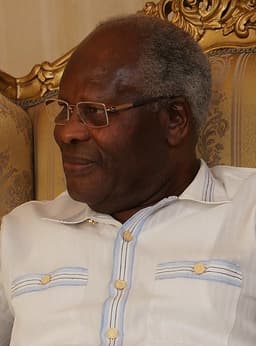
Bakili Muluzi
Politician · Modern
49.3Total

Lord Willingdon
Politician · Modern
55.0Total
Basic Information
Born
1943
1866
Died
—
1941
Era
Modern
Modern
Nationality
Malawi
United Kingdom
Occupation
Politician
Politician
Civilization
Other
Western
Score Comparison
Military (10%)
45.7
41.6
Political (20%)
48.0
68.0
Influence (20%)
51.8
53.3
Legacy (20%)
43.3
43.3
Leadership (15%)
65.0
74.0
Strategy (15%)
39.8
53.5
TOTAL
49.3
55.0
Bakili Muluzi — Complete Timeline
1994 AD
Elected President of MalawiPolitical Action
Muluzi won Malawi's first multi-party election since independence, defeating longtime dictator Hastings Kamuzu Banda. He became the first democratically elected president of Malawi, ending 30 years of one-party rule.
DemocracyElectionTransition
Impact: nationalprogressive
1999 AD
Re-elected President of MalawiPolitical Action◆ Major
Muluzi won a second term in office, defeating Gwanda Chakuamba. The election was marred by allegations of irregularities, but Muluzi's United Democratic Front retained power.
ElectionPresidency
Impact: national
2002 AD
Attempted Constitutional Amendment for Third TermPolitical Action◆ Major
Muluzi attempted to amend the Malawian constitution to allow a third presidential term. The effort failed due to opposition from civil society, parliament, and international pressure, forcing him to step down in 2004.
Constitutional CrisisTerm Limits
Impact: nationaldestructive
2009 AD
Arrested on Corruption ChargesPolitical Action◆ Major
Muluzi was arrested and charged with corruption and theft of public funds amounting to $11 million during his presidency. The case dragged on for years, with Muluzi eventually acquitted in 2012 due to lack of evidence.
CorruptionLegal Case
Impact: nationaldestructive
Lord Willingdon — Complete Timeline
1931 AD
Appointment as Viceroy of IndiaPolitical Action◆ Major
Willingdon was appointed Viceroy of India, succeeding Lord Irwin. His tenure was marked by a hardline approach to the Indian independence movement, including the suppression of the Civil Disobedience Movement and the arrest of Congress leaders.
British IndiaViceroyNationalism
Impact: regional
1932 AD
Suppression of the Civil Disobedience MovementPolitical Action◆ Major
Willingdon launched a crackdown on the Indian National Congress, arresting Gandhi, Jawaharlal Nehru, and thousands of other activists. He banned Congress organizations and imposed emergency powers, effectively crushing the Civil Disobedience Movement.
British IndiaRepressionNationalism
Impact: regionaldestructive
Communal AwardPolitical Action◆ Major
Willingdon's government implemented the Communal Award, which granted separate electorates for minorities, including depressed classes (Dalits). The award was opposed by Gandhi, who went on a fast-unto-death, leading to the Poona Pact.
British IndiaCommunal RepresentationDalits
Impact: regional
1935 AD
Government of India Act 1935Reform◆ Major
Willingdon's tenure saw the passage of the Government of India Act 1935, which proposed a federal structure and provincial autonomy. The act was a major constitutional reform but was criticized for retaining British control over key areas and for its communal provisions.
British IndiaConstitutional ReformFederalism
Impact: regional
This comparison has not been analyzed yet.
One-time AI generation (~1 minute). Scores and timeline are already available below.
Rankings
🥇
Lord WillingdonLeader
Mil: 41.6Pol: 68.0Inf: 53.3
55.0
🥈
Bakili Muluzi
Mil: 45.7Pol: 48.0Inf: 51.8
49.3
+5.7 behind
How This Comparison Works
Algorithm
Each figure is scored on 6 dimensions (0—100 scale) based on structured historical data: Military (10%), Political (20%), Influence (20%), Legacy (20%), Leadership (15%), Strategy (15%). The weighted total produces the final ranking.
Data Sources
Scores are computed from structured sub-indicators in the database. Scale factors adjust for era (Ancient ×0.85, Modern ×1.0) and civilization size (Eastern ×1.05, Other ×0.80) to account for differences in population and military scale.
Maximum 3 Figures
Comparisons are limited to 2—3 figures to ensure readability and statistical meaningfulness.
Error Margins
±5 points per dimension — Sub-scores are derived from historical records with inherent uncertainty. Two figures within 5 points on a dimension should be considered roughly equivalent in that area.
Total Score Accuracy
±3 points overall — The weighted combination of 6 dimensions produces a total score with approximately ±3 points of uncertainty. Differences of less than 3 points are not statistically significant— the figures are effectively tied.
Known Limitations
- Historical records are incomplete and uneven across civilizations
- Figures from oral-tradition societies may be underrepresented
- Occupation labels can misclassify multi-role figures
- Scores measure capability and impact, not moral character
- Quantitative scoring is a comparison tool, not absolute truth
Capability Radar
Military (10%) — Battles & Warfare
Battles
24
10
Win Rate
22
10
Expansion
28
10
Political (20%) — Governance & Reform
Reform
40
50
Diplomacy
45
60
Economy
35
40
Influence (20%) — Cultural & Global Reach
Cultural
30
20
Global
20
30
Legacy (20%) — Historical Impact
Historical
35
30
Longevity
25
20
Leadership (15%) — Power & Stability
Tenure
50
60
Stability
30
30
Strategy (15%) — Tactics & Innovation
Strategy
28
10
Tactics
31
10
Reform
35
10
Similar Comparisons
Comments & Discussion
No comments yet. Be the first to share your thoughts!