Loading...
This comparison has not been analyzed yet.
One-time AI generation (~1 minute). Scores and timeline are already available below.
Barham Salih vs George Yeo
Barham Salih leads by 4.5 pts · 2 figures compared
…
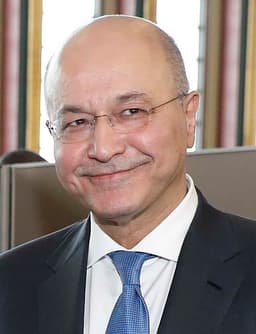
Barham Salih
Politician · Modern
56.4Total

George Yeo
Politician · Modern
51.9Total
Basic Information
Born
1960
1954
Died
—
—
Era
Modern
Modern
Nationality
Iraq
Singapore
Occupation
Politician
Politician
Civilization
Middle Eastern
Eastern
Score Comparison
Military (10%)
50.0
14.9
Political (20%)
72.0
59.3
Influence (20%)
54.9
62.0
Legacy (20%)
42.5
49.2
Leadership (15%)
80.0
72.0
Strategy (15%)
42.0
29.4
TOTAL
56.4
51.9
Barham Salih — Complete Timeline
2018 AD
Elected President of IraqPolitical Action◆ Major
Barham Salih was elected President of Iraq by parliament, succeeding Fuad Masum. As a Kurdish politician, his election continued the tradition of a Kurdish president in the post-2005 political system.
PresidencyKurdish Leadership
Impact: nationalconstructive
2019 AD
Proposed Reform AgendaReform
Salih proposed a reform agenda including anti-corruption measures, economic diversification, and improved governance. His proposals came amid widespread protests demanding political change and better public services.
ReformAnti-CorruptionProtests
Impact: nationalconstructive
2022 AD
Left Office after Single TermPolitical Action
Barham Salih left the presidency after his single term ended, following the 2022 presidential election. He was succeeded by Abdul Latif Rashid, another Kurdish politician.
End of TermPolitical Transition
Impact: national
George Yeo — Complete Timeline
1988 AD
Elected to Parliament for Aljunied GRCPolitical Action
George Yeo was first elected to Parliament as a Member of Parliament for Aljunied GRC. This marked the beginning of his political career in the People's Action Party.
ElectionParliamentPAP
constructive
1991 AD
Appointed Minister for Information and the ArtsPolitical Action
Yeo was appointed Minister for Information and the Arts, where he championed cultural development and the arts in Singapore. He oversaw the establishment of the National Arts Council and the Singapore Art Museum.
Cultural PolicyArtsSingapore
Impact: nationalconstructive
1999 AD
Appointed Minister for Trade and IndustryPolitical Action◆ Major
Yeo was appointed Minister for Trade and Industry, overseeing Singapore's economic development and trade negotiations. He promoted innovation and entrepreneurship, and helped steer the economy through the post-Asian financial crisis period.
Economic PolicyTradeIndustry
Impact: nationalconstructive
2004 AD
Appointed Minister for Foreign AffairsPolitical Action◆ Major
George Yeo was appointed Singapore's Minister for Foreign Affairs, serving until 2011. He played a key role in shaping Singapore's foreign policy, including strengthening ties with China and India, and advocating for ASEAN integration.
DiplomacyASEANSingapore Foreign Policy
Impact: regionalconstructive
2011 AD
Lost Parliamentary Seat in General ElectionPolitical Action◆ Major
George Yeo lost his parliamentary seat in Aljunied GRC to the Workers' Party in the 2011 general election. This defeat ended his 23-year political career and was a significant setback for the People's Action Party.
Election DefeatPolitical CareerPAP
Impact: nationaltragic
This comparison has not been analyzed yet.
One-time AI generation (~1 minute). Scores and timeline are already available below.
Rankings
🥇
Barham SalihLeader
Mil: 50.0Pol: 72.0Inf: 54.9
56.4
🥈
George Yeo
Mil: 14.9Pol: 59.3Inf: 62.0
51.9
+4.5 behind
How This Comparison Works
Algorithm
Each figure is scored on 6 dimensions (0—100 scale) based on structured historical data: Military (10%), Political (20%), Influence (20%), Legacy (20%), Leadership (15%), Strategy (15%). The weighted total produces the final ranking.
Data Sources
Scores are computed from structured sub-indicators in the database. Scale factors adjust for era (Ancient ×0.85, Modern ×1.0) and civilization size (Eastern ×1.05, Other ×0.80) to account for differences in population and military scale.
Maximum 3 Figures
Comparisons are limited to 2—3 figures to ensure readability and statistical meaningfulness.
Error Margins
±5 points per dimension — Sub-scores are derived from historical records with inherent uncertainty. Two figures within 5 points on a dimension should be considered roughly equivalent in that area.
Total Score Accuracy
±3 points overall — The weighted combination of 6 dimensions produces a total score with approximately ±3 points of uncertainty. Differences of less than 3 points are not statistically significant— the figures are effectively tied.
Known Limitations
- Historical records are incomplete and uneven across civilizations
- Figures from oral-tradition societies may be underrepresented
- Occupation labels can misclassify multi-role figures
- Scores measure capability and impact, not moral character
- Quantitative scoring is a comparison tool, not absolute truth
Capability Radar
Military (10%) — Battles & Warfare
Battles
22
12
Win Rate
27
16
Expansion
29
23
Political (20%) — Governance & Reform
Reform
55
65
Diplomacy
60
75
Economy
45
70
Influence (20%) — Cultural & Global Reach
Cultural
30
55
Global
30
55
Legacy (20%) — Historical Impact
Historical
35
50
Longevity
20
45
Leadership (15%) — Power & Stability
Tenure
40
60
Stability
35
65
Strategy (15%) — Tactics & Innovation
Strategy
30
22
Tactics
35
26
Reform
37
32
Similar Comparisons
Comments & Discussion
No comments yet. Be the first to share your thoughts!