Loading...
Bayinnaung vs Dinh Tien Hoang
Bayinnaung leads by 8.2 pts · 2 figures compared
…
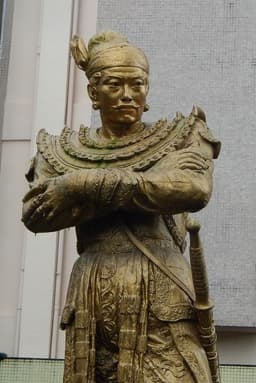
Bayinnaung
Emperor · Modern
68.6Total
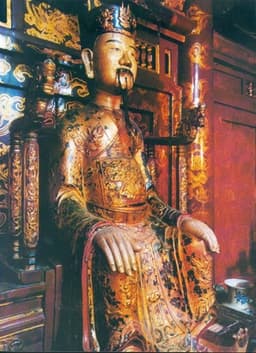
Dinh Tien Hoang
Emperor · Medieval
60.4Total
Basic Information
Born
1516
924
Died
1581
979
Era
Modern
Medieval
Nationality
Myanmar
Vietnam
Occupation
Emperor
Emperor
Civilization
Eastern
Eastern
Score Comparison
Military (10%)
77.1
60.0
Political (20%)
82.0
72.0
Influence (20%)
65.0
65.0
Legacy (20%)
55.0
40.0
Leadership (15%)
74.0
77.2
Strategy (15%)
75.0
58.0
TOTAL
68.6
60.4
Bayinnaung — Complete Timeline
1550 AD
Establishment of the Toungoo EmpirePolitical Action
King Bayinnaung ascended the throne and began a series of military campaigns that created the largest empire in Southeast Asian history. At its peak, the Toungoo empire covered modern Myanmar, Thailand, Laos, and parts of China and India.
Toungoo EmpireSoutheast AsiaImperial Expansion
Impact: regionalconstructive
1557 AD
Conquest of the Shan StatesWar◆ Major
King Bayinnaung conquered the Shan States, bringing them under Toungoo control. This expansion added significant territory and resources to the Burmese empire.
Shan StatesToungoo ExpansionBurmese Empire
Impact: regional
1569 AD
Capture of AyutthayaWar
King Bayinnaung's forces captured the Siamese capital of Ayutthaya after a long siege. He installed a vassal king and made Siam a tributary state of the Toungoo empire.
Burmese-Siamese WarAyutthayaToungoo Empire
Impact: regional
1570 AD
Administrative ReformsReform◆ Major
King Bayinnaung implemented administrative reforms to govern his vast empire, including the appointment of governors and the standardization of laws and taxes. These reforms helped maintain control over conquered territories.
GovernanceAdministrationToungoo Empire
Impact: regionalconstructive
1574 AD
Conquest of Lan XangWar◆ Major
King Bayinnaung conquered the Lao kingdom of Lan Xang (modern Laos), bringing it under Toungoo control. This further expanded the Burmese empire to its greatest territorial extent.
Lan XangToungoo ExpansionLaos
Impact: regional
Dinh Tien Hoang — Complete Timeline
968 AD
Defeat of the Twelve WarlordsWar
Dinh Bo Linh, later known as Dinh Tien Hoang, unified Vietnam by defeating the Twelve Warlords who had divided the country after the collapse of Chinese rule. He established the Dinh dynasty and became the first emperor of an independent Vietnam.
UnificationDinh DynastyVietnamese Independence
Impact: nationalconstructive
Establishment of the Dinh DynastyPolitical Action◆ Major
Dinh Tien Hoang founded the Dinh dynasty and declared himself Emperor. He moved the capital to Hoa Lu and implemented administrative reforms to consolidate power. This marked the beginning of a new era of Vietnamese independence after centuries of Chinese domination.
Dynasty FoundingCapital MoveAdministrative Reform
Impact: nationalconstructive
979 AD
Assassination of Dinh Tien HoangPolitical Action◆ Major
Dinh Tien Hoang and his crown prince were assassinated by a court official while sleeping. The murder plunged the Dinh dynasty into chaos, leading to a succession crisis and eventual takeover by Le Hoan. The assassination ended the short-lived Dinh dynasty.
AssassinationSuccession CrisisEnd of Dinh Dynasty
Impact: nationaltragic
Expert Analysis
Bayinnaung vs Dinh Tien Hoang
The Emperor and the Unifier
In the steamy heat of a Southeast Asian dawn, two men stood at the threshold of power, separated by centuries and geography, yet linked by a common ambition: to forge order from chaos. One would build an empire so vast it would be remembered for half a millennium; the other would lay a foundation so fragile that his own blood would wash it away within a decade. Their stories, told side by side, reveal the thin line between triumph and tragedy in the forging of nations.
Origins
Bayinnaung was born in 1516 into a fractious Burma, a land of warring kingdoms and shifting alliances. His father was a minor noble, and his early life was one of obscurity—until he caught the eye of King Tabinshwehti, who recognized in the boy a rare blend of ambition and loyalty. Bayinnaung rose through the ranks as a soldier and confidant, learning the arts of war and statecraft in the crucible of constant conflict. The Toungoo dynasty was still young, and its survival depended on men who could wield both sword and scroll.
Dinh Tien Hoang, born in 924, emerged from a different kind of darkness. For nearly a millennium, Vietnam had been a province of Chinese empires, its identity suppressed under layers of Confucian bureaucracy and cultural domination. When the Tang dynasty collapsed, local warlords—known as the Twelve Warlords—carved up the land into petty fiefdoms. Dinh Bo Linh, as he was then called, grew up in this blood-soaked patchwork, the son of a regional governor who taught him that survival meant seizing what others could not hold.
Rise to Power
Bayinnaung’s path to the throne was paved with blood and patience. In 1550, after the death of his mentor Tabinshwehti, he ascended as king of the Toungoo dynasty. He did not inherit a stable realm; he inherited a powder keg. Within months, he launched campaigns that would define his reign. His strategy was relentless: conquer, consolidate, then conquer again. By 1557, he had subdued the Shan States, absorbing their lands and their fighting men into his growing war machine. Each victory was a stepping stone, and Bayinnaung never paused to admire the view.
Dinh Tien Hoang’s rise was more direct, born of a single, decisive moment. In 968, after years of grinding warfare, he defeated the last of the Twelve Warlords. The victory was not merely military; it was psychological. He declared himself Emperor—a title no Vietnamese ruler had dared claim in centuries—and established the Dinh dynasty. He moved his capital to Hoa Lu, a fortress of limestone karsts and narrow valleys, where he could defend his fledgling state from any Chinese revanchist dream. The unification of Vietnam was his singular achievement, and he accomplished it in less than a decade.
Leadership & Governance
Bayinnaung’s genius lay not only in conquest but in administration. By 1570, he had implemented sweeping reforms to govern his sprawling empire, which stretched from the Irrawaddy delta to the Mekong. He appointed loyal governors to oversee provinces, standardized weights and measures, and patronized Buddhist monasteries to bind his realm with a common faith. Yet his greatest triumph came in 1569, when his forces captured the Siamese capital of Ayutthaya after a brutal siege. Rather than destroy it, he installed a vassal king and demanded tribute—a strategy of control through deference, not annihilation. His empire was a mosaic of client states, held together by fear and reward.
Dinh Tien Hoang’s governance was more intimate and more precarious. With only a small territory and a young dynasty, he focused on survival. He built fortifications, forged alliances with local chieftains, and enforced a strict legal code. But his rule was shadowed by paranoia. He surrounded himself with loyalists, yet could not trust even his own court. The machinery of state was personal, not institutional—a weakness that would prove fatal.
Triumph & Tragedy
Bayinnaung’s zenith came in 1574, when he conquered the Lao kingdom of Lan Xang. His empire now covered most of mainland Southeast Asia, the largest such domain in the region’s history. He was called “the Conqueror of Ten Directions,” and envoys from as far as India brought gifts. But the empire was a gilded cage. Its borders were overstretched, its vassals restless. After his death in 1581, the structure he had built crumbled within decades, undone by the very centrifugal forces he had tried to master.
Dinh Tien Hoang’s tragedy was more personal. In 979, while he and his crown prince slept, a court official crept into their chamber and murdered them both. The motive remains obscure—perhaps a personal grudge, perhaps a political conspiracy. The Dinh dynasty, barely a decade old, collapsed into chaos. Within years, Vietnam fell under the control of the Early Le dynasty, and Dinh’s dream of an independent Vietnam survived only because others would later reclaim it.
Character & Destiny
Bayinnaung was a builder, but he built on sand. His ambition was boundless, his energy inexhaustible, yet he never solved the fundamental problem of empire: how to make conquered peoples loyal. He ruled through fear and patronage, not through shared identity. His legacy was a monument to will, but also to its limits.
Dinh Tien Hoang was a unifier, but he unified with a knife’s edge. His victory over the Twelve Warlords was a masterpiece of military and political skill, yet he could not secure his own dynasty. His death was a reminder that in the chaos of medieval Southeast Asia, even the strongest ruler could be undone by a single dagger.
Legacy
Today, Bayinnaung is remembered as a national hero in Myanmar, a symbol of the Toungoo dynasty’s golden age. His conquests are taught in schools, his name invoked by generals and politicians. Yet his empire vanished, leaving no lasting institutions, only memories.
Dinh Tien Hoang is revered in Vietnam as the father of independence, the man who broke the Chinese yoke. His assassination is a cautionary tale, but his achievement—the unification of Vietnam—endured. Later dynasties would build on his foundation, and the nation he forged, however fragile, never again returned to Chinese rule.
Conclusion
Two men, two empires, two fates. Bayinnaung conquered the world but could not keep it; Dinh Tien Hoang built a nation but could not protect his own life. Their stories remind us that history rewards not just the bold, but the lucky—and that the greatest victories are often the most fragile. In the end, what remains is not the size of the empire, but the depth of the foundation.
Rankings
🥇
BayinnaungLeader
Mil: 77.1Pol: 82.0Inf: 65.0
68.6
🥈
Dinh Tien Hoang
Mil: 60.0Pol: 72.0Inf: 65.0
60.4
+8.2 behind
How This Comparison Works
Algorithm
Each figure is scored on 6 dimensions (0—100 scale) based on structured historical data: Military (10%), Political (20%), Influence (20%), Legacy (20%), Leadership (15%), Strategy (15%). The weighted total produces the final ranking.
Data Sources
Scores are computed from structured sub-indicators in the database. Scale factors adjust for era (Ancient ×0.85, Modern ×1.0) and civilization size (Eastern ×1.05, Other ×0.80) to account for differences in population and military scale.
Maximum 3 Figures
Comparisons are limited to 2—3 figures to ensure readability and statistical meaningfulness.
Error Margins
±5 points per dimension — Sub-scores are derived from historical records with inherent uncertainty. Two figures within 5 points on a dimension should be considered roughly equivalent in that area.
Total Score Accuracy
±3 points overall — The weighted combination of 6 dimensions produces a total score with approximately ±3 points of uncertainty. Differences of less than 3 points are not statistically significant— the figures are effectively tied.
Known Limitations
- Historical records are incomplete and uneven across civilizations
- Figures from oral-tradition societies may be underrepresented
- Occupation labels can misclassify multi-role figures
- Scores measure capability and impact, not moral character
- Quantitative scoring is a comparison tool, not absolute truth
Capability Radar
Military (10%) — Battles & Warfare
Battles
85
70
Win Rate
90
75
Expansion
92
65
Political (20%) — Governance & Reform
Reform
70
70
Diplomacy
78
65
Economy
72
60
Influence (20%) — Cultural & Global Reach
Cultural
70
65
Global
55
55
Legacy (20%) — Historical Impact
Historical
75
75
Longevity
60
70
Leadership (15%) — Power & Stability
Tenure
85
60
Stability
65
55
Strategy (15%) — Tactics & Innovation
Strategy
88
70
Tactics
80
65
Reform
75
60
Similar Comparisons
Comments & Discussion
Bayinnaung's Ghost6/16/2026
Bayinnaung wasn't just bigger—he was a gearhead of war. Dinh Tien Hoang's Vietnam was a patchwork of twelve warlords, barely a skirmish league. Bayinnaung conquered 19+ states in 30 years, using Portuguese mercenaries and elephant cavalry like a proto-steamroller. Dinh's success was born of Chinese collapse, not raw ambition. One built an empire that spanned from Laos to Siam; the other built a dynasty that crumbled when his son died. That's the difference between a carpenter and a demolitions e
弯刀统御6/16/2026
别被“统一者”的头衔骗了。Dinh Tien Hoang靠的是血腥清洗——他处决了所有对手,连亲儿子都未放过,才勉强把十二使君时代压成一种短暂秩序。Bayinnaung至少试图通过联姻和佛教将多样民族黏合起来,丁朝那套纯粹是恐惧管理,根基浅得像雨季的水洼。一个建了座庙,一个搭了个纸棚。
Empire's Accountant6/16/2026
Let's talk numbers. Bayinnaung's "empire" covered roughly 1.5 million sq km at its peak, with a population maybe 5-6 million. Dinh Tien Hoang's Dai Co Viet was about 200,000 sq km and maybe 2 million people. Scale matters for comparative greatness—Bayinnaung managed cross-cultural logistics across Mon, Shan, Thai, and Burmese territories. Dinh's achievement was reuniting his own ethnic core after a civil war. That's not emperor vs. emperor; that's a marathon runner vs. a long-distance sprinter.
历史透镜6/16/2026
比较这两位等于拿望远镜看一颗钉。Bayinnaung活在16世纪东南亚的多极世界里,靠葡萄牙火器和缅甸战象扩张;Dinh Tien Hoang面对的是五代十国的碎片化中国边境。Dinh的“统一”更像是清场式的屠杀,而Bayinnaung的帝国包容了不同的信仰和语言。如果你问谁更配称“大帝”,我选那个让敌人主动称臣而非战栗的人。