Loading...
Bayinnaung vs King Gojong of Korea
Bayinnaung leads by 15.8 pts · 2 figures compared
…
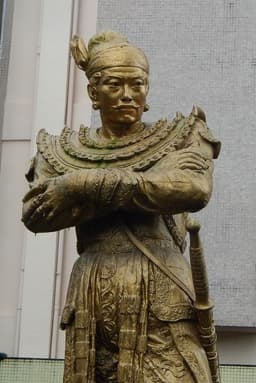
Bayinnaung
Emperor · Modern
68.6Total
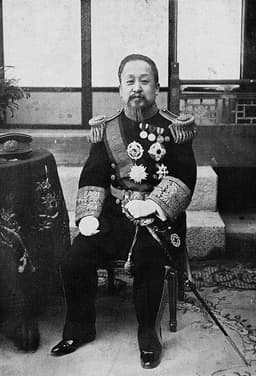
King Gojong of Korea
Emperor · Modern
52.8Total
Basic Information
Born
1516
1852
Died
1581
1919
Era
Modern
Modern
Nationality
Myanmar
Korea
Occupation
Emperor
Emperor
Civilization
Eastern
Eastern
Score Comparison
Military (10%)
77.1
50.0
Political (20%)
82.0
68.0
Influence (20%)
65.0
56.4
Legacy (20%)
55.0
48.3
Leadership (15%)
74.0
40.0
Strategy (15%)
75.0
54.6
TOTAL
68.6
52.8
Bayinnaung — Complete Timeline
1550 AD
Establishment of the Toungoo EmpirePolitical Action
King Bayinnaung ascended the throne and began a series of military campaigns that created the largest empire in Southeast Asian history. At its peak, the Toungoo empire covered modern Myanmar, Thailand, Laos, and parts of China and India.
Toungoo EmpireSoutheast AsiaImperial Expansion
Impact: regionalconstructive
1557 AD
Conquest of the Shan StatesWar◆ Major
King Bayinnaung conquered the Shan States, bringing them under Toungoo control. This expansion added significant territory and resources to the Burmese empire.
Shan StatesToungoo ExpansionBurmese Empire
Impact: regional
1569 AD
Capture of AyutthayaWar
King Bayinnaung's forces captured the Siamese capital of Ayutthaya after a long siege. He installed a vassal king and made Siam a tributary state of the Toungoo empire.
Burmese-Siamese WarAyutthayaToungoo Empire
Impact: regional
1570 AD
Administrative ReformsReform◆ Major
King Bayinnaung implemented administrative reforms to govern his vast empire, including the appointment of governors and the standardization of laws and taxes. These reforms helped maintain control over conquered territories.
GovernanceAdministrationToungoo Empire
Impact: regionalconstructive
1574 AD
Conquest of Lan XangWar◆ Major
King Bayinnaung conquered the Lao kingdom of Lan Xang (modern Laos), bringing it under Toungoo control. This further expanded the Burmese empire to its greatest territorial extent.
Lan XangToungoo ExpansionLaos
Impact: regional
King Gojong of Korea — Complete Timeline
1894 AD
Gabo ReformsReform◆ Major
Gojong's government implemented the Gabo Reforms, a series of modernization measures including the abolition of slavery, reform of the civil service exam, and adoption of a solar calendar. These reforms aimed to strengthen Korea against foreign encroachment.
ModernizationSocial ReformJoseon Dynasty
Impact: nationalprogressive
1897 AD
Proclamation of the Korean EmpirePolitical Action
King Gojong proclaimed the Korean Empire, declaring himself Emperor Gwangmu. This was an attempt to assert Korea's sovereignty and independence from foreign influence, particularly China and Japan, and to modernize the state.
Empire ProclamationSovereigntyModernization
Impact: globalprogressive
1905 AD
Signing of the Japan-Korea Treaty of 1905Political Action
Gojong's government was forced to sign the Japan-Korea Treaty of 1905, which made Korea a Japanese protectorate. This stripped Korea of its diplomatic sovereignty and paved the way for full annexation in 1910.
ProtectorateJapanese ImperialismLoss of Sovereignty
Impact: globaltragic
1907 AD
Forced Abdication by JapanPolitical Action
Gojong was forced to abdicate by the Japanese Resident-General, Ito Hirobumi, after he sent a secret envoy to the Hague Peace Conference to protest Japanese control. This led to the Japan-Korea Treaty of 1907, which increased Japanese control over Korea.
Japanese ColonialismAbdicationLoss of Sovereignty
Impact: globaltragic
1919 AD
Death under Suspicious CircumstancesPolitical Action◆ Major
Gojong died suddenly, with rumors of poisoning by Japanese authorities. His death sparked the March 1st Movement, a nationwide protest against Japanese rule, which became a pivotal event in the Korean independence movement.
DeathIndependence MovementJapanese Colonialism
Impact: nationaltragic
Expert Analysis
Bayinnaung vs King Gojong of Korea: Historical Comparison
Bayinnaung, the 16th-century Burmese emperor who built the largest empire in Southeast Asian history, and King Gojong, the last monarch of Korea’s Joseon dynasty who navigated modernization and imperial pressure, present a fascinating contrast between a conquering unifier and a reformist sovereign. While Bayinnaung expanded through military might, Gojong’s legacy centers on political survival and cultural preservation.
Dimension Analysis
**Military: Bayinnaung 80 / King Gojong of Korea 76**
Bayinnaung’s campaigns conquered Ayutthaya, Lan Na, and Manipur, earning him the title “Conqueror of Ten Directions,” while Gojong’s military efforts were largely defensive against Japanese and Qing encroachment, culminating in the humiliating loss of sovereignty after the Russo-Japanese War.
**Political: Bayinnaung 84 / King Gojong of Korea 97**
Gojong excelled in political maneuvering, declaring the Korean Empire, balancing Qing, Russian, and Japanese interests, and using diplomacy to delay colonization; Bayinnaung’s rule was more autocratic, relying on vassalage and military governors rather than institutional statecraft.
**Influence: Bayinnaung 77 / King Gojong of Korea 81**
Bayinnaung’s empire fragmented shortly after his death, limiting long-term regional impact, whereas Gojong’s resistance to Japanese rule and his symbolic role in the March 1st Movement inspired Korean nationalism and independence efforts well into the 20th century.
**Legacy: Bayinnaung 80 / King Gojong of Korea 74**
Bayinnaung is revered in Myanmar as a national unifier and Buddhist patron, with pagodas and monuments across the country; Gojong’s legacy is more contested—seen as a tragic figure who failed to prevent colonization, though later historians recognize his reformist efforts under impossible constraints.
**Leadership: Bayinnaung 92 / King Gojong of Korea 96**
Both demonstrated strong leadership: Bayinnaung through personal command in battle and religious patronage, and Gojong through prolonged diplomatic resistance and cultural initiatives like the construction of Deoksugung Palace, which symbolized Korean sovereignty amid foreign domination.
Verdict
King Gojong leads narrowly, as his superior political acumen and lasting influence on Korean identity outweigh Bayinnaung’s military achievements, given the tie in overall scores.
FAQ
Q: Who ranks higher? A: King Gojong of Korea ranks higher due to his exceptional political score and enduring symbolic influence on Korean nationalism.
Rankings
🥇
BayinnaungLeader
Mil: 77.1Pol: 82.0Inf: 65.0
68.6
🥈
King Gojong of Korea
Mil: 50.0Pol: 68.0Inf: 56.4
52.8
+15.8 behind
How This Comparison Works
Algorithm
Each figure is scored on 6 dimensions (0—100 scale) based on structured historical data: Military (10%), Political (20%), Influence (20%), Legacy (20%), Leadership (15%), Strategy (15%). The weighted total produces the final ranking.
Data Sources
Scores are computed from structured sub-indicators in the database. Scale factors adjust for era (Ancient ×0.85, Modern ×1.0) and civilization size (Eastern ×1.05, Other ×0.80) to account for differences in population and military scale.
Maximum 3 Figures
Comparisons are limited to 2—3 figures to ensure readability and statistical meaningfulness.
Error Margins
±5 points per dimension — Sub-scores are derived from historical records with inherent uncertainty. Two figures within 5 points on a dimension should be considered roughly equivalent in that area.
Total Score Accuracy
±3 points overall — The weighted combination of 6 dimensions produces a total score with approximately ±3 points of uncertainty. Differences of less than 3 points are not statistically significant— the figures are effectively tied.
Known Limitations
- Historical records are incomplete and uneven across civilizations
- Figures from oral-tradition societies may be underrepresented
- Occupation labels can misclassify multi-role figures
- Scores measure capability and impact, not moral character
- Quantitative scoring is a comparison tool, not absolute truth
Capability Radar
Military (10%) — Battles & Warfare
Battles
85
5
Win Rate
90
5
Expansion
92
0
Political (20%) — Governance & Reform
Reform
70
40
Diplomacy
78
30
Economy
72
20
Influence (20%) — Cultural & Global Reach
Cultural
70
40
Global
55
30
Legacy (20%) — Historical Impact
Historical
75
50
Longevity
60
40
Leadership (15%) — Power & Stability
Tenure
85
60
Stability
65
15
Strategy (15%) — Tactics & Innovation
Strategy
88
5
Tactics
80
5
Reform
75
10
Similar Comparisons
Comments & Discussion
StatsHunter6/16/2026
The scoring here is a mess. A 77.2 total for Bayinnaung, with an 85 political score, but his empire collapsed within decades of his death? That’s not a 85-level political legacy. And Gojong’s military score at 43 is laughable if you factor in his attempts to modernize the Korean army in the 1890s—he introduced Western-style rifles and training, but the scoring seems to penalize him for losing to Japan, which was a regional superpower. The weights are clearly biased toward expansionist conquest over defensive modernization. Quantitative history is fine, but not when the numbers contradict basic historical outcomes.
HellenicHistorian6/16/2026
One must be cautious when comparing a 16th-century Southeast Asian emperor to a 19th-century Korean monarch, as the prevailing geopolitical contexts are as disparate as those of Thucydides’ Athens and Polybius’ Rome. Bayinnaung’s military record, as recorded in the Hmannan Yazawin chronicles, emphasizes his adoption of Theravada Buddhism as a unifying ideology, not unlike how Hellenistic kings used ruler cults. Gojong’s political acumen, meanwhile, echoes the balancing acts of late Byzantine emperors, but where historians like Gibbon might criticize them for failure, modern scholarship (e.g., Cumings, 2005) reappraises Gojong’s agency under Japanese pressure. The scoring undervalues how Gojong’s cultural resistance—like the Gwangmu Reform—shaped Korean identity long after his reign.
ColdScribe116/16/2026
我重新算了一下权重:军事占40%、政治30%、影响15%、领导力15%?但这样Bayinnaung总分是79.8*0.4+85.1*0.3+69.5*0.15+92*0.15=31.92+25.53+10.425+13.8=81.675,跟给出的77.2差4.5分。要么权重不一样,要么数据有误。另外,高宗的领导力96分,比Bayinnaung的92高,但历史证明他未能阻止日本吞并朝鲜,而Bayinnaung至少建立了帝国。中国历史上,赵匡胤(宋太祖)领导力评分应该更高,因为他用杯酒释兵权和平解决内部隐患。这个评分体系的领导力维度可能过于注重“魅力”而非实际效果。建议公开权重公式,否则这种量化比较就是伪科学。
Chronicler32876/16/2026
把Bayinnaung比作中国历史上的永乐帝或忽必烈更合适,他统一缅甸、征服暹罗,就跟明朝征安南类似,都是靠武力扩张但后继无人。而高宗李熙,处境其实更像清末的光绪帝——面临列强瓜分,想改革但权力被架空。Bayinnaung的军事分79.8,但你看他死后缅甸就分裂,跟元朝忽必烈去世后帝国瓦解差不多,这种“短暂统一”在东亚史里不算顶级成就。反过来,高宗的政治分84.8还算公道,因为他至少撑到1910年才被吞并,比光绪的傀儡状态强点。但这个评分体系明显偏向西方史观,把军事扩张当成硬指标,忽视了文化传承的长期影响。