Loading...
This comparison has not been analyzed yet.
One-time AI generation (~1 minute). Scores and timeline are already available below.
Bazilio Olara-Okello vs Mariano Arista
Mariano Arista leads by 4.1 pts · 2 figures compared
…

Bazilio Olara-Okello
General · Modern
39.1Total
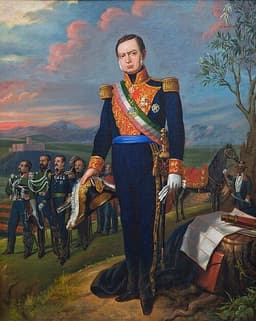
Mariano Arista
General · Modern
43.2Total
Basic Information
Born
1929
1802
Died
—
1855
Era
Modern
Modern
Nationality
Uganda
Mexico
Occupation
General
General
Civilization
Other
Western
Score Comparison
Military (10%)
50.0
38.3
Political (20%)
26.4
35.1
Influence (20%)
47.9
49.4
Legacy (20%)
38.3
40.0
Leadership (15%)
30.0
48.4
Strategy (15%)
41.0
45.0
TOTAL
39.1
43.2
Bazilio Olara-Okello — Complete Timeline
1979 AD
Role in the Uganda-Tanzania WarWar
Olara-Okello fought in the Uganda-Tanzania War (1978-1979) as a commander in the Uganda National Liberation Army. He participated in the overthrow of Idi Amin, contributing to the eventual capture of Kampala by Tanzanian and Ugandan rebel forces.
WarUgandaTanzania
Impact: regional
1985 AD
Overthrow of Milton ObotePolitical Action◆ Major
Bazilio Olara-Okello led the military coup that overthrew President Milton Obote in July 1985. As a senior general in the Uganda National Liberation Army, he orchestrated the takeover, which ended Obote's second presidency and installed a military junta.
CoupUgandaOverthrow
Impact: nationaldestructive
Head of State of UgandaPolitical Action◆ Major
Following the coup, Olara-Okello briefly served as Head of State of Uganda from July to August 1985. He then handed over power to Tito Okello, who became president, while Olara-Okello remained a key military figure in the junta.
Head of StateUgandaMilitary Junta
Impact: national
1986 AD
Exile after Museveni's victoryPolitical Action
After Museveni's National Resistance Army captured Kampala in January 1986, Olara-Okello fled into exile. He lived in Sudan and later returned to Uganda, but remained politically marginalized.
ExileUgandaPolitical Marginalization
Impact: nationaltragic
Mariano Arista — Complete Timeline
1846 AD
Appointed Commander of the Army of the NorthWar
Arista was appointed commander of the Mexican Army of the North at the start of the Mexican-American War. He was responsible for defending the northern frontier against U.S. forces under General Zachary Taylor.
Mexican-American WarArmy of the NorthTaylor
Impact: regional
Battle of Palo AltoWar◆ Major
Arista commanded Mexican forces at the Battle of Palo Alto, the first major engagement of the Mexican-American War. His army was defeated by U.S. forces using superior artillery, forcing a retreat.
Mexican-American WarBattleDefeat
Impact: regionaltragic
Battle of Resaca de la PalmaWar◆ Major
Arista's forces were defeated again at the Battle of Resaca de la Palma. The U.S. Army captured his personal papers and artillery, leading to his removal from command and a court-martial.
Mexican-American WarBattleDefeat
Impact: regionaltragic
1851 AD
Became President of MexicoPolitical Action◆ Major
Arista was elected president of Mexico in 1851, succeeding Jos
PresidencyEconomic ReformConservatives
Impact: nationalconstructive
1853 AD
Overthrown by Santa AnnaPolitical Action◆ Major
Arista was overthrown by a conservative revolt led by Antonio L
OverthrowSanta AnnaExile
Impact: nationaltragic
This comparison has not been analyzed yet.
One-time AI generation (~1 minute). Scores and timeline are already available below.
Rankings
🥇
Mariano AristaLeader
Mil: 38.3Pol: 35.1Inf: 49.4
43.2
🥈
Bazilio Olara-Okello
Mil: 50.0Pol: 26.4Inf: 47.9
39.1
+4.1 behind
How This Comparison Works
Algorithm
Each figure is scored on 6 dimensions (0—100 scale) based on structured historical data: Military (10%), Political (20%), Influence (20%), Legacy (20%), Leadership (15%), Strategy (15%). The weighted total produces the final ranking.
Data Sources
Scores are computed from structured sub-indicators in the database. Scale factors adjust for era (Ancient ×0.85, Modern ×1.0) and civilization size (Eastern ×1.05, Other ×0.80) to account for differences in population and military scale.
Maximum 3 Figures
Comparisons are limited to 2—3 figures to ensure readability and statistical meaningfulness.
Error Margins
±5 points per dimension — Sub-scores are derived from historical records with inherent uncertainty. Two figures within 5 points on a dimension should be considered roughly equivalent in that area.
Total Score Accuracy
±3 points overall — The weighted combination of 6 dimensions produces a total score with approximately ±3 points of uncertainty. Differences of less than 3 points are not statistically significant— the figures are effectively tied.
Known Limitations
- Historical records are incomplete and uneven across civilizations
- Figures from oral-tradition societies may be underrepresented
- Occupation labels can misclassify multi-role figures
- Scores measure capability and impact, not moral character
- Quantitative scoring is a comparison tool, not absolute truth
Capability Radar
Military (10%) — Battles & Warfare
Battles
20
40
Win Rate
25
30
Expansion
10
20
Political (20%) — Governance & Reform
Reform
5
25
Diplomacy
10
20
Economy
5
15
Influence (20%) — Cultural & Global Reach
Cultural
10
15
Global
5
10
Legacy (20%) — Historical Impact
Historical
15
20
Longevity
5
10
Leadership (15%) — Power & Stability
Tenure
15
30
Stability
5
10
Strategy (15%) — Tactics & Innovation
Strategy
20
30
Tactics
20
35
Reform
10
25
Similar Comparisons
Comments & Discussion
No comments yet. Be the first to share your thoughts!