Loading...
This comparison has not been analyzed yet.
One-time AI generation (~1 minute). Scores and timeline are already available below.
Behanzin vs Hamoud bin Mohammed
Hamoud bin Mohammed leads by 6.2 pts · 2 figures compared
…

Behanzin
Emperor · Modern
49.5Total
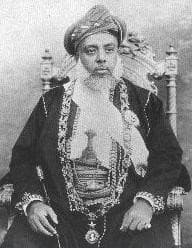
Hamoud bin Mohammed
Emperor · Modern
55.7Total
Basic Information
Born
1844
1853
Died
1906
1902
Era
Modern
Modern
Nationality
Dahomey
Zanzibar
Occupation
Emperor
Emperor
Civilization
Other
Other
Score Comparison
Military (10%)
20.0
43.3
Political (20%)
68.0
62.7
Influence (20%)
56.4
54.9
Legacy (20%)
46.7
46.7
Leadership (15%)
40.0
74.0
Strategy (15%)
55.0
54.3
TOTAL
49.5
55.7
Behanzin — Complete Timeline
1890 AD
Refusal to sign protectorate treatyPolitical Action◆ Major
Upon ascending the throne, Behanzin refused to sign a French protectorate treaty that would have made Dahomey a French colony. This act of defiance directly led to the escalation of hostilities and the Second Franco-Dahomean War.
DiplomacyDefiancePre-War
Impact: regional
1892 AD
Dahomey-French War (Second)War
Behanzin led a full-scale war against French colonial forces under General Alfred Dodds. Despite fierce resistance and the use of the Dahomey Amazons, the French superior firepower and logistics led to the capture of the capital, Abomey, in November 1892.
French ConquestFall of AbomeyColonial War
Impact: regionaltragic
1894 AD
Exile to MartiniquePolitical Action◆ Major
After surrendering to the French in 1894, Behanzin was deposed and exiled to Martinique, a French colony in the Caribbean. This exile ended his reign and marked the definitive end of Dahomey's independence, as the French established full colonial control.
ExileColonial SubjugationEnd of Kingdom
Impact: nationaltragic
Hamoud bin Mohammed — Complete Timeline
1896 AD
British Recognition as SultanPolitical Action◆ Major
After the Anglo-Zanzibar War, the British installed Hamoud bin Mohammed as sultan. He was chosen for his pro-British stance and willingness to cooperate with British anti-slavery policies, marking Zanzibar's transition to a British protectorate.
British ProtectorateInstallationColonial Rule
1897 AD
Abolition of Slavery in ZanzibarReform
Hamoud bin Mohammed issued a decree abolishing the legal status of slavery in Zanzibar. This ended the island's role as a major slave trade hub, freeing approximately 60,000 enslaved people and compensating slave owners.
AbolitionSlaveryHuman Rights
Impact: regionalprogressive
Enactment of the Slavery Abolition DecreeReform◆ Major
Hamoud bin Mohammed signed the Slavery Abolition Decree on April 5, 1897, which freed all slaves in Zanzibar and Pemba. The decree included provisions for former slaves to become tenants or wage laborers on plantations.
Abolition DecreeEmancipationSocial Reform
Impact: regionalprogressive
This comparison has not been analyzed yet.
One-time AI generation (~1 minute). Scores and timeline are already available below.
Rankings
🥇
Hamoud bin MohammedLeader
Mil: 43.3Pol: 62.7Inf: 54.9
55.7
🥈
Behanzin
Mil: 20.0Pol: 68.0Inf: 56.4
49.5
+6.2 behind
How This Comparison Works
Algorithm
Each figure is scored on 6 dimensions (0—100 scale) based on structured historical data: Military (10%), Political (20%), Influence (20%), Legacy (20%), Leadership (15%), Strategy (15%). The weighted total produces the final ranking.
Data Sources
Scores are computed from structured sub-indicators in the database. Scale factors adjust for era (Ancient ×0.85, Modern ×1.0) and civilization size (Eastern ×1.05, Other ×0.80) to account for differences in population and military scale.
Maximum 3 Figures
Comparisons are limited to 2—3 figures to ensure readability and statistical meaningfulness.
Error Margins
±5 points per dimension — Sub-scores are derived from historical records with inherent uncertainty. Two figures within 5 points on a dimension should be considered roughly equivalent in that area.
Total Score Accuracy
±3 points overall — The weighted combination of 6 dimensions produces a total score with approximately ±3 points of uncertainty. Differences of less than 3 points are not statistically significant— the figures are effectively tied.
Known Limitations
- Historical records are incomplete and uneven across civilizations
- Figures from oral-tradition societies may be underrepresented
- Occupation labels can misclassify multi-role figures
- Scores measure capability and impact, not moral character
- Quantitative scoring is a comparison tool, not absolute truth
Capability Radar
Military (10%) — Battles & Warfare
Battles
55
5
Win Rate
40
5
Expansion
30
5
Political (20%) — Governance & Reform
Reform
45
70
Diplomacy
50
40
Economy
40
30
Influence (20%) — Cultural & Global Reach
Cultural
45
30
Global
35
40
Legacy (20%) — Historical Impact
Historical
50
50
Longevity
40
40
Leadership (15%) — Power & Stability
Tenure
60
40
Stability
35
30
Strategy (15%) — Tactics & Innovation
Strategy
55
5
Tactics
60
5
Reform
50
5
Similar Comparisons
Comments & Discussion
No comments yet. Be the first to share your thoughts!