Loading...
Ben Chifley vs Midhat Pasha
Midhat Pasha leads by 8.3 pts · 2 figures compared
…

Ben Chifley
Politician · Modern
56.0Total
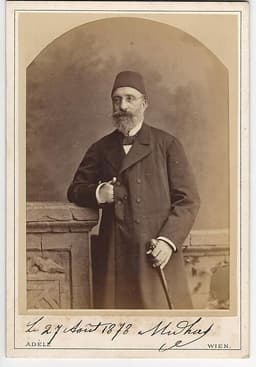
Midhat Pasha
Politician · Modern
64.3Total
Basic Information
Born
1885
1822
Died
1951
1884
Era
Modern
Modern
Nationality
Australia
Ottoman Empire
Occupation
Politician
Politician
Civilization
Western
Middle Eastern
Score Comparison
Military (10%)
48.9
10.0
Political (20%)
72.0
78.0
Influence (20%)
54.9
82.0
Legacy (20%)
47.5
72.0
Leadership (15%)
68.0
62.0
Strategy (15%)
45.0
38.3
TOTAL
56.0
64.3
Ben Chifley — Complete Timeline
1945 AD
Became Prime Minister of AustraliaPolitical Action◆ Major
Ben Chifley became Prime Minister of Australia on July 13, 1945, succeeding John Curtin after his death. He led the Labor government through the post-war reconstruction period.
Prime MinisterPost-WarLabor
Impact: national
1947 AD
Nationalized the Banking System (Attempted)Political Action◆ Major
Chifley's government attempted to nationalize the private banking system in 1947, passing the Banking Act. The High Court declared the act unconstitutional in 1948, and the move was highly controversial, contributing to the Labor government's defeat in 1949.
Bank NationalizationEconomic PolicyControversy
Impact: nationaldestructive
1949 AD
Introduced the Snowy Mountains SchemeReform◆ Major
Chifley's government initiated the Snowy Mountains Hydro-Electric Scheme in 1949, a massive engineering project to divert water for irrigation and generate hydroelectric power. It became a symbol of post-war nation-building and employed thousands of migrants.
Snowy Mountains SchemeInfrastructurePost-War
Impact: nationalconstructive
Defeated in 1949 Federal ElectionPolitical Action◆ Major
Chifley's Labor government was defeated in the federal election on December 10, 1949, by the Liberal-Country Party coalition led by Robert Menzies. The loss ended eight years of Labor rule and began a long period of conservative government.
Election DefeatLaborMenzies
Impact: nationaldestructive
Midhat Pasha — Complete Timeline
1864 AD
Governorship of the Danube VilayetReform◆ Major
As governor of the Danube Vilayet from 1864 to 1868, Midhat Pasha implemented extensive reforms. He built roads, bridges, and schools, established a provincial bank, and promoted agricultural development. His administration became a model for Tanzimat provincial governance.
GovernorshipReformInfrastructure
Impact: regionalconstructive
1872 AD
Appointment as Grand VizierPolitical Action◆ Major
Midhat Pasha was appointed Grand Vizier for the first time in 1872. He had previously served as governor of the Danube Vilayet and was known for his reformist ideas. His tenure was short-lived due to opposition from conservative factions and the sultan.
AppointmentReformOttoman Politics
Impact: nationalconstructive
1876 AD
Proclamation of the Ottoman Constitution of 1876Reform
Midhat Pasha was the chief architect of the first Ottoman Constitution, proclaimed on December 23, 1876. The constitution established a bicameral parliament, guaranteed civil liberties, and limited the sultan's powers. It was a landmark in Ottoman modernization, though it was suspended in 1878.
ConstitutionReformParliament
Impact: nationalprogressive
1881 AD
Exile and TrialPolitical Action◆ Major
Midhat Pasha was arrested in 1881 on charges of involvement in the murder of Sultan Abd
ExileTrialExecution
Impact: nationaltragic
Expert Analysis
Origins
Ben Chifley was born on September 22, 1885, in Bathurst, New South Wales, to Irish Catholic parents. His father was a blacksmith. He left school at 14 to work for the New South Wales Government Railways, where he later became a locomotive driver. He was active in the Australian Labor Party from a young age.
Midhat Pasha was born in 1822 in Istanbul, Ottoman Empire, to a Muslim family of modest means. His father was a judge. He received a traditional Islamic education and entered government service in his youth, working in the secretariat of the Grand Vizier.
Rise to Power
Chifley entered federal politics in 1928, winning the seat of Macquarie. He served as Minister for Defence in the Scullin government (1929-1932). After Labor's defeat, he returned to his union roots. During World War II, he was appointed Treasurer in John Curtin's government in 1941, managing the wartime economy. Upon Curtin's death on July 13, 1945, Chifley became Prime Minister.
Midhat Pasha rose through the Ottoman bureaucracy, becoming governor of the Danube Vilayet in 1864. His successful reforms there gained him national recognition. He served as Grand Vizier briefly in 1872 and again in 1876-1877. His key turning point was the proclamation of the Ottoman Constitution on December 23, 1876, which he championed.
Leadership & Governance
Chifley's leadership style was pragmatic and social-democratic. He believed in state intervention and the welfare state. His government expanded social services, introduced a national airline (TAA), and initiated the Snowy Mountains Hydro-Electric Scheme in 1949. He attempted to nationalize the banking system in 1947, but the High Court declared it unconstitutional. This overreach contributed to his defeat.
Midhat Pasha was a reformist administrator. As governor, he built infrastructure, established a provincial council, and modernized the legal system. As Grand Vizier, he pushed for the constitution, which included a bicameral parliament. However, his reforms faced opposition from Sultan Abdülhamid II, who suspended the constitution in 1878 and exiled Midhat.
Triumph & Tragedy
Chifley's greatest success was managing Australia's post-war reconstruction, maintaining full employment, and launching the Snowy Mountains Scheme. His tragedy was the failed bank nationalization and the 1949 election loss to Robert Menzies, which began 23 years of Liberal rule.
Midhat's triumph was the 1876 Constitution, a milestone in Ottoman history. His tragedy came when Sultan Abdülhamid II exiled him after suspending the constitution. Midhat was later arrested in 1881, tried for the murder of Sultan Abdülaziz, and sentenced to death, commuted to life in prison. He was killed in prison in 1884, likely murdered.
Character & Destiny
Chifley was known for his integrity and plain-speaking. He was a committed socialist but also a pragmatist. His determination to nationalize banks, despite opposition, showed his ideological conviction but also his political inflexibility. This contributed to his downfall.
Midhat was a visionary reformer, but he underestimated the Sultan's power and the conservative forces in the Ottoman Empire. His idealism led him to push for reforms that ultimately cost him his life. Historians view him as a martyr for constitutionalism.
Legacy
Chifley's legacy includes the Snowy Mountains Scheme, a lasting symbol of nation-building. His Labor Party remained influential, but his defeat marked a shift in Australian politics. He scored 47.5 in Legacy, reflecting his limited long-term impact.
Midhat Pasha's legacy is more profound. The 1876 Constitution, though short-lived, inspired later Turkish constitutional movements. He is remembered as the 'Father of the Ottoman Constitution' and a pioneer of democracy in the Islamic world. His Legacy score of 72.0 reflects this enduring influence.
Conclusion
Midhat Pasha had a greater historical impact than Ben Chifley. While Chifley's domestic achievements were notable, they were largely confined to Australia and reversed or overshadowed by subsequent governments. Midhat's constitutional reforms, though suppressed, set a precedent that influenced the modernization of Turkey and the broader Middle East. His total score of 64.3 to Chifley's 56.0 reflects this difference. Midhat's vision for constitutional governance, despite his personal tragedy, left a more lasting mark on world history.
Rankings
🥇
Midhat PashaLeader
Mil: 10.0Pol: 78.0Inf: 82.0
64.3
🥈
Ben Chifley
Mil: 48.9Pol: 72.0Inf: 54.9
56.0
+8.3 behind
How This Comparison Works
Algorithm
Each figure is scored on 6 dimensions (0—100 scale) based on structured historical data: Military (10%), Political (20%), Influence (20%), Legacy (20%), Leadership (15%), Strategy (15%). The weighted total produces the final ranking.
Data Sources
Scores are computed from structured sub-indicators in the database. Scale factors adjust for era (Ancient ×0.85, Modern ×1.0) and civilization size (Eastern ×1.05, Other ×0.80) to account for differences in population and military scale.
Maximum 3 Figures
Comparisons are limited to 2—3 figures to ensure readability and statistical meaningfulness.
Error Margins
±5 points per dimension — Sub-scores are derived from historical records with inherent uncertainty. Two figures within 5 points on a dimension should be considered roughly equivalent in that area.
Total Score Accuracy
±3 points overall — The weighted combination of 6 dimensions produces a total score with approximately ±3 points of uncertainty. Differences of less than 3 points are not statistically significant— the figures are effectively tied.
Known Limitations
- Historical records are incomplete and uneven across civilizations
- Figures from oral-tradition societies may be underrepresented
- Occupation labels can misclassify multi-role figures
- Scores measure capability and impact, not moral character
- Quantitative scoring is a comparison tool, not absolute truth
Capability Radar
Military (10%) — Battles & Warfare
Battles
31
0
Win Rate
33
0
Expansion
34
0
Political (20%) — Governance & Reform
Reform
65
85
Diplomacy
55
70
Economy
70
60
Influence (20%) — Cultural & Global Reach
Cultural
40
55
Global
30
55
Legacy (20%) — Historical Impact
Historical
50
70
Longevity
35
60
Leadership (15%) — Power & Stability
Tenure
45
65
Stability
60
40
Strategy (15%) — Tactics & Innovation
Strategy
39
0
Tactics
38
0
Reform
42
10
Similar Comparisons
Comments & Discussion
No comments yet. Be the first to share your thoughts!