Loading...
Binyamin Netanyahu vs Salva Kiir
Binyamin Netanyahu leads by 11.1 pts · 2 figures compared
…
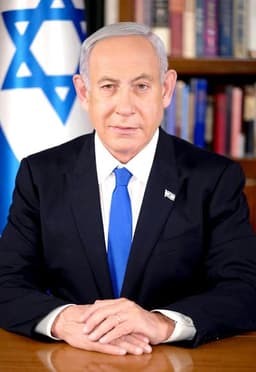
Binyamin Netanyahu
Politician · Modern
56.3Total

Salva Kiir
Politician · Modern
45.2Total
Basic Information
Born
1949
1951
Died
—
—
Era
Modern
Modern
Nationality
Israel
South Sudan
Occupation
Politician
Politician
Civilization
Middle Eastern
Other
Score Comparison
Military (10%)
21.2
29.8
Political (20%)
65.0
29.3
Influence (20%)
58.3
51.0
Legacy (20%)
58.0
41.7
Leadership (15%)
78.0
62.2
Strategy (15%)
36.8
52.8
TOTAL
56.3
45.2
Binyamin Netanyahu — Complete Timeline
1996 AD
First Term as Prime Minister of IsraelPolitical Action◆ Major
Netanyahu became the youngest person to serve as Prime Minister of Israel after winning the 1996 election. His first term was marked by a slowdown in the Oslo peace process and increased settlement construction in the West Bank.
Israeli PoliticsElectionPeace Process
Impact: regional
1998 AD
Signed the Wye River MemorandumPolitical Action◆ Major
Netanyahu signed the Wye River Memorandum with Yasser Arafat, which outlined further Israeli withdrawals from the West Bank and security cooperation. The agreement was never fully implemented due to political opposition in Israel.
Israeli-Palestinian PeaceWye RiverNegotiations
Impact: regional
2012 AD
Addressed the United Nations General Assembly on Iran Nuclear ThreatPolitical Action◆ Major
Netanyahu delivered a speech at the UN General Assembly where he drew a red line on a diagram of a bomb to illustrate the point at which Iran's nuclear program would become irreversible. This speech was a major diplomatic effort to pressure the international community to take action against Iran.
Iran Nuclear ProgramUN SpeechDiplomacy
Impact: global
2019 AD
Became Longest-Serving Prime Minister of IsraelPolitical Action◆ Major
Netanyahu surpassed David Ben-Gurion's record to become Israel's longest-serving prime minister. His tenure was characterized by political stability, economic growth, and a rightward shift in Israeli politics, but also by corruption investigations and political polarization.
Israeli PoliticsRecordLongevity
Impact: national
Indicted for CorruptionPolitical Action◆ Major
Israel's Attorney General indicted Netanyahu on charges of bribery, fraud, and breach of trust in three separate cases. The indictments led to ongoing legal proceedings and political crises, including multiple elections and a power-sharing government.
CorruptionLegal ProceedingsPolitical Crisis
Impact: nationaldestructive
2020 AD
Normalization Agreements with UAE, Bahrain, Morocco, SudanPolitical Action
Under the Abraham Accords brokered by the United States, Netanyahu's government signed normalization agreements with the United Arab Emirates, Bahrain, Morocco, and Sudan. These were the first Arab-Israeli peace deals since 1994.
Abraham AccordsNormalizationDiplomacy
Impact: globalconstructive
Salva Kiir — Complete Timeline
2005 AD
Succession as SPLM leaderPolitical Action◆ Major
Following the death of John Garang in a helicopter crash, Salva Kiir succeeded him as leader of the Sudan People's Liberation Movement (SPLM) and as President of Southern Sudan. Kiir inherited the task of implementing the Comprehensive Peace Agreement (CPA).
SuccessionSPLMSouthern Sudan
Impact: regional
2011 AD
South Sudanese independence referendumPolitical Action◆ Major
Kiir oversaw the January 2011 referendum on self-determination for South Sudan, as stipulated by the CPA. The vote resulted in 98.83% support for independence. South Sudan formally declared independence on July 9, 2011, with Kiir becoming its first president.
IndependenceReferendumStatehood
Impact: regionalconstructive
2013 AD
Outbreak of South Sudanese Civil WarWar◆ Major
A political power struggle between Kiir and former Vice President Riek Machar escalated into a full-scale civil war. Fighting along ethnic lines (Dinka vs. Nuer) led to tens of thousands of deaths and a humanitarian crisis, with widespread atrocities committed by both sides.
Civil WarEthnic ConflictHumanitarian Crisis
Impact: nationaldestructive
2018 AD
Revitalized Peace AgreementPolitical Action◆ Major
Kiir signed the Revitalized Agreement on the Resolution of the Conflict in South Sudan (R-ARCSS) with Riek Machar and other opposition groups. The agreement established a transitional unity government, with Machar returning as First Vice President in 2020, though implementation remained fragile.
Peace AgreementPower-SharingTransition
Impact: nationalconstructive
Expert Analysis
Origins
Binyamin Netanyahu was born in 1949 in Tel Aviv, Israel, into a secular Jewish family. His father, Benzion Netanyahu, was a professor of Jewish history. Netanyahu spent part of his youth in the United States, attending high school in Philadelphia. He returned to Israel for military service in the elite Sayeret Matkal unit and later studied at MIT, earning a B.S. in architecture and an M.S. in management.
Salva Kiir was born in 1951 in the village of Akok, in what is now South Sudan, into a Dinka family. He received little formal education. Kiir joined the Anyanya rebel movement during the First Sudanese Civil War and later became a key figure in the Sudan People's Liberation Army (SPLA) under John Garang.
Rise to Power
Netanyahu entered politics in the 1980s, serving as Israel's ambassador to the UN from 1984 to 1988. He returned to Israel and was elected to the Knesset in 1988. In 1993, he became leader of the Likud party. Netanyahu won the 1996 prime ministerial election, becoming the youngest person to hold the office at age 46. His first term was marked by a slowdown in the Oslo peace process, culminating in the 1998 Wye River Memorandum.
Kiir rose through the ranks of the SPLA during the Second Sudanese Civil War. After the 2005 Comprehensive Peace Agreement, he became First Vice President of Sudan and President of the Government of Southern Sudan. Following the death of John Garang in a helicopter crash in July 2005, Kiir succeeded him as leader of the Sudan People's Liberation Movement (SPLM) and as President of Southern Sudan. He oversaw the 2011 independence referendum, which resulted in 98.83% support for secession, leading to South Sudan's independence on July 9, 2011.
Leadership & Governance
Netanyahu's leadership is characterized by a focus on security, economic liberalization, and opposition to the Iran nuclear deal. His political score of 65.0 reflects his ability to form coalitions and remain in power for over 15 years. He promoted high-tech growth and signed the Abraham Accords in 2020, normalizing relations with UAE, Bahrain, Morocco, and Sudan. However, his governance has been divisive, with three elections in 2019-2020 and corruption charges leading to his indictment in 2019.
Kiir's governance has been marked by ethnic tensions and authoritarian tendencies. His leadership score of 62.2 is marred by the outbreak of civil war in 2013 after he sacked his entire cabinet and accused Vice President Riek Machar of plotting a coup. The war killed hundreds of thousands and displaced millions. Kiir's political score of 29.3 reflects his inability to stabilize the country or build effective institutions.
Triumph & Tragedy
Netanyahu's greatest triumph is the Abraham Accords, which achieved normalization with four Arab states without a Palestinian state. His long tenure (surpassing David Ben-Gurion's record in 2019) is a testament to his political skill. His tragedies include the 2014 Gaza war's high civilian casualties and his indictment for bribery, fraud, and breach of trust, which tarnished his legacy.
Kiir's triumph is leading South Sudan to independence, fulfilling a long-held dream. However, his tragedy is the civil war that erupted just two years later, fueled by his own power struggles. The war has resulted in one of the world's worst humanitarian crises. His military score of 29.8 is low, reflecting his inability to maintain peace.
Character & Destiny
Netanyahu is strategic and media-savvy, with a confrontational style. His strategy score of 36.8 suggests that his long-term planning was often reactive. He is a polarizing figure, admired for security but criticized for corruption. His leadership score of 78.0 indicates strong control over his party and government.
Kiir is known for his calm demeanor but has been criticized for authoritarianism and ethnic favoritism. His strategy score of 52.8 is higher than Netanyahu's, but his political score is lower. He has struggled to build a nation, often resorting to violence to maintain power.
Legacy
Netanyahu's legacy is mixed: he transformed Israel's economy and international standing but exacerbated political divisions and stalled peace efforts. His influence score of 58.3 and legacy score of 58.0 reflect his enduring impact but also the controversies.
Kiir's legacy is largely negative: he is remembered as the leader who plunged South Sudan into civil war. His legacy score of 41.7 is low, and his influence score of 51.0 is modest. The country remains fragile, with ongoing violence and poverty.
Conclusion
Netanyahu had a greater impact on his nation and the world, with a total score of 56.3 versus Kiir's 45.2. Netanyahu's Abraham Accords reshaped Middle East diplomacy, while Kiir's tenure is defined by state failure. Despite his flaws, Netanyahu's political longevity and strategic achievements outweigh Kiir's inability to govern effectively. Kiir's legacy is a cautionary tale of leadership failure.
Rankings
🥇
Binyamin NetanyahuLeader
Mil: 21.2Pol: 65.0Inf: 58.3
56.3
🥈
Salva Kiir
Mil: 29.8Pol: 29.3Inf: 51.0
45.2
+11.1 behind
How This Comparison Works
Algorithm
Each figure is scored on 6 dimensions (0—100 scale) based on structured historical data: Military (10%), Political (20%), Influence (20%), Legacy (20%), Leadership (15%), Strategy (15%). The weighted total produces the final ranking.
Data Sources
Scores are computed from structured sub-indicators in the database. Scale factors adjust for era (Ancient ×0.85, Modern ×1.0) and civilization size (Eastern ×1.05, Other ×0.80) to account for differences in population and military scale.
Maximum 3 Figures
Comparisons are limited to 2—3 figures to ensure readability and statistical meaningfulness.
Error Margins
±5 points per dimension — Sub-scores are derived from historical records with inherent uncertainty. Two figures within 5 points on a dimension should be considered roughly equivalent in that area.
Total Score Accuracy
±3 points overall — The weighted combination of 6 dimensions produces a total score with approximately ±3 points of uncertainty. Differences of less than 3 points are not statistically significant— the figures are effectively tied.
Known Limitations
- Historical records are incomplete and uneven across civilizations
- Figures from oral-tradition societies may be underrepresented
- Occupation labels can misclassify multi-role figures
- Scores measure capability and impact, not moral character
- Quantitative scoring is a comparison tool, not absolute truth
Capability Radar
Military (10%) — Battles & Warfare
Battles
10
5
Win Rate
15
5
Expansion
35
5
Political (20%) — Governance & Reform
Reform
60
20
Diplomacy
75
25
Economy
70
10
Influence (20%) — Cultural & Global Reach
Cultural
50
20
Global
70
25
Legacy (20%) — Historical Impact
Historical
65
30
Longevity
60
20
Leadership (15%) — Power & Stability
Tenure
85
55
Stability
55
5
Strategy (15%) — Tactics & Innovation
Strategy
25
5
Tactics
20
5
Reform
30
5
Similar Comparisons
Comments & Discussion
No comments yet. Be the first to share your thoughts!