Loading...
Bocchus I of Mauretania vs Demetrius I Soter
Demetrius I Soter leads by 5.1 pts · 2 figures compared
…

Bocchus I of Mauretania
Emperor · Ancient
41.0Total
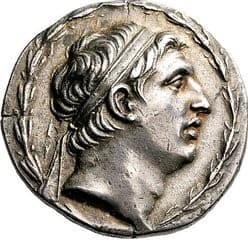
Demetrius I Soter
Emperor · Ancient
46.1Total
Basic Information
Born
-110
-187
Died
-80
-150
Era
Ancient
Ancient
Nationality
Mauretania
Seleucid Empire
Occupation
Emperor
Emperor
Civilization
Other
Middle Eastern
Score Comparison
Military (10%)
35.0
40.0
Political (20%)
35.1
37.9
Influence (20%)
44.0
49.4
Legacy (20%)
38.3
43.3
Leadership (15%)
51.9
48.4
Strategy (15%)
38.3
60.0
TOTAL
41.0
46.1
Bocchus I of Mauretania — Complete Timeline
105 BC
Betrayal of Jugurtha to SullaPolitical Action◆ Major
Bocchus I, king of Mauretania, initially allied with Jugurtha but later betrayed him. He lured Jugurtha into a trap and handed him over to the Roman quaestor Sulla, ending the Jugurthine War and earning Roman favor.
Jugurthine WarBetrayalRoman Alliance
Impact: regional
Demetrius I Soter — Complete Timeline
162 BC
Return from Roman HostagePolitical Action◆ Major
Demetrius I Soter escaped from Rome, where he had been held as a hostage, and returned to Syria. He overthrew the regent Lysias and the young king Antiochus V, claiming the Seleucid throne. His return was supported by the Roman Senate.
ReturnCoupSeleucid Dynasty
Impact: regional
161 BC
Campaign Against the MaccabeesWar◆ Major
Demetrius I sent an army under General Nicanor to suppress the Maccabean Revolt in Judea. Nicanor was defeated and killed at the Battle of Adasa by Judas Maccabeus. This victory solidified Maccabean control over Judea.
CampaignMaccabean RevoltBattle of Adasa
Impact: regionaldestructive
150 BC
Death in BattleWar◆ Major
Demetrius I was killed in battle against the forces of Alexander Balas, a rival claimant to the Seleucid throne supported by Rome and Pergamon. His death ended his reign and plunged the Seleucid Empire into further civil war.
BattleDeathCivil War
Impact: regionaltragic
Expert Analysis
Origins
Bocchus I of Mauretania (born c. 110 BC) was a Berber king of Mauretania, a region in northwest Africa. His early life is obscure, but he likely inherited the throne from his father, Mastanesosus. Bocchus ruled a kingdom that was initially independent but increasingly pressured by Rome's expansion. He had multiple wives and children, including a daughter who married Jugurtha of Numidia. His reign began around 118 BC, and he navigated the complex politics of North Africa, balancing between native tribes and Roman interests.
Demetrius I Soter (born c. 185 BC) was a prince of the Seleucid Empire, the son of Seleucus IV Philopator. He was sent to Rome as a hostage under the Treaty of Apamea (188 BC), which ended the war with Rome. While in Rome, he received a Roman education and observed Roman politics. His father was assassinated in 175 BC, and the throne was usurped by his uncle Antiochus IV Epiphanes, then by a regent Lysias after Antiochus' death. Demetrius spent years in Rome, plotting his return.
Rise to Power
Bocchus I rose to power as king of Mauretania, but his prominence came through his role in the Jugurthine War (112–106 BC). Initially, he allied with his son-in-law Jugurtha of Numidia against Rome. However, as Roman forces under Gaius Marius and Sulla gained the upper hand, Bocchus switched sides. In 105 BC, he lured Jugurtha into a trap and handed him over to the Roman quaestor Sulla. This betrayal earned him Roman favor: he was granted the title 'Friend of the Roman People' and retained his kingdom. His political score of 35.1 reflects this opportunistic move.
Demetrius I Soter escaped from Rome in 162 BC with the help of the historian Polybius. He landed in Syria and quickly gathered support, overthrowing the regent Lysias and the young king Antiochus V Eupator. He executed them and claimed the throne. His military score of 40.0 and strategy of 60.0 reflect his successful coup. However, his rule was contested from the start, as Rome and other powers opposed him.
Leadership & Governance
Bocchus I governed Mauretania as a client king under Roman suzerainty. His leadership style was pragmatic and survival-oriented. He maintained his kingdom's autonomy by aligning with Rome, suppressing internal dissent, and avoiding direct conflict. He did not implement major reforms but stabilized his realm. His leadership score of 51.9 is decent for a secondary king.
Demetrius I Soter aimed to restore Seleucid power and territorial integrity. He fought campaigns against the Maccabees in Judea (led by Judas Maccabeus) and against rival claimants. He sent General Nicanor to crush the revolt, but Nicanor was defeated at the Battle of Adasa (161 BC). Demetrius also faced a usurper, Alexander Balas, backed by Rome and Pergamon. His governance was marked by constant warfare, and he failed to secure lasting stability. His political score of 37.9 indicates weak diplomatic skills.
Triumph & Tragedy
Bocchus I's greatest triumph was his betrayal of Jugurtha, which secured his kingdom and earned Roman protection. He died peacefully, having maintained Mauretania's independence. His tragedy is that he is remembered only as a turncoat, with no enduring legacy. His influence score of 44.0 and legacy of 38.3 reflect his limited impact.
Demetrius I's triumph was his dramatic escape from Rome and seizure of the Seleucid throne, displaying strategic acumen (strategy 60.0). His tragedy was his inability to consolidate power: he was killed in battle in 150 BC against Alexander Balas, after losing support. His death ended a period of instability, and the empire further fragmented. His influence score of 49.4 and legacy of 43.3 are higher than Bocchus's, but still modest.
Character & Destiny
Bocchus I was opportunistic and cautious, valuing survival over honor. His betrayal of Jugurtha, while pragmatic, stained his reputation. He chose Roman patronage over native alliances, a decision that shaped his peaceful reign but limited his historical footprint.
Demetrius I was ambitious and courageous, but also impetuous and poor at diplomacy. His return from Rome showed daring, but he failed to build alliances. He alienated Rome and the Jewish population, leading to his downfall. His character—stubborn and combative—led to his death in battle.
Legacy
Bocchus I's legacy is minimal: he is a footnote in the Jugurthine War. He demonstrated how African kings could survive by submitting to Rome. His dynasty continued under Roman influence, but his name is obscure.
Demetrius I Soter's legacy is more substantial: he briefly revived Seleucid fortunes, but his failures accelerated the empire's decline. He is remembered for his role in the Maccabean revolt, which strengthened Jewish independence. His death marked the beginning of a period of civil wars. His total score of 46.1 is marginally higher than Bocchus's 41.0.
Conclusion
Demetrius I Soter had greater impact than Bocchus I. Despite his ultimate failure, Demetrius attempted to restore a major empire and influenced the course of Jewish history. Bocchus was a minor figure whose actions only affected a local conflict. The score gap of 5.1 points reflects this: Demetrius scored higher in military (40.0 to 35.0), influence (49.4 to 44.0), and strategy (60.0 to 38.3). While neither was a great historical figure, Demetrius's actions had wider repercussions. Bocchus's betrayal was a single event; Demetrius's campaigns shaped the Seleucid decline. Thus, Demetrius I Soter stands as the more significant figure.
Rankings
🥇
Demetrius I SoterLeader
Mil: 40.0Pol: 37.9Inf: 49.4
46.1
🥈
Bocchus I of Mauretania
Mil: 35.0Pol: 35.1Inf: 44.0
41.0
+5.1 behind
How This Comparison Works
Algorithm
Each figure is scored on 6 dimensions (0—100 scale) based on structured historical data: Military (10%), Political (20%), Influence (20%), Legacy (20%), Leadership (15%), Strategy (15%). The weighted total produces the final ranking.
Data Sources
Scores are computed from structured sub-indicators in the database. Scale factors adjust for era (Ancient ×0.85, Modern ×1.0) and civilization size (Eastern ×1.05, Other ×0.80) to account for differences in population and military scale.
Maximum 3 Figures
Comparisons are limited to 2—3 figures to ensure readability and statistical meaningfulness.
Error Margins
±5 points per dimension — Sub-scores are derived from historical records with inherent uncertainty. Two figures within 5 points on a dimension should be considered roughly equivalent in that area.
Total Score Accuracy
±3 points overall — The weighted combination of 6 dimensions produces a total score with approximately ±3 points of uncertainty. Differences of less than 3 points are not statistically significant— the figures are effectively tied.
Known Limitations
- Historical records are incomplete and uneven across civilizations
- Figures from oral-tradition societies may be underrepresented
- Occupation labels can misclassify multi-role figures
- Scores measure capability and impact, not moral character
- Quantitative scoring is a comparison tool, not absolute truth
Capability Radar
Military (10%) — Battles & Warfare
Battles
20
45
Win Rate
30
40
Expansion
20
40
Political (20%) — Governance & Reform
Reform
10
30
Diplomacy
60
40
Economy
20
30
Influence (20%) — Cultural & Global Reach
Cultural
10
30
Global
10
25
Legacy (20%) — Historical Impact
Historical
25
40
Longevity
15
30
Leadership (15%) — Power & Stability
Tenure
40
35
Stability
25
25
Strategy (15%) — Tactics & Innovation
Strategy
30
55
Tactics
25
50
Reform
10
30
Similar Comparisons
Comments & Discussion
No comments yet. Be the first to share your thoughts!