Loading...
Cao Kun vs Mir Jumla
Mir Jumla leads by 17.1 pts · 2 figures compared
…
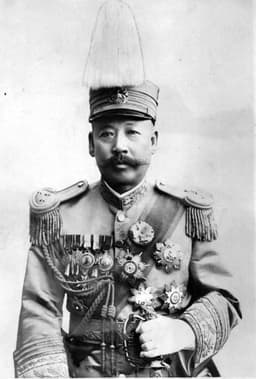
Cao Kun
General · Modern
43.2Total

Mir Jumla
General · Modern
60.3Total
Basic Information
Born
1862
1591
Died
1938
1663
Era
Modern
Modern
Nationality
China
India
Occupation
General
General
Civilization
Eastern
Indian
Score Comparison
Military (10%)
38.3
78.0
Political (20%)
30.8
68.0
Influence (20%)
51.0
54.1
Legacy (20%)
40.8
45.8
Leadership (15%)
50.7
71.0
Strategy (15%)
41.7
66.3
TOTAL
43.2
60.3
Cao Kun — Complete Timeline
1920 AD
Zhili-Anhui WarWar◆ Major
Cao Kun led the Zhili clique to victory over the Anhui clique in the Zhili-Anhui War. This battle established the Zhili faction as the dominant force in northern China and expanded Cao Kun's political and military power.
Warlord EraWarZhili Clique
Impact: national
1922 AD
First Zhili-Fengtian WarWar◆ Major
Cao Kun's Zhili forces defeated the Fengtian clique under Zhang Zuolin in the First Zhili-Fengtian War. This victory solidified Zhili control over Beijing and the central government.
Warlord EraWarZhili Clique
Impact: national
1923 AD
Presidential Bribery ScandalPolitical Action
Cao Kun bribed members of the National Assembly to elect him President of the Republic of China, spending millions of yuan. This scandal discredited the Republican government and deepened public cynicism toward warlord politics.
Republic of ChinaCorruptionPresidency
Impact: nationaldestructive
1924 AD
Second Zhili-Fengtian WarWar◆ Major
Cao Kun's Zhili clique was defeated by the Fengtian clique in the Second Zhili-Fengtian War. The loss led to his overthrow and house arrest, ending his political career and the Zhili dominance.
Warlord EraWarDefeat
Impact: nationaltragic
Mir Jumla — Complete Timeline
1660 AD
Governor of BengalPolitical Action◆ Major
Mir Jumla was appointed governor of Bengal by Emperor Aurangzeb. He reorganized the administration, improved revenue collection, and launched military campaigns to consolidate Mughal control.
GovernorshipBengalAdministration
Impact: regionalconstructive
1661 AD
Siege of Cooch BeharWar
Mir Jumla besieged and captured the kingdom of Cooch Behar in present-day West Bengal. The ruler submitted to Mughal authority, extending Mughal influence into the Brahmaputra valley.
SiegeCooch BeharMughal Campaign
Impact: regional
1662 AD
Conquest of AssamWar◆ Major
Mir Jumla led a Mughal invasion of the Ahom kingdom in Assam. He captured the capital Garhgaon and imposed Mughal authority, though the conquest proved temporary due to disease and resistance.
Mughal ExpansionAssamAhom Kingdom
Impact: regional
1663 AD
Death from Illness in AssamOther
Mir Jumla died from illness during his campaign in Assam. His death ended the Mughal offensive, and the Ahom kingdom soon regained independence, limiting the long-term impact of his conquest.
DeathAssamCampaign End
Impact: regionaltragic
Expert Analysis
Origins
Cao Kun (1862-1938) was born into a poor farming family in Tianjin, China. He joined the Huai Army as a youth and later became a key figure in the Beiyang Army under Yuan Shikai. His early career was defined by loyalty to Yuan, which provided him with military connections and a path to power.
Mir Jumla (1591-1663), originally named Mir Muhammad Sayyid Ardestani, was born in Isfahan, Iran (then Safavid Empire). He began as a trader in the Golconda Sultanate, later serving as a minister before defecting to the Mughal Empire. His administrative skills and military acumen brought him to the attention of Emperor Shah Jahan and later Aurangzeb.
Rise to Power
Cao Kun rose through the Beiyang ranks, becoming a general and military governor of Zhili province. He gained prominence during the Warlord Era after Yuan Shikai's death in 1916. His turning point came in 1920, when he led the Zhili clique to victory in the Zhili-Anhui War, defeating Duan Qirui's Anhui clique and establishing Zhili dominance in northern China. By 1922, after the First Zhili-Fengtian War, he controlled Beijing, scoring 50.7 in leadership.
Mir Jumla's rise was more gradual. He served as a minister in Golconda, but after a conflict with the sultan, he fled to the Mughal court in 1656. Emperor Shah Jahan appointed him a commander, and he quickly proved his worth. Under Aurangzeb, he became governor of Bengal in 1660. His military score of 78.0 reflects his effectiveness in expanding Mughal territory.
Leadership & Governance
Cao Kun's governance was marred by corruption. In 1923, he bribed members of the National Assembly with millions of yuan to elect him President of the Republic of China, a scandal that discredited the presidency. His political score of 30.8 reflects this weakness. He focused on military consolidation but failed to implement meaningful reforms, relying on patronage and alliances.
Mir Jumla, in contrast, was an effective administrator. As governor of Bengal, he reorganized revenue collection, improved infrastructure, and launched military campaigns. His rule was marked by efficiency, but he also faced challenges from local rulers and disease. His political score of 68.0 highlights his administrative competence.
Triumph & Tragedy
Cao Kun's greatest success was the Zhili-Anhui War (1920), where his forces decisively defeated the Anhui clique. He also won the First Zhili-Fengtian War in 1922, solidifying his control over Beijing. However, his presidency was short-lived. In 1924, during the Second Zhili-Fengtian War, his ally Feng Yuxiang betrayed him, leading to Cao's defeat and house arrest. His legacy score of 40.8 reflects this downfall.
Mir Jumla's triumph was the conquest of Assam in 1662-1663. He captured the Ahom capital Garhgaon and imposed Mughal authority. However, his campaign was cut short by his death from illness in 1663. The Ahom kingdom soon regained independence, limiting the long-term impact of his conquest. His influence score of 54.1 shows moderate impact.
Character & Destiny
Cao Kun was pragmatic and ambitious but lacked strategic vision. His willingness to bribe for power alienated him from the public and other warlords. His character led to his isolation, and when the Fengtian clique attacked, he had few reliable allies. His total score of 43.2 reflects these flaws.
Mir Jumla was a skilled diplomat and military leader. His defection from Golconda to the Mughals showed opportunism, but he remained loyal to Aurangzeb. His death in Assam was a tragic end, but his administrative reforms in Bengal had lasting effects. His total score of 60.3 indicates a more balanced legacy.
Legacy
Cao Kun is remembered primarily for the presidential bribery scandal, which discredited the early Republic of China. His military victories were temporary, and his clique collapsed after his defeat. He represents the instability of the Warlord Era, with a legacy score of 40.8.
Mir Jumla's legacy is more positive. He is remembered as an able governor of Bengal and a successful general. His conquest of Assam, though temporary, demonstrated Mughal military power. His administrative reforms in Bengal improved revenue collection, contributing to the Mughal economy. His legacy score of 45.8 is slightly higher than Cao's.
Conclusion
Mir Jumla had greater impact than Cao Kun. With a total score of 60.3 compared to Cao's 43.2, Mir Jumla excelled in military (78.0 vs 38.3) and political (68.0 vs 30.8) domains. While Cao's victories shaped the Warlord Era, his corruption and short presidency limited his influence. Mir Jumla's administrative reforms in Bengal and his conquest of Assam, despite its temporary nature, had more enduring effects on Mughal governance. Cao Kun's legacy is largely negative, while Mir Jumla's is mixed but more substantial. Thus, Mir Jumla stands as the more significant figure.
Rankings
🥇
Mir JumlaLeader
Mil: 78.0Pol: 68.0Inf: 54.1
60.3
🥈
Cao Kun
Mil: 38.3Pol: 30.8Inf: 51.0
43.2
+17.1 behind
How This Comparison Works
Algorithm
Each figure is scored on 6 dimensions (0—100 scale) based on structured historical data: Military (10%), Political (20%), Influence (20%), Legacy (20%), Leadership (15%), Strategy (15%). The weighted total produces the final ranking.
Data Sources
Scores are computed from structured sub-indicators in the database. Scale factors adjust for era (Ancient ×0.85, Modern ×1.0) and civilization size (Eastern ×1.05, Other ×0.80) to account for differences in population and military scale.
Maximum 3 Figures
Comparisons are limited to 2—3 figures to ensure readability and statistical meaningfulness.
Error Margins
±5 points per dimension — Sub-scores are derived from historical records with inherent uncertainty. Two figures within 5 points on a dimension should be considered roughly equivalent in that area.
Total Score Accuracy
±3 points overall — The weighted combination of 6 dimensions produces a total score with approximately ±3 points of uncertainty. Differences of less than 3 points are not statistically significant— the figures are effectively tied.
Known Limitations
- Historical records are incomplete and uneven across civilizations
- Figures from oral-tradition societies may be underrepresented
- Occupation labels can misclassify multi-role figures
- Scores measure capability and impact, not moral character
- Quantitative scoring is a comparison tool, not absolute truth
Capability Radar
Military (10%) — Battles & Warfare
Battles
30
75
Win Rate
35
70
Expansion
25
80
Political (20%) — Governance & Reform
Reform
10
40
Diplomacy
20
55
Economy
15
45
Influence (20%) — Cultural & Global Reach
Cultural
15
30
Global
10
25
Legacy (20%) — Historical Impact
Historical
25
45
Longevity
10
30
Leadership (15%) — Power & Stability
Tenure
40
50
Stability
10
40
Strategy (15%) — Tactics & Innovation
Strategy
30
75
Tactics
25
80
Reform
20
60
Similar Comparisons
Comments & Discussion
No comments yet. Be the first to share your thoughts!