Loading...
Catherine the Great vs Daoguang Emperor
Catherine the Great leads by 23.1 pts · 2 figures compared
…
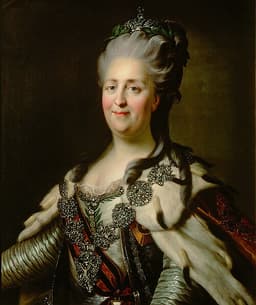
Catherine the Great
Emperor · Modern
66.8Total

Daoguang Emperor
Emperor · Modern
43.7Total
Basic Information
Born
1729
1782
Died
1796
1850
Era
Modern
Modern
Nationality
Russia
China
Occupation
Emperor
Emperor
Civilization
Western
Eastern
Score Comparison
Military (10%)
78.5
14.9
Political (20%)
90.0
25.0
Influence (20%)
65.0
51.8
Legacy (20%)
40.0
45.0
Leadership (15%)
80.0
65.0
Strategy (15%)
72.0
45.0
TOTAL
66.8
43.7
Catherine the Great — Complete Timeline
1762 AD
Coup d'État of 1762Political Action
Catherine II led a coup d'
CoupAccessionPower
Impact: national
1764 AD
Hermitage Museum FoundedCultural◆ Major
Catherine the Great founded the Hermitage Museum in St. Petersburg by purchasing a large collection of paintings from Berlin. The museum grew into one of the world's largest art collections, reflecting her patronage of Enlightenment culture.
ArtMuseumEnlightenment
Impact: globalconstructive
1768 AD
Russo-Turkish War (1768-1774)War◆ Major
Catherine the Great initiated a war against the Ottoman Empire, resulting in Russian victory. The Treaty of K
WarOttoman EmpireExpansion
Impact: regional
1783 AD
Annexation of CrimeaPolitical Action◆ Major
Catherine the Great formally annexed the Crimean Peninsula from the Ottoman Empire. This strategic acquisition gave Russia a dominant position in the Black Sea and a warm-water port, fulfilling a long-standing imperial ambition.
AnnexationCrimeaBlack Sea
Impact: regional
1785 AD
Charter to the Gentry GrantedReform◆ Major
Catherine the Great issued the Charter to the Gentry, which codified the rights and privileges of the Russian nobility. It exempted nobles from taxation and military service, solidifying their social status and support for her rule.
NobilityReformSocial Structure
Impact: nationalconstructive
Daoguang Emperor — Complete Timeline
1839 AD
First Opium WarWar
British forces attacked China after Daoguang ordered the destruction of opium stocks in Canton. The Qing military was decisively defeated, leading to the Treaty of Nanjing in 1842.
Opium WarBritish invasionMilitary defeat
Impact: globaldestructive
Lin Zexu's anti-opium campaignPolitical Action◆ Major
Daoguang appointed Lin Zexu as Imperial Commissioner to suppress the opium trade in Canton. Lin confiscated and destroyed over 20,000 chests of opium, which triggered the British military response.
Opium suppressionLin ZexuDrug policy
Impact: nationalconstructive
1840 AD
Fiscal crisis and military declineOther◆ Major
The Opium War exposed the Qing's fiscal and military weaknesses. Daoguang's government faced severe budget deficits, outdated military technology, and a corrupt bureaucracy, leading to a loss of imperial prestige.
Fiscal crisisMilitary weaknessQing decline
Impact: nationaldestructive
1842 AD
Treaty of NanjingPolitical Action
Daoguang's government signed the Treaty of Nanjing, the first of the 'unequal treaties.' China ceded Hong Kong to Britain, opened five treaty ports, paid an indemnity, and granted extraterritorial rights to British subjects.
Unequal treatyHong Kong cessionTreaty ports
Impact: globaldestructive
1843 AD
Treaty of the BoguePolitical Action◆ Major
Daoguang's government signed the Treaty of the Bogue, which granted Britain most-favored-nation status and further extraterritorial rights. This treaty expanded the concessions made in the Treaty of Nanjing.
Unequal treatyBritish concessionsExtraterritoriality
Impact: globaldestructive
Expert Analysis
Origins
Catherine II (1729–1796) was born Sophie Friederike Auguste in Stettin, Prussia (now Poland). Her father was a minor German prince, and her mother was a member of the Holstein-Gottorp family. She received a thorough education in French Enlightenment thought, studying Voltaire, Montesquieu, and Diderot. In 1745, she married Grand Duke Peter of Holstein-Gottorp, the heir to the Russian throne, converting to Orthodoxy and adopting the name Catherine. Her early years in Russia were isolating; she immersed herself in reading and cultivated relationships with influential nobles.
The Daoguang Emperor (1782–1850), born Mianning, was the sixth emperor of the Qing dynasty. His father, the Jiaqing Emperor, reigned during a period of internal decline. As a prince, he received a traditional Confucian education emphasizing frugality and moral governance. He ascended the throne in 1820, inheriting a corrupt bureaucracy, an empty treasury, and growing Western pressure. Unlike Catherine, Daoguang had little exposure to foreign ideas, viewing the outside world with suspicion.
Rise to Power
Catherine's rise came through a coup d'état in 1762. Her husband, Peter III, was erratic, pro-Prussian, and deeply unpopular. With the support of the Orlov brothers and the Imperial Guard, Catherine overthrew Peter, who was later murdered. She was proclaimed Empress Regnant. This bold move, scoring 90.0 in political acumen, showcased her ability to forge alliances and seize opportunity.
Daoguang's accession was peaceful: he was chosen as successor by his father. His early reign focused on fiscal austerity, cutting palace expenses, and curbing corruption. However, his cautious nature and reverence for tradition prevented meaningful reform. The Opium War (1839–1842) exposed his weaknesses. He initially supported Lin Zexu's anti-opium campaign, destroying 20,000 chests of opium, but when Britain retaliated with superior naval power, the Qing forces collapsed. Daoguang's military score of 14.9 reflects this catastrophic failure.
Leadership & Governance
Catherine modernized Russia through sweeping reforms. She convened the Legislative Commission in 1767 to codify laws, though it was ultimately dissolved. She expanded education, establishing the Smolny Institute for noble girls and the Russian Academy. She purchased Diderot's library and founded the Hermitage Museum, bringing Enlightenment culture to Russia. Her Charter to the Gentry (1785) codified noble privileges, securing their support. However, she also tightened serfdom, crushing Pugachev's Rebellion (1773–1775) with brutality. Her leadership score of 80.0 reflects a pragmatic balance between reform and autocracy.
Daoguang governed by Confucian precepts, emphasizing thrift and personal morality. He reduced court spending and dismissed corrupt officials, but he failed to address systemic problems: a decaying military, fiscal deficits, and technological stagnation. The Opium War revealed the Qing's inability to adapt. The Treaty of Nanjing (1842) ceded Hong Kong, opened five ports, and imposed a 21 million silver dollar indemnity. The subsequent Treaty of the Bogue granted extraterritoriality and most-favored-nation status. Daoguang's political score of 25.0 reflects his failure to navigate foreign pressure or modernize.
Triumph & Tragedy
Catherine's triumphs include expanding Russia's borders: the Russo-Turkish War (1768–1774) gave Russia access to the Black Sea, and the annexation of Crimea (1783) solidified dominance in the region. She partitioned Poland with Prussia and Austria, adding vast territories. Her cultural legacy, including the Hermitage, endures. Yet her reign had tragedies: she intensified serfdom, which fueled peasant uprisings. Her son Paul I despised her, and her death in 1796 left a succession crisis. Her influence score of 65.0 reflects mixed impacts.
Daoguang's triumph was personal frugality and moral example, but his reign was defined by tragedy. The Opium War humiliated China, and the unequal treaties set a precedent for a century of exploitation. He died in 1850, seeing his empire weakened. His legacy score of 45.0 acknowledges his role in Chinese decline, though he was more a victim of circumstances than an active reformer.
Character & Destiny
Catherine was ambitious, intellectually curious, and politically shrewd. She corresponded with Voltaire and Diderot, presenting herself as an enlightened despot. Her personal life, including many lovers, was openly scandalous, but she maintained control. Her character drove her to expand Russia's power and culture, but her reliance on nobility limited social reform.
Daoguang was cautious, indecisive, and bound by tradition. He lacked vision and flexibility, unable to comprehend the Western threat. His frugality became parsimony, and his moralistic approach failed in a world of gunboats. His destiny was to preside over decline, not revival. Historical assessments see him as well-intentioned but ineffectual.
Legacy
Catherine's legacy is immense: she made Russia a European great power, expanded its borders, and fostered Enlightenment culture. The Hermitage remains a world treasure. However, her reinforcement of serfdom sowed seeds of future revolution. Her total score of 66.8 places her among influential monarchs.
Daoguang's legacy is cautionary: his reign marked the start of China's 'Century of Humiliation.' The unequal treaties crippled sovereignty, and his failure to reform led to the Taiping Rebellion under his successor. He is remembered as a well-meaning but weak emperor. His total score of 43.7 reflects limited impact.
Conclusion
Catherine the Great had significantly greater impact than Daoguang. Her military (78.5 vs 14.9), political (90.0 vs 25.0), and leadership (80.0 vs 65.0) scores demonstrate a ruler who actively shaped history. Daoguang, while conscientious, was overwhelmed by forces he could not understand. Catherine's legacy of expansion and modernization endures, while Daoguang's is a lesson in stagnation. The score gap of 23.1 points confirms Catherine as the more consequential figure.
Rankings
🥇
Catherine the GreatLeader
Mil: 78.5Pol: 90.0Inf: 65.0
66.8
🥈
Daoguang Emperor
Mil: 14.9Pol: 25.0Inf: 51.8
43.7
+23.1 behind
How This Comparison Works
Algorithm
Each figure is scored on 6 dimensions (0—100 scale) based on structured historical data: Military (10%), Political (20%), Influence (20%), Legacy (20%), Leadership (15%), Strategy (15%). The weighted total produces the final ranking.
Data Sources
Scores are computed from structured sub-indicators in the database. Scale factors adjust for era (Ancient ×0.85, Modern ×1.0) and civilization size (Eastern ×1.05, Other ×0.80) to account for differences in population and military scale.
Maximum 3 Figures
Comparisons are limited to 2—3 figures to ensure readability and statistical meaningfulness.
Error Margins
±5 points per dimension — Sub-scores are derived from historical records with inherent uncertainty. Two figures within 5 points on a dimension should be considered roughly equivalent in that area.
Total Score Accuracy
±3 points overall — The weighted combination of 6 dimensions produces a total score with approximately ±3 points of uncertainty. Differences of less than 3 points are not statistically significant— the figures are effectively tied.
Known Limitations
- Historical records are incomplete and uneven across civilizations
- Figures from oral-tradition societies may be underrepresented
- Occupation labels can misclassify multi-role figures
- Scores measure capability and impact, not moral character
- Quantitative scoring is a comparison tool, not absolute truth
Capability Radar
Military (10%) — Battles & Warfare
Battles
85
10
Win Rate
80
5
Expansion
90
5
Political (20%) — Governance & Reform
Reform
90
10
Diplomacy
85
5
Economy
85
10
Influence (20%) — Cultural & Global Reach
Cultural
85
20
Global
80
30
Legacy (20%) — Historical Impact
Historical
85
40
Longevity
80
30
Leadership (15%) — Power & Stability
Tenure
95
60
Stability
80
20
Strategy (15%) — Tactics & Innovation
Strategy
85
5
Tactics
75
5
Reform
90
5
Similar Comparisons
Comments & Discussion
No comments yet. Be the first to share your thoughts!