Loading...
This comparison has not been analyzed yet.
One-time AI generation (~1 minute). Scores and timeline are already available below.
Catherine the Great vs Gustaf VI Adolf
Catherine the Great leads by 13.7 pts · 2 figures compared
…
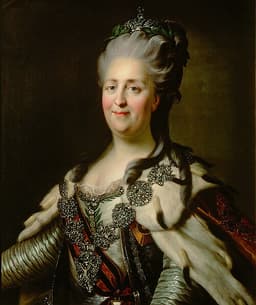
Catherine the Great
Emperor · Modern
66.8Total
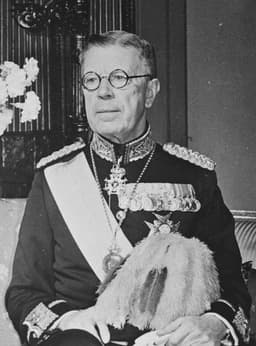
Gustaf VI Adolf
Emperor · Modern
53.1Total
Basic Information
Born
1729
1882
Died
1796
1973
Era
Modern
Modern
Nationality
Russia
Sweden
Occupation
Emperor
Emperor
Civilization
Western
Western
Score Comparison
Military (10%)
78.5
48.7
Political (20%)
90.0
45.0
Influence (20%)
65.0
54.1
Legacy (20%)
40.0
42.5
Leadership (15%)
80.0
78.0
Strategy (15%)
72.0
56.4
TOTAL
66.8
53.1
Catherine the Great — Complete Timeline
1762 AD
Coup d'État of 1762Political Action
Catherine II led a coup d'
CoupAccessionPower
Impact: national
1764 AD
Hermitage Museum FoundedCultural◆ Major
Catherine the Great founded the Hermitage Museum in St. Petersburg by purchasing a large collection of paintings from Berlin. The museum grew into one of the world's largest art collections, reflecting her patronage of Enlightenment culture.
ArtMuseumEnlightenment
Impact: globalconstructive
1768 AD
Russo-Turkish War (1768-1774)War◆ Major
Catherine the Great initiated a war against the Ottoman Empire, resulting in Russian victory. The Treaty of K
WarOttoman EmpireExpansion
Impact: regional
1783 AD
Annexation of CrimeaPolitical Action◆ Major
Catherine the Great formally annexed the Crimean Peninsula from the Ottoman Empire. This strategic acquisition gave Russia a dominant position in the Black Sea and a warm-water port, fulfilling a long-standing imperial ambition.
AnnexationCrimeaBlack Sea
Impact: regional
1785 AD
Charter to the Gentry GrantedReform◆ Major
Catherine the Great issued the Charter to the Gentry, which codified the rights and privileges of the Russian nobility. It exempted nobles from taxation and military service, solidifying their social status and support for her rule.
NobilityReformSocial Structure
Impact: nationalconstructive
Gustaf VI Adolf — Complete Timeline
1950 AD
Accession to the thronePolitical Action◆ Major
Gustaf VI Adolf became King of Sweden on October 29, 1950, following the death of his father, Gustaf V. His reign was marked by his scholarly interests and the continued evolution of Sweden's constitutional monarchy.
AccessionSuccession
Impact: national
1952 AD
Archaeological excavations in Italy and GreeceCultural
Gustaf VI Adolf participated in archaeological excavations in Italy (especially at San Giovenale) and Greece. He was a respected amateur archaeologist and contributed to Etruscan studies, publishing several papers.
ArchaeologyEtruscan StudiesScholarship
Impact: regionalconstructive
Presidency of the Swedish Archaeological SocietyCultural
Gustaf VI Adolf served as president of the Swedish Archaeological Society and was a member of the Royal Swedish Academy of Letters. His patronage elevated the status of archaeology in Sweden.
ArchaeologyPatronageAcademy
Impact: nationalconstructive
1954 AD
State visit to the United StatesPolitical Action
Gustaf VI Adolf made a state visit to the United States in 1954, strengthening Swedish-American relations during the Cold War. The visit included meetings with President Dwight D. Eisenhower.
State VisitDiplomacyCold War
Impact: globalconstructive
1974 AD
Support for the 1974 Instrument of GovernmentReform◆ Major
Gustaf VI Adolf accepted the 1974 Instrument of Government, which stripped the monarchy of all remaining political powers, making the king a purely ceremonial head of state. This was a major constitutional reform.
Constitutional ReformCeremonial Monarchy
Impact: national
This comparison has not been analyzed yet.
One-time AI generation (~1 minute). Scores and timeline are already available below.
Rankings
🥇
Catherine the GreatLeader
Mil: 78.5Pol: 90.0Inf: 65.0
66.8
🥈
Gustaf VI Adolf
Mil: 48.7Pol: 45.0Inf: 54.1
53.1
+13.7 behind
How This Comparison Works
Algorithm
Each figure is scored on 6 dimensions (0—100 scale) based on structured historical data: Military (10%), Political (20%), Influence (20%), Legacy (20%), Leadership (15%), Strategy (15%). The weighted total produces the final ranking.
Data Sources
Scores are computed from structured sub-indicators in the database. Scale factors adjust for era (Ancient ×0.85, Modern ×1.0) and civilization size (Eastern ×1.05, Other ×0.80) to account for differences in population and military scale.
Maximum 3 Figures
Comparisons are limited to 2—3 figures to ensure readability and statistical meaningfulness.
Error Margins
±5 points per dimension — Sub-scores are derived from historical records with inherent uncertainty. Two figures within 5 points on a dimension should be considered roughly equivalent in that area.
Total Score Accuracy
±3 points overall — The weighted combination of 6 dimensions produces a total score with approximately ±3 points of uncertainty. Differences of less than 3 points are not statistically significant— the figures are effectively tied.
Known Limitations
- Historical records are incomplete and uneven across civilizations
- Figures from oral-tradition societies may be underrepresented
- Occupation labels can misclassify multi-role figures
- Scores measure capability and impact, not moral character
- Quantitative scoring is a comparison tool, not absolute truth
Capability Radar
Military (10%) — Battles & Warfare
Battles
85
22
Win Rate
80
24
Expansion
90
32
Political (20%) — Governance & Reform
Reform
90
60
Diplomacy
85
65
Economy
85
55
Influence (20%) — Cultural & Global Reach
Cultural
85
40
Global
80
25
Legacy (20%) — Historical Impact
Historical
85
35
Longevity
80
30
Leadership (15%) — Power & Stability
Tenure
95
70
Stability
80
75
Strategy (15%) — Tactics & Innovation
Strategy
85
35
Tactics
75
34
Reform
90
40
Similar Comparisons
Comments & Discussion
No comments yet. Be the first to share your thoughts!