Loading...
Catherine the Great vs James II of England
Catherine the Great leads by 18.5 pts · 2 figures compared
…
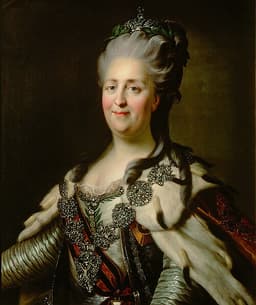
Catherine the Great
Emperor · Modern
66.8Total

James II of England
Emperor · Modern
48.3Total
Basic Information
Born
1729
1633
Died
1796
1701
Era
Modern
Modern
Nationality
Russia
England
Occupation
Emperor
Emperor
Civilization
Western
Western
Score Comparison
Military (10%)
78.5
45.0
Political (20%)
90.0
35.1
Influence (20%)
65.0
53.3
Legacy (20%)
40.0
45.8
Leadership (15%)
80.0
51.9
Strategy (15%)
72.0
60.0
TOTAL
66.8
48.3
Catherine the Great — Complete Timeline
1762 AD
Coup d'État of 1762Political Action
Catherine II led a coup d'
CoupAccessionPower
Impact: national
1764 AD
Hermitage Museum FoundedCultural◆ Major
Catherine the Great founded the Hermitage Museum in St. Petersburg by purchasing a large collection of paintings from Berlin. The museum grew into one of the world's largest art collections, reflecting her patronage of Enlightenment culture.
ArtMuseumEnlightenment
Impact: globalconstructive
1768 AD
Russo-Turkish War (1768-1774)War◆ Major
Catherine the Great initiated a war against the Ottoman Empire, resulting in Russian victory. The Treaty of K
WarOttoman EmpireExpansion
Impact: regional
1783 AD
Annexation of CrimeaPolitical Action◆ Major
Catherine the Great formally annexed the Crimean Peninsula from the Ottoman Empire. This strategic acquisition gave Russia a dominant position in the Black Sea and a warm-water port, fulfilling a long-standing imperial ambition.
AnnexationCrimeaBlack Sea
Impact: regional
1785 AD
Charter to the Gentry GrantedReform◆ Major
Catherine the Great issued the Charter to the Gentry, which codified the rights and privileges of the Russian nobility. It exempted nobles from taxation and military service, solidifying their social status and support for her rule.
NobilityReformSocial Structure
Impact: nationalconstructive
James II of England — Complete Timeline
1685 AD
Monmouth RebellionWar◆ Major
James II faced a rebellion led by his nephew, the Duke of Monmouth, who claimed the throne. The rebellion was crushed at the Battle of Sedgemoor, and Monmouth was executed, but the harsh reprisals (Bloody Assizes) increased opposition to James.
RebellionBattleRepression
Impact: nationaldestructive
Accession of James IIPolitical Action
James II became king of England after the death of his brother Charles II. His open Catholicism and pro-Catholic policies immediately alarmed the Protestant establishment, setting the stage for conflict.
SuccessionCatholicStuart
Impact: national
1687 AD
Declaration of IndulgencePolitical Action◆ Major
James II issued a Declaration of Indulgence, suspending penal laws against Catholics and nonconformists. This act was seen as an attempt to impose Catholicism and was widely opposed by the Anglican establishment.
ReligionTolerationCatholic
Impact: national
1688 AD
Birth of James Francis Edward StuartPolitical Action
The birth of James II's son, James Francis Edward Stuart, created a Catholic heir to the throne. This event alarmed Protestant leaders, who feared a permanent Catholic dynasty, and led to the invitation to William of Orange to intervene.
SuccessionCatholicCrisis
Impact: national
Glorious RevolutionPolitical Action
James II was deposed by William of Orange, who invaded England with Dutch forces. James fled to France, and William and Mary were crowned joint monarchs, establishing Protestant succession and parliamentary supremacy.
RevolutionDepositionProtestant
Impact: global
1690 AD
Battle of the BoyneWar◆ Major
James II led a French-backed army against William III at the Battle of the Boyne in Ireland. His defeat ended his hopes of reclaiming the throne and solidified William's control over Ireland and England.
BattleIrelandDefeat
Impact: regionaldestructive
Expert Analysis
Origins
Catherine the Great (1729–1796) was born Sophie of Anhalt-Zerbst in Stettin, Prussia. Her father was a minor German prince, and her mother was a member of the Holstein-Gottorp dynasty. She received a typical education for a German princess, focusing on French language, religion, and etiquette. In 1744, she was invited to Russia by Empress Elizabeth to marry her nephew, the future Peter III. She converted to Orthodoxy and took the name Catherine.
James II of England (1633–1701) was born at St James's Palace in London, the second surviving son of King Charles I and Henrietta Maria. His early life was marked by the English Civil War; he fled to France in 1648. He served in the French and Spanish armies, gaining military experience. After the Restoration of his brother Charles II in 1660, James became Lord High Admiral, commanding the Royal Navy in the Second and Third Anglo-Dutch Wars.
Rise to Power
Catherine's rise came through a coup d'état in 1762. Her husband, Peter III, became emperor in 1762 but quickly alienated the nobility and the military with his pro-Prussian policies and contempt for Russian traditions. Catherine, with the help of the Orlov brothers and the Imperial Guard, led a revolt. Peter was arrested and forced to abdicate; he died shortly after under suspicious circumstances. Catherine was proclaimed empress on July 9, 1762, scoring 90.0 in political skill.
James II ascended the throne peacefully upon the death of his brother Charles II on February 6, 1685. He had a strong claim and was initially accepted by Parliament. However, his open Catholicism and pro-Catholic policies quickly caused tension. He faced a rebellion in June 1685 led by his nephew, the Duke of Monmouth, which he crushed at the Battle of Sedgemoor on July 6, 1685, with 45.0 military score. The subsequent Bloody Assizes under Judge Jeffreys executed hundreds, tarnishing his reputation.
Leadership & Governance
Catherine the Great was an enlightened despot who corresponded with Voltaire and Diderot. She reformed education, founding the Smolny Institute for noble girls and expanding the school system. She issued the Charter to the Gentry in 1785, codifying noble privileges and exempting them from taxation and military service. She also attempted legal reform with the Nakaz (Instruction), but it had limited effect. Her governance expanded the Russian Empire through the Russo-Turkish War (1768–1774) and the annexation of Crimea in 1783, adding significant territory. Her leadership score is 80.0.
James II attempted to impose religious toleration for Catholics and nonconformists. He issued the Declaration of Indulgence in 1687, suspending penal laws against Catholics. He also appointed Catholics to military and government positions, alarming the Protestant establishment. His governance was autocratic and bypassed Parliament, which he prorogued in 1685 and never recalled. His political score of 35.1 reflects his inability to manage the political landscape.
Triumph & Tragedy
Catherine's triumphs include the expansion of Russia's borders: the Treaty of Küçük Kaynarca (1774) gave Russia access to the Black Sea and the right to protect Orthodox Christians in the Ottoman Empire. The annexation of Crimea in 1783 was a strategic masterstroke, giving Russia a warm-water port. She also founded the Hermitage Museum, beginning with a purchase of 225 paintings from Berlin in 1764, which grew into one of the world's great museums. However, her reign saw the Pugachev Rebellion (1773–1775), a massive peasant uprising that she brutally suppressed. The rebellion exposed the harsh realities of serfdom, which she expanded rather than reformed. Her influence score is 65.0.
James II's triumph was the swift suppression of the Monmouth Rebellion in 1685, which secured his throne temporarily. However, his tragedy was the Glorious Revolution of 1688. The birth of his son, James Francis Edward Stuart, on June 10, 1688, created a Catholic heir, prompting seven Protestant nobles to invite William of Orange to invade. James fled to France in December 1688, and William and Mary were crowned joint monarchs. James's legacy score is 45.8, reflecting his role as the last Catholic monarch of England.
Character & Destiny
Catherine was pragmatic, intelligent, and ambitious. She was a skilled politician who knew how to manage the nobility and present herself as a Russian patriot despite her German origins. She was also a patron of the arts and education. Her strategic score of 72.0 reflects her ability to plan and execute long-term goals, such as the partition of Poland (1772, 1793, 1795) which expanded Russia westward. However, she was also ruthless, as seen in the suppression of the Pugachev Rebellion and the treatment of her husband.
James II was stubborn and inflexible. He was a devout Catholic who believed in divine right and religious uniformity. His character led him to pursue pro-Catholic policies despite clear opposition. His military score of 45.0 and political score of 35.1 indicate his inability to adapt. His destiny was sealed by his own actions: the birth of his son was the catalyst, but his policies had already alienated key groups. He chose to flee rather than fight, abandoning his throne.
Legacy
Catherine's legacy is immense. She modernized Russia, expanded its borders, and helped establish it as a European power. The Hermitage Museum remains a cultural treasure. However, she also entrenched serfdom and autocracy, which hindered Russia's development. Her total score is 66.8, with high marks in political and leadership categories.
James II's legacy is primarily as the monarch whose overthrow led to the Bill of Rights (1689) and the establishment of constitutional monarchy in England. The Glorious Revolution ensured Protestant succession and limited royal power. However, James himself is remembered negatively as a failed absolutist. His total score is 48.3, reflecting his poor political and military performance.
Conclusion
Catherine the Great had a significantly greater impact than James II of England. Her total score of 66.8 compared to James's 48.3 reflects her success in expanding and modernizing Russia, while James's reign ended in failure and exile. Catherine's political score of 90.0 dwarfs James's 35.1, and her military score of 78.5 is far above his 45.0. While James's downfall led to important constitutional changes, Catherine's achievements in territorial expansion, cultural patronage, and governance had a more direct and lasting influence on world history. Therefore, Catherine the Great is the more impactful figure.
Rankings
🥇
Catherine the GreatLeader
Mil: 78.5Pol: 90.0Inf: 65.0
66.8
🥈
James II of England
Mil: 45.0Pol: 35.1Inf: 53.3
48.3
+18.5 behind
How This Comparison Works
Algorithm
Each figure is scored on 6 dimensions (0—100 scale) based on structured historical data: Military (10%), Political (20%), Influence (20%), Legacy (20%), Leadership (15%), Strategy (15%). The weighted total produces the final ranking.
Data Sources
Scores are computed from structured sub-indicators in the database. Scale factors adjust for era (Ancient ×0.85, Modern ×1.0) and civilization size (Eastern ×1.05, Other ×0.80) to account for differences in population and military scale.
Maximum 3 Figures
Comparisons are limited to 2—3 figures to ensure readability and statistical meaningfulness.
Error Margins
±5 points per dimension — Sub-scores are derived from historical records with inherent uncertainty. Two figures within 5 points on a dimension should be considered roughly equivalent in that area.
Total Score Accuracy
±3 points overall — The weighted combination of 6 dimensions produces a total score with approximately ±3 points of uncertainty. Differences of less than 3 points are not statistically significant— the figures are effectively tied.
Known Limitations
- Historical records are incomplete and uneven across civilizations
- Figures from oral-tradition societies may be underrepresented
- Occupation labels can misclassify multi-role figures
- Scores measure capability and impact, not moral character
- Quantitative scoring is a comparison tool, not absolute truth
Capability Radar
Military (10%) — Battles & Warfare
Battles
85
40
Win Rate
80
35
Expansion
90
20
Political (20%) — Governance & Reform
Reform
90
20
Diplomacy
85
25
Economy
85
30
Influence (20%) — Cultural & Global Reach
Cultural
85
30
Global
80
30
Legacy (20%) — Historical Impact
Historical
85
40
Longevity
80
35
Leadership (15%) — Power & Stability
Tenure
95
30
Stability
80
15
Strategy (15%) — Tactics & Innovation
Strategy
85
40
Tactics
75
45
Reform
90
50
Similar Comparisons
Comments & Discussion
No comments yet. Be the first to share your thoughts!