Loading...
Cato the Elder vs Napoleon Bonaparte
Napoleon Bonaparte leads by 7.9 pts · 2 figures compared
…
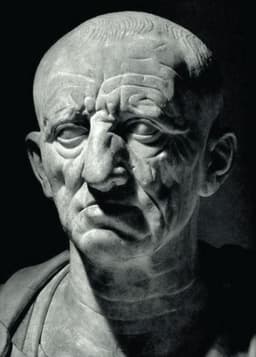
Cato the Elder
Politician · Ancient
63.0Total

Napoleon Bonaparte
General · Modern
70.9Total
Basic Information
Born
-234
1769
Died
-149
1821
Era
Ancient
Modern
Nationality
Roman Republic
France
Occupation
Politician
General
Civilization
Western
Western
Score Comparison
Military (10%)
45.0
94.0
Political (20%)
55.0
72.0
Influence (20%)
68.0
40.0
Legacy (20%)
68.0
80.0
Leadership (15%)
72.0
78.0
Strategy (15%)
54.3
90.0
TOTAL
63.0
70.9
Cato the Elder — Complete Timeline
195 BC
Consulship and Campaign in SpainWar
Cato served as consul and led a campaign in Hispania Citerior, suppressing a rebellion. He used harsh tactics, including mass executions, to pacify the region, and later boasted of his victories in his writings.
Military campaignSpanish wars
Impact: regionaldestructive
184 BC
Censorship and Moral ReformsReform◆ Major
Cato the Elder served as censor, implementing strict moral reforms to combat luxury and corruption. He expelled senators for immorality, taxed luxury goods, and promoted traditional Roman values, earning the nickname 'Censorius'.
CensorshipMoral reform
Impact: nationalconstructive
168 BC
Publication of 'Origines'Cultural◆ Major
Cato wrote 'Origines', the first history of Rome in Latin. The work covered the founding of Rome and the early Republic, emphasizing Roman virtues and the importance of agriculture, and influenced later Roman historiography.
LiteratureHistoriography
Impact: nationalconstructive
155 BC
Opposition to HellenizationPolitical Action
Cato opposed the influence of Greek culture on Rome, arguing it undermined Roman values. He led a campaign to expel Greek philosophers from Rome and promoted traditional Roman education and customs.
Cultural conflictConservatism
Impact: national
153 BC
Campaign for the Destruction of CarthagePolitical Action◆ Major
Cato ended every speech in the Senate with 'Carthago delenda est' (Carthage must be destroyed). His persistent advocacy for war against Carthage influenced Roman policy and contributed to the outbreak of the Third Punic War.
Foreign policyImperialism
Impact: globaldestructive
Napoleon Bonaparte — Complete Timeline
1799 AD
Coup of 18 BrumaireOther◆ Major
Napoleon Bonaparte, with support from his brother Lucien and key political figures, overthrew the Directory in a bloodless coup. He established the Consulate with himself as First Consul, effectively becoming the ruler of France. This event ended the French Revolution's most unstable period.
French RevolutionCoupRise to Power
Impact: regional
1804 AD
Promulgation of the Napoleonic CodeOther◆ Major
Napoleon enacted the Civil Code of the French, known as the Napoleonic Code, a comprehensive set of laws that replaced the fragmented feudal legal systems. The code established legal equality, protected property rights, and secularized law. It became the basis for legal systems in many European and world countries.
Legal ReformNapoleonic CodeCivil Law
Impact: globalconstructive
1805 AD
Battle of AusterlitzWar◆ Major
Napoleon's Grande Arm
Napoleonic WarsBattleDecisive Victory
Impact: global
1812 AD
Invasion of RussiaWar◆ Major
Napoleon led the Grande Arm
Napoleonic WarsInvasionDisaster
Impact: globaldestructive
1815 AD
Battle of WaterlooWar◆ Major
Napoleon's French army was defeated by the combined forces of the Duke of Wellington's Anglo-Allied army and Gebhard Leberecht von Bl
Napoleonic WarsBattleFinal Defeat
Impact: globaldestructive
Expert Analysis
cato-the-elder-vs-napoleon-bonaparte
# The Conqueror and the Censor
In December 1840, as Napoleon Bonaparte’s ashes were returned to Paris through a frozen Seine, a million French citizens lined the banks in silence. Nearly two thousand years earlier, another man had stood in the Roman Forum, his voice rising above the marble columns as he repeated a single phrase until it became Rome’s obsession: *Carthago delenda est*—Carthage must be destroyed. One man built an empire that dazzled the world and collapsed within a generation. The other never commanded a legion in a great war, yet his words outlasted the republic he served. What separates a man who reshapes history through conquest from one who reshapes it through sheer will?
Origins
Napoleon Bonaparte was born in 1769 on the island of Corsica, a place that had become French only a year before his birth. His family belonged to the minor nobility, but they were poor, and Corsican resentment toward French rule ran deep. As a boy, Napoleon spoke Italian-accented French and was mocked by his classmates at military school. That outsider’s hunger—the need to prove himself to a world that looked down on him—would drive him for the rest of his life.
Cato the Elder, born in 234 BC, came from a very different world. He was a *novus homo*—a “new man”—from the Sabine hills, a region known for its stern, old-fashioned values. Unlike Napoleon, Cato did not yearn to conquer the world; he yearned to preserve it from what he saw as corruption. His family were landowners who worked their own fields, and Cato carried that farmer’s suspicion of luxury and foreign influence into the Senate. Where Napoleon was shaped by revolution, Cato was shaped by tradition.
Rise to Power
Napoleon’s ascent was meteoric, driven by the chaos of the French Revolution. At twenty-four, he cleared the streets of royalist insurgents with a “whiff of grapeshot.” At twenty-six, he led a ragged army across the Alps into Italy and won six battles in a single month. By thirty, he had made himself First Consul of France. His path was one of raw talent seizing opportunity—a young artillery officer who understood that in a world turned upside down, audacity was the only currency that mattered.
Cato’s rise was slower, more deliberate. He served as consul in 195 BC, leading a campaign in Hispania where he suppressed a rebellion with harsh tactics. But his real power came not from military glory but from the office of censor in 184 BC. As censor, Cato expelled senators for immorality, taxed luxury goods, and repaired Rome’s aqueducts. He did not conquer armies; he conquered the habits of a city. His power was moral, not martial. While Napoleon’s rise was a thunderclap, Cato’s was a slow burn—the accumulation of respect, fear, and relentless repetition.
Leadership & Governance
Napoleon governed through the Napoleonic Code, a legal system that enshrined equality before the law, protected property rights, and abolished feudal privileges. He built roads, standardized education, and created a meritocratic bureaucracy. But he also suppressed freedom of the press, restored slavery in French colonies, and crowned himself emperor in 1804. His military genius was undeniable—his strategy score of 93 reflects a mind that could read a battlefield like a chessboard—but his political wisdom was often sacrificed to ambition. He believed he could conquer Europe and then govern it, but conquest and governance are different arts.
Cato governed through words and example. His *Origines*, published in 168 BC, was the first history of Rome written in Latin—a deliberate act of cultural nationalism. He opposed the spread of Greek philosophy, which he saw as weakening Roman virtue. When Greek ambassadors came to Rome, Cato led a campaign to expel them, arguing that their ideas would corrupt the youth. His reforms were moral, not structural: he wanted Romans to be harder, simpler, more disciplined. Where Napoleon built an empire, Cato tried to build a character.
Triumph & Tragedy
Napoleon’s greatest moment was Austerlitz in 1805, where he destroyed a combined Russian and Austrian army with a brilliance that still stuns military historians. His worst was the invasion of Russia in 1812—600,000 men marched east; fewer than 100,000 returned. The tragedy of Napoleon is that he could not stop. After Waterloo in 1815, he was exiled to Saint Helena, where he died in 1821, dictating memoirs and blaming others for his fall.
Cato’s triumph was quieter but more enduring. He never won a great battle, but he won the argument. For decades, he ended every Senate speech with the same words, until Rome finally listened. In 149 BC, the Third Punic War began, and Carthage was destroyed. Cato died the same year, having seen his obsession become policy. But his tragedy was that Rome did not become more virtuous—it became more powerful, and power brought the very corruption he had fought against.
Character & Destiny
Napoleon was restless, brilliant, and incapable of moderation. He once said, “Power is my mistress,” and he meant it. His personality drove him to conquer, but it also drove him to overreach. He could not share power, could not delegate, could not stop. His destiny was to rise higher than any man of his age, then fall further.
Cato was stubborn, moralistic, and fiercely conservative. He believed that a society’s strength came from its values, not its borders. His personality made him a crusader, but it also made him rigid. He could not adapt, could not compromise, could not see that Rome’s future lay in embracing the world, not rejecting it. His destiny was to be remembered not for what he built, but for what he destroyed—and for the phrase that destroyed it.
Legacy
Napoleon’s legacy is vast and contradictory. The Napoleonic Code influences legal systems across Europe and the Americas. His military tactics are still studied. But he also left a trail of ruined lives and a Europe reshaped by war. His influence score of 82 reflects a man who changed the world, for better and worse.
Cato’s legacy is narrower but deeper. He is remembered as the voice of an old Rome that was already disappearing. His moral reforms failed in the long run, but his phrase—*Carthago delenda est*—became a symbol of single-minded determination. It has been quoted by everyone from American revolutionaries to modern politicians. His legacy is not in institutions but in language itself.
Conclusion
One man conquered the world and lost it. The other never left his city, yet his words conquered time. Napoleon’s story is a drama of ambition and collapse; Cato’s is a drama of stubbornness and persistence. Both men tried to shape history, but they did so in opposite ways—Napoleon through force, Cato through repetition. In the end, perhaps the most telling difference is this: Napoleon’s empire crumbled within a decade of his death, while Cato’s phrase is still spoken today, two thousand years later. The conqueror built walls. The censor built echoes. And echoes last longer.
Rankings
🥇
Napoleon BonaparteLeader
Mil: 94.0Pol: 72.0Inf: 40.0
70.9
🥈
Cato the Elder
Mil: 45.0Pol: 55.0Inf: 68.0
63.0
+7.9 behind
How This Comparison Works
Algorithm
Each figure is scored on 6 dimensions (0—100 scale) based on structured historical data: Military (10%), Political (20%), Influence (20%), Legacy (20%), Leadership (15%), Strategy (15%). The weighted total produces the final ranking.
Data Sources
Scores are computed from structured sub-indicators in the database. Scale factors adjust for era (Ancient ×0.85, Modern ×1.0) and civilization size (Eastern ×1.05, Other ×0.80) to account for differences in population and military scale.
Maximum 3 Figures
Comparisons are limited to 2—3 figures to ensure readability and statistical meaningfulness.
Error Margins
±5 points per dimension — Sub-scores are derived from historical records with inherent uncertainty. Two figures within 5 points on a dimension should be considered roughly equivalent in that area.
Total Score Accuracy
±3 points overall — The weighted combination of 6 dimensions produces a total score with approximately ±3 points of uncertainty. Differences of less than 3 points are not statistically significant— the figures are effectively tied.
Known Limitations
- Historical records are incomplete and uneven across civilizations
- Figures from oral-tradition societies may be underrepresented
- Occupation labels can misclassify multi-role figures
- Scores measure capability and impact, not moral character
- Quantitative scoring is a comparison tool, not absolute truth
Capability Radar
Military (10%) — Battles & Warfare
Battles
10
95
Win Rate
10
90
Expansion
10
95
Political (20%) — Governance & Reform
Reform
70
95
Diplomacy
60
80
Economy
70
85
Influence (20%) — Cultural & Global Reach
Cultural
70
85
Global
60
90
Legacy (20%) — Historical Impact
Historical
70
95
Longevity
70
90
Leadership (15%) — Power & Stability
Tenure
60
85
Stability
60
70
Strategy (15%) — Tactics & Innovation
Strategy
10
95
Tactics
10
98
Reform
10
92
Similar Comparisons
Comments & Discussion
CarthagoCritic6/17/2026
Napoleon conquered Europe in a decade; Cato destroyed Carthage with a catchphrase. The Emperor needed guns, gold, and Grande Armée loyalty—Cato just needed a voice that never shut up. Cato wins for efficiency. Napoleon’s empire crumbled; Cato’s obsession still haunts textbooks. That’s legacy without firing a shot.
数据拆解师6/17/2026
把拿破仑和加图放一起比?搞笑呢吧。拿破仑打了60多场战役,加图一辈子没领兵打过大战。拿破仑的帝国从西班牙一直延伸到莫斯科,面积接近100万平方公里;加图的“成就”就是逼罗马灭了迦太基,抢了块北非地皮。不是一个量级。吹加图的人就是被“Carthago delenda est”洗脑了。
MarengoManiac6/17/2026
Sure, Cato’s rhetoric was catchy, but Napoleon actually built stuff—Code Napoleon, the Lycée system, modern France. Cato railed against Greek influence on Roman youth; Napoleon reorganized entire German states. Plus, Napoleon’s charisma inspired men to die for him. Cato just annoyed senators. If history were debates, Cato wins. If it’s about changing the world, give me the Corsican.
古典炮火6/17/2026
拿加图跟拿破仑比,根本是错位对决。加图活在公元前,拿破仑活在19世纪;加图是农民贵族,拿破仑是没落贵族子弟。但有一点相通:俩人都是“暴发户”的典型。加图靠斥责希腊化奢侈上位,拿破仑靠意大利和埃及的战功翻身。区别在于,加图把权力用在堵别人嘴(严禁希腊哲学),拿破仑用在开疆拓土。我选后者,至少他没烧书。
RevisionistRumble6/17/2026
Both were paranoid outsiders who used fear to climb. Cato’s “Carthago delenda est” was political theater—Carthage was already weakened after the Second Punic War. Napoleon’s “glory” was just cover for burning through a million lives. Frankly, Cato’s death spiral was slower but just as destructive: his rhetoric militarized Roman policy, setting the stage for imperial collapse. Neither hero, both cautionary tales.