Loading...
Cesare Borgia vs Julius Caesar
Julius Caesar leads by 22.6 pts · 2 figures compared
…
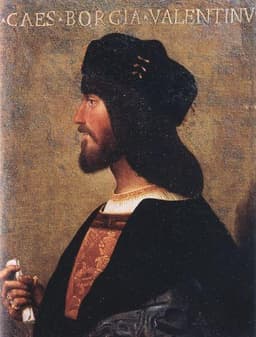
Cesare Borgia
General · Medieval
60.2Total

Julius Caesar
General · Ancient
82.8Total
Basic Information
Born
1475
-100
Died
1507
-44
Era
Medieval
Ancient
Nationality
Italy
Roman Republic
Occupation
General
General
Civilization
Western
Western
Score Comparison
Military (10%)
67.5
88.0
Political (20%)
68.0
78.0
Influence (20%)
68.0
85.0
Legacy (20%)
40.0
82.0
Leadership (15%)
64.0
80.0
Strategy (15%)
66.3
85.0
TOTAL
60.2
82.8
Cesare Borgia — Complete Timeline
1493 AD
Appointment as CardinalPolitical Action◆ Major
Cesare Borgia was appointed cardinal by his father, Pope Alexander VI. This position gave him significant power within the Church and access to papal resources. He used his cardinalate to advance his family's political interests in Italy.
CardinalNepotismPapacy
Impact: regional
1498 AD
Resignation from the CardinalatePolitical Action◆ Major
Cesare Borgia resigned as cardinal to pursue a military and political career. He became the first person to voluntarily leave the College of Cardinals. This move allowed him to focus on conquering territories in the Romagna region of Italy.
ResignationMilitaryRomagna
Impact: regional
1499 AD
Conquest of the RomagnaWar◆ Major
Cesare Borgia, with French support, launched a campaign to conquer the cities of the Romagna. He captured Imola, Forl
ConquestRomagnaMachiavelli
Impact: regional
1503 AD
Fall from PowerPolitical Action
After the death of Pope Alexander VI, Cesare Borgia lost his political support. He was captured by his enemies and imprisoned in Spain. His territories in Italy quickly collapsed. This sudden fall demonstrated the fragility of his power base.
FallImprisonmentCollapse
Impact: regionaltragic
1507 AD
Death in BattleWar
Cesare Borgia was killed in a skirmish near Viana, Navarre, while serving as a mercenary captain. His death ended any chance of restoring his former power. He died at age 31, having failed to regain his Italian territories.
DeathMercenaryNavarre
tragic
Julius Caesar — Complete Timeline
58 BC
Gallic WarsWar◆ Major
Caesar, as proconsul of Gaul, launched a series of campaigns that conquered all of Gaul (modern France, Belgium, and parts of Switzerland). He fought numerous battles, including against the Helvetii, the Belgae, and the Gallic chieftain Vercingetorix. The wars brought immense wealth and a loyal army to Caesar.
Gallic WarsConquestRoman Expansion
Impact: regional
49 BC
Crossing the RubiconPolitical Action◆ Major
Caesar led Legio XIII across the Rubicon River into Italy, defying the Roman Senate's order to disband his army. This act triggered a civil war against Pompey and the Optimates, ultimately leading to Caesar's dictatorship and the end of the Roman Republic.
Roman Civil WarEnd of RepublicPower Struggle
Impact: global
48 BC
Battle of PharsalusWar◆ Major
Caesar's outnumbered army defeated the larger forces of Pompey the Great at Pharsalus in Greece. Caesar's tactical use of a reserve line to counter Pompey's cavalry charge proved decisive. Pompey fled to Egypt, where he was assassinated, leaving Caesar as the undisputed master of the Roman world.
Roman Civil WarBattleDecisive Victory
Impact: regional
44 BC
Appointment as Dictator for LifePolitical Action◆ Major
The Roman Senate appointed Caesar dictator perpetuo (dictator for life), granting him unprecedented personal power. This move concentrated military, legislative, and judicial authority in one person, effectively ending the Roman Republic's traditional system of checks and balances and alarming many senators.
DictatorshipEnd of RepublicPower Consolidation
Impact: regionaldestructive
Assassination on the Ides of MarchPolitical Action◆ Major
A group of Roman senators, led by Marcus Junius Brutus and Gaius Cassius Longinus, stabbed Caesar to death at a meeting of the Senate in the Theatre of Pompey. The assassination was intended to restore the Republic, but instead triggered another civil war that led to the rise of the Roman Empire.
AssassinationRoman PoliticsEnd of Republic
Impact: globaldestructive
Expert Analysis
cesare-borgia-vs-julius-caesar
# The Conqueror and the Cardinal's Son
On a January morning in 49 BCE, Julius Caesar stood at the banks of the Rubicon River, a small stream that marked the boundary of his lawful command. To cross with his army was treason, a declaration of civil war against the Roman Republic. He hesitated, then uttered a phrase that would echo through millennia: *"Alea iacta est"*—the die is cast. Fifteen centuries later, another ambitious man would also gamble everything on the sword, but his story would end not in triumph but in a forgotten skirmish near a Spanish town. Cesare Borgia, the son of a pope, rose and fell so swiftly that his name became synonymous with ruthless ambition—yet Julius Caesar, who shared that same hunger for power, became the father of an empire. What separated the two men was not merely luck, but the deeper currents of history, character, and the worlds they inherited.
Origins
Julius Caesar was born into the patrician Julian clan, one of Rome's oldest families, but his branch had fallen into relative obscurity. His father died when Caesar was sixteen, leaving him in a politically volatile Rome where the old Republic was already cracking under the weight of its own success. He grew up in an era of civil wars, where ambitious generals like Marius and Sulla had shown that military loyalty could override constitutional law. Caesar's world was one of senatorial intrigue, public spectacle, and the relentless pursuit of *dignitas*—personal honor and status—that defined Roman aristocratic life.
Cesare Borgia, by contrast, was born in 1475 into a world where the Church was a political dynasty. His father, Rodrigo Borgia, was a cardinal before becoming Pope Alexander VI, and the family name was synonymous with corruption, nepotism, and ambition. Cesare was made a cardinal at eighteen, but he never wanted the priesthood. He longed for the sword, not the cross. Renaissance Italy was a patchwork of warring city-states, foreign invaders, and shifting alliances—a chessboard where a clever and ruthless player could carve out a kingdom. But unlike Caesar, who emerged from a tradition of republican service and military command, Borgia inherited power through his father's tiara, not his own achievements.
Rise to Power
Caesar's path was long and deliberate. He served as a military tribune, then quaestor in Spain, where he reportedly wept before a statue of Alexander the Great, lamenting that by his age, Alexander had conquered the world while Caesar had done nothing. He climbed the *cursus honorum*—the ladder of Roman offices—through a combination of military success, political alliances, and sheer audacity. His election as pontifex maximus in 63 BCE and his role in the Catilinarian conspiracy made him a figure of influence. But his true power came from the Gallic Wars (58–50 BCE), where he conquered a vast territory, built a loyal army, and amassed immense wealth. When the Senate ordered him to disband his legions, he chose war.
Cesare Borgia's rise was faster, more brutal, and entirely dependent on his father. In 1498, he became the first cardinal in history to voluntarily resign, trading his red hat for a general's sword. With French support and papal gold, he launched a campaign in 1499 to conquer the Romagna, a region of fractious cities and petty lords. He captured Imola, Forlì, and Rimini with a combination of military force and treachery. His most famous stroke was the "peacemaking" at Senigallia in 1502, where he invited his rebellious condottieri to a banquet and had them strangled. Machiavelli, who observed Borgia firsthand, would later use him as the model for *The Prince*—a ruler who understood that cruelty well used could secure power.
Leadership & Governance
Caesar governed as a reformer. As dictator, he overhauled the calendar, granted citizenship to provincial elites, reformed debt laws, and initiated massive public works. His military genius lay in speed, discipline, and personal bravery—he often fought in the front lines, rallying his men by name. He understood that clemency could be as powerful as cruelty, pardoning former enemies like Brutus and Cassius, a decision that would haunt him. His political wisdom was real but flawed: he centralized power without creating a stable system to succeed him, relying on his own charisma to hold the state together.
Borgia's governance was more cynical. He sought to create a hereditary kingdom in central Italy, using his father's papal authority to legitimize his conquests. He appointed capable administrators, built roads, and maintained order—the Romagna remembered him as a harsh but effective ruler. But his power rested entirely on the Borgia name and French backing. When his father died in 1503, the structure collapsed. He had no army loyal to him alone, no institutional support, and no political base beyond his family. His military skill was real—he was a daring commander—but his strategy was short-term, focused on immediate gains rather than building enduring loyalty.
Triumph & Tragedy
Caesar's greatest moment was his victory at the Battle of Alesia in 52 BCE, where he besieged the Gallic chieftain Vercingetorix and defeated a massive relief army, completing the conquest of Gaul. His tragedy was the Ides of March, 44 BCE, when sixty senators stabbed him to death in the Pompeian Theater. He had achieved supreme power, but he could not transform the Republic into a monarchy without destroying himself.
Borgia's triumph was the conquest of the Romagna, a feat that impressed even Machiavelli. His tragedy came swiftly. After Alexander VI's death, the new Pope, Julius II, a lifelong enemy of the Borgias, stripped Cesare of his titles and imprisoned him. He escaped to Spain, then died in 1507 at the age of thirty-one, killed in a minor battle near Viana, Navarre, while serving as a mercenary. His body lay stripped and abandoned for hours before a priest recognized him.
Character & Destiny
Caesar was audacious, calculating, and deeply aware of his own image. He wrote his own commentaries, controlled his narrative, and cultivated an aura of invincibility. He took risks—crossing the Rubicon, fighting in Egypt, pardoning enemies—but he always calculated the odds. His flaw was overconfidence in his ability to control men who hated him.
Borgia was colder, more ruthless, and less introspective. He killed his own brother's servant, possibly his brother himself, and used treachery as a tool. But he lacked Caesar's patience and strategic vision. He built a kingdom on sand, not stone. His destiny was shaped by the accident of his birth—a pope's son in an era when the Church was a political machine—and by his inability to outlive his father's protection.
Legacy
Caesar's legacy is immeasurable. His name became a title—Caesar, Kaiser, Tsar—and his reforms shaped Western civilization. The Roman Empire he set in motion lasted for centuries, and his writings remain classics of military literature.
Borgia's legacy is narrower but profound. He became the archetype of the amoral Renaissance prince, inspiring Machiavelli's vision of a ruler willing to do evil for the sake of order. His life is a cautionary tale about power without foundation, ambition without patience.
Conclusion
The difference between Caesar and Borgia is the difference between a man who built a world and a man who tried to seize one. Caesar understood that power must be rooted in institutions, loyalty, and time. Borgia believed that ruthlessness and fortune were enough. Both died violently, but one died at the height of his power, the other in obscurity. The die Caesar cast landed on a throne. The die Borgia cast landed in the dust.
Rankings
🥇
Julius CaesarLeader
Mil: 88.0Pol: 78.0Inf: 85.0
82.8
🥈
Cesare Borgia
Mil: 67.5Pol: 68.0Inf: 68.0
60.2
+22.6 behind
How This Comparison Works
Algorithm
Each figure is scored on 6 dimensions (0—100 scale) based on structured historical data: Military (10%), Political (20%), Influence (20%), Legacy (20%), Leadership (15%), Strategy (15%). The weighted total produces the final ranking.
Data Sources
Scores are computed from structured sub-indicators in the database. Scale factors adjust for era (Ancient ×0.85, Modern ×1.0) and civilization size (Eastern ×1.05, Other ×0.80) to account for differences in population and military scale.
Maximum 3 Figures
Comparisons are limited to 2—3 figures to ensure readability and statistical meaningfulness.
Error Margins
±5 points per dimension — Sub-scores are derived from historical records with inherent uncertainty. Two figures within 5 points on a dimension should be considered roughly equivalent in that area.
Total Score Accuracy
±3 points overall — The weighted combination of 6 dimensions produces a total score with approximately ±3 points of uncertainty. Differences of less than 3 points are not statistically significant— the figures are effectively tied.
Known Limitations
- Historical records are incomplete and uneven across civilizations
- Figures from oral-tradition societies may be underrepresented
- Occupation labels can misclassify multi-role figures
- Scores measure capability and impact, not moral character
- Quantitative scoring is a comparison tool, not absolute truth
Capability Radar
Military (10%) — Battles & Warfare
Battles
55
95
Win Rate
60
92
Expansion
55
97
Political (20%) — Governance & Reform
Reform
40
90
Diplomacy
55
85
Economy
35
82
Influence (20%) — Cultural & Global Reach
Cultural
55
88
Global
60
94
Legacy (20%) — Historical Impact
Historical
70
95
Longevity
65
96
Leadership (15%) — Power & Stability
Tenure
45
75
Stability
30
60
Strategy (15%) — Tactics & Innovation
Strategy
60
94
Tactics
65
96
Reform
50
88
Similar Comparisons
Comments & Discussion
TheConqueror'sGhost6/17/2026
Calling this a comparison is like comparing a wildfire to a campfire. Caesar crossed the Rubicon with a trained army and a political machine that had been grinding for decades—he was the culmination of Roman ambition. Borgia had a daddy who was the Pope and a Swiss guard budget. Give me Caesar's military reforms, his siege of Alesia, or even his clemency toward former enemies. Borgia? He had Niccolò Machiavelli fanboying over him. That's his legacy: being the model for a political handbook. One
数值考古学家6/17/2026
数据上看,凯撒的战役规模与时间跨度远超波吉亚:高卢战争八年,征服了超过800座城市、300个部落,伤亡数字以十万计。而波吉亚在意大利中部的所谓征服,顶多算几个城镇的领土更替,连一场像样的围城战记录都难找。把两人放在同一量级比较,等于把拿破仑和某村长械斗相提并论——数字不会撒谎,波吉亚的实际控制力与持久影响力在历史统计图上只是一根小牙签。
NonCredoMagistrum6/17/2026
The fanboys love to hype Cesare as Caesar's spiritual successor, but it's a shallow parlor trick. Machiavelli's *The Prince* used Borgia as a case study in cruelty, not greatness. Meanwhile, Caesar was writing prose that Cicero admired and reforming the calendar we still use. Borgia's military campaigns were essentially papal gang wars with Italian city-states. When Julius Caesar was assassinated, the Roman Empire mourned for generations. When Cesare Borgia died in 1507, the chronicle reads: "An
帝国批判者6/17/2026
拿凯撒来衬托波吉亚,本身就是对罗马历史的降维打击。凯撒是共和体制崩塌的产物,他利用的是元老院、军团、民会这套复杂的政治机器,而波吉亚不过是个裙带关系下的暴发户——他甚至不是合法子嗣,而是教皇亚历山大六世的私生子。更讽刺的是,波吉亚的倒台恰恰因为他依赖教皇的庇护,而凯撒的崛起靠的是自己培育的军事政治资本。家族势力 vs 个人实力,这根本不是一个量级的游戏。
SilvaRhetor6/17/2026
The contrast here isn't between two men—it's between two ages of ambition. Caesar operated in a world where individual brilliance could still reshape civilization through war, politics, and culture. Borgia lived in the Renaissance's dawn of institutional power—the Church, the banking houses, the emerging nation-states. Caesar wrote commentaries; Borgia commissioned portraits. Caesar reformed Roman law; Borgia made deals with the Medici. One built the foundation of Western governance;