Loading...
Cesare Borgia vs Napoleon Bonaparte
Napoleon Bonaparte leads by 10.7 pts · 2 figures compared
…
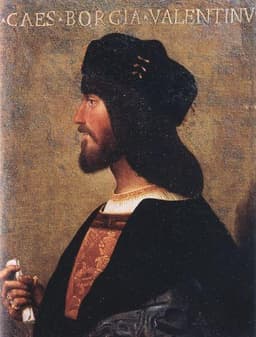
Cesare Borgia
General · Medieval
60.2Total

Napoleon Bonaparte
General · Modern
70.9Total
Basic Information
Born
1475
1769
Died
1507
1821
Era
Medieval
Modern
Nationality
Italy
France
Occupation
General
General
Civilization
Western
Western
Score Comparison
Military (10%)
67.5
94.0
Political (20%)
68.0
72.0
Influence (20%)
68.0
40.0
Legacy (20%)
40.0
80.0
Leadership (15%)
64.0
78.0
Strategy (15%)
66.3
90.0
TOTAL
60.2
70.9
Cesare Borgia — Complete Timeline
1493 AD
Appointment as CardinalPolitical Action◆ Major
Cesare Borgia was appointed cardinal by his father, Pope Alexander VI. This position gave him significant power within the Church and access to papal resources. He used his cardinalate to advance his family's political interests in Italy.
CardinalNepotismPapacy
Impact: regional
1498 AD
Resignation from the CardinalatePolitical Action◆ Major
Cesare Borgia resigned as cardinal to pursue a military and political career. He became the first person to voluntarily leave the College of Cardinals. This move allowed him to focus on conquering territories in the Romagna region of Italy.
ResignationMilitaryRomagna
Impact: regional
1499 AD
Conquest of the RomagnaWar◆ Major
Cesare Borgia, with French support, launched a campaign to conquer the cities of the Romagna. He captured Imola, Forl
ConquestRomagnaMachiavelli
Impact: regional
1503 AD
Fall from PowerPolitical Action
After the death of Pope Alexander VI, Cesare Borgia lost his political support. He was captured by his enemies and imprisoned in Spain. His territories in Italy quickly collapsed. This sudden fall demonstrated the fragility of his power base.
FallImprisonmentCollapse
Impact: regionaltragic
1507 AD
Death in BattleWar
Cesare Borgia was killed in a skirmish near Viana, Navarre, while serving as a mercenary captain. His death ended any chance of restoring his former power. He died at age 31, having failed to regain his Italian territories.
DeathMercenaryNavarre
tragic
Napoleon Bonaparte — Complete Timeline
1799 AD
Coup of 18 BrumaireOther◆ Major
Napoleon Bonaparte, with support from his brother Lucien and key political figures, overthrew the Directory in a bloodless coup. He established the Consulate with himself as First Consul, effectively becoming the ruler of France. This event ended the French Revolution's most unstable period.
French RevolutionCoupRise to Power
Impact: regional
1804 AD
Promulgation of the Napoleonic CodeOther◆ Major
Napoleon enacted the Civil Code of the French, known as the Napoleonic Code, a comprehensive set of laws that replaced the fragmented feudal legal systems. The code established legal equality, protected property rights, and secularized law. It became the basis for legal systems in many European and world countries.
Legal ReformNapoleonic CodeCivil Law
Impact: globalconstructive
1805 AD
Battle of AusterlitzWar◆ Major
Napoleon's Grande Arm
Napoleonic WarsBattleDecisive Victory
Impact: global
1812 AD
Invasion of RussiaWar◆ Major
Napoleon led the Grande Arm
Napoleonic WarsInvasionDisaster
Impact: globaldestructive
1815 AD
Battle of WaterlooWar◆ Major
Napoleon's French army was defeated by the combined forces of the Duke of Wellington's Anglo-Allied army and Gebhard Leberecht von Bl
Napoleonic WarsBattleFinal Defeat
Impact: globaldestructive
Expert Analysis
cesare-borgia-vs-napoleon-bonaparte
### The Prince and the Emperor
In the summer of 1507, a minor skirmish near the town of Viana, in the Kingdom of Navarre, ended with a corpse stripped of its armor and left to rot in a ditch. The dead man was Cesare Borgia, once the most feared man in Italy, a cardinal who had traded his red hat for a sword. Just over a century later, in the autumn of 1815, a British warship carried another fallen conqueror to a remote island in the South Atlantic. Napoleon Bonaparte, who had made all Europe tremble, would spend his final years dictating memoirs in a damp house on Saint Helena. Both men rose from obscurity to dominate their age; both fell into utter ruin. Yet one is remembered as a political mastermind, the other as a military titan. What explains the difference? The answer lies not just in their talents, but in the worlds that shaped them.
### Origins
Cesare Borgia was born in 1475 into the most corrupt and ambitious family in Renaissance Italy. His father, Rodrigo Borgia, became Pope Alexander VI in 1492, turning the papacy into a family business. Cesare was made a cardinal at eighteen, a position of immense spiritual authority that he never once took seriously. He was a product of a world where politics was a blood sport, where alliances shifted like sand, and where a man’s power lasted only as long as his patron’s health.
Napoleon Bonaparte, born in 1769 on the island of Corsica, came from a different world entirely. His family were minor nobles in a French province recently annexed. He was educated in mainland France, where he absorbed the Enlightenment ideals of merit, law, and order. If Cesare was the child of Machiavelli’s Italy—a place of cynical calculation—Napoleon was the child of Voltaire’s France—a place of rational ambition. One was forged in the crucible of family intrigue; the other, in the fires of revolution.
### Rise to Power
Cesare’s path was inheritance. When his father became pope, the young cardinal was handed the keys to the Vatican’s treasury and army. But he wanted more. In 1498, he made a stunning move: he resigned his cardinalate—the first man in history to do so voluntarily—to become a secular prince. With French backing and papal gold, he launched a campaign in 1499 to conquer the Romagna, a region of fractious city-states. His methods were brutal and efficient. He would offer peace, then strangle his enemies; he would ally with one lord, then betray him. By 1502, he had carved out a personal kingdom.
Napoleon’s rise was a matter of merit and chaos. As a young artillery officer during the French Revolution, he seized his chance at the Siege of Toulon in 1793, earning promotion to brigadier general at twenty-four. He was a man of the new order, where talent trumped birth. By 1796, he led the Army of Italy, winning a string of dazzling victories that made him a national hero. Where Cesare relied on his father’s name, Napoleon relied on his own genius—and on the unprecedented opportunity created by a revolution that had swept away the old elite.
### Leadership & Governance
Cesare Borgia ruled through fear. He appointed a brutal lieutenant, Ramiro de Lorca, to pacify the Romagna with executions. When the region was calm, Cesare had Ramiro cut in half and left in the town square—a message that the cruelty was his alone. His military campaigns were clever but small-scale, relying on mercenaries and French allies. He had no vision beyond power itself. As Machiavelli later wrote in *The Prince*, Cesare had the cunning but lacked the luck to sustain it.
Napoleon governed through law and glory. His Napoleonic Code, enacted in 1804, standardized French law, abolished feudalism, and enshrined meritocracy. He built roads, schools, and a central bank. His military strategy was revolutionary: he used speed, massed artillery, and decisive battles to shatter his enemies. At Austerlitz in 1805, he crushed the combined armies of Russia and Austria, a victory of such perfection it became a textbook example. Where Cesare ruled a patchwork of terrified cities, Napoleon commanded an empire of 70 million people.
### Triumph & Tragedy
Cesare’s triumph was brief. By 1503, he was the arbiter of Italy, his power at its zenith. But in August of that year, his father died, probably poisoned. The papal election fell to Julius II, a sworn enemy of the Borgias. Cesare’s allies evaporated; his armies melted away. He was captured, imprisoned, and eventually fled to Navarre, where he died in 1507 at thirty-one, killed in a pointless fight for a petty king.
Napoleon’s tragedy was grander in scale. His invasion of Russia in 1812 was his Waterloo before Waterloo. He led the *Grande Armée* of 600,000 men into the Russian winter; fewer than 100,000 returned. The disaster shattered his aura of invincibility. In 1814, he was forced to abdicate and exiled to Elba. He escaped, raised another army, and met the British and Prussians at Waterloo in June 1815. The battle was close, but his generals failed him, and his old magic was gone. He died in 1821 on Saint Helena, a prisoner of the British.
### Character & Destiny
Cesare was cold, calculating, and utterly without sentiment. He once had his own brother-in-law murdered and his sister’s husband killed. He trusted no one, and no one trusted him. His fatal flaw was that his power was entirely borrowed from his father. When the pope died, Cesare was exposed as a man with a sword but no foundation.
Napoleon was driven by ambition and a belief in his own destiny. He was ruthless but also pragmatic, capable of forgiving enemies who served him well. His fatal flaw was hubris. He could not stop. He invaded Spain, Russia, and every nation that resisted, stretching his empire until it snapped. He was a man who conquered the world but could not govern his own ego.
### Legacy
Cesare Borgia lives today as a symbol: the archetype of the ruthless Renaissance prince. Machiavelli used him as the model for *The Prince*, and his name still evokes poison, intrigue, and ambition without morality. His military and political scores are modest—a total of 60.4—and he is remembered more as a cautionary tale than a great leader.
Napoleon Bonaparte changed the world. His legal code governs much of Europe today. His military tactics are still studied. He redrew the map of Europe, ended the Holy Roman Empire, and spread the ideals of nationalism and meritocracy. His total score of 82.4 reflects his vast influence and military genius. Yet he is also a warning: the man who rose from nothing to rule a continent, and who fell because he could not stop reaching for more.
### Conclusion
Standing on the deck of the *HMS Bellerophon* in 1815, Napoleon looked out at the English coast and said, “What a beautiful country.” He was a man who had seen the world and wanted to possess it all. Cesare Borgia, dying in the mud of Navarre, probably saw nothing but the sky. Both men chased power with a hunger that consumed them. One left a legacy of law and war; the other, a legend of cunning and ruin. Their stories remind us that history is not just about what we achieve, but about the stage we are given—and how we use it.
Rankings
🥇
Napoleon BonaparteLeader
Mil: 94.0Pol: 72.0Inf: 40.0
70.9
🥈
Cesare Borgia
Mil: 67.5Pol: 68.0Inf: 68.0
60.2
+10.7 behind
How This Comparison Works
Algorithm
Each figure is scored on 6 dimensions (0—100 scale) based on structured historical data: Military (10%), Political (20%), Influence (20%), Legacy (20%), Leadership (15%), Strategy (15%). The weighted total produces the final ranking.
Data Sources
Scores are computed from structured sub-indicators in the database. Scale factors adjust for era (Ancient ×0.85, Modern ×1.0) and civilization size (Eastern ×1.05, Other ×0.80) to account for differences in population and military scale.
Maximum 3 Figures
Comparisons are limited to 2—3 figures to ensure readability and statistical meaningfulness.
Error Margins
±5 points per dimension — Sub-scores are derived from historical records with inherent uncertainty. Two figures within 5 points on a dimension should be considered roughly equivalent in that area.
Total Score Accuracy
±3 points overall — The weighted combination of 6 dimensions produces a total score with approximately ±3 points of uncertainty. Differences of less than 3 points are not statistically significant— the figures are effectively tied.
Known Limitations
- Historical records are incomplete and uneven across civilizations
- Figures from oral-tradition societies may be underrepresented
- Occupation labels can misclassify multi-role figures
- Scores measure capability and impact, not moral character
- Quantitative scoring is a comparison tool, not absolute truth
Capability Radar
Military (10%) — Battles & Warfare
Battles
55
95
Win Rate
60
90
Expansion
55
95
Political (20%) — Governance & Reform
Reform
40
95
Diplomacy
55
80
Economy
35
85
Influence (20%) — Cultural & Global Reach
Cultural
55
85
Global
60
90
Legacy (20%) — Historical Impact
Historical
70
95
Longevity
65
90
Leadership (15%) — Power & Stability
Tenure
45
85
Stability
30
70
Strategy (15%) — Tactics & Innovation
Strategy
60
95
Tactics
65
98
Reform
50
92
Similar Comparisons
Comments & Discussion
PapalOutcast6/17/2026
People romanticize Cesare as some Machiavellian genius, but he was just a brute with a pope for a dad. He lost everything the moment Alexander VI died of malaria in 1503. Napoleon, by contrast, built a lasting legal code and institutions that outlived his defeats. Borgia’s legacy is a cautionary tale about nepotism; Bonaparte’s is a blueprint for modern statecraft. Borgia couldn’t even hold onto the Romagna without papal troops.
卡比利亚之鹰6/17/2026
拿拿破仑跟切萨雷比?简直笑掉大牙。拿破仑是革命之子,靠战功和民法典统治欧洲;切萨雷不过是个教皇私生子,靠毒药和刺杀夺权。他所谓的“统一意大利”就是烧杀抢掠,连个稳定的税制都搞不出来。拿破仑在奥斯特里茨打赢了沙皇,而切萨雷连乌尔比诺公爵都打不过,最后死在一个无名小卒的埋伏里。一个真帝王,一个假王子。
DataFaktum6/17/2026
Let's look at numbers: Napoleon commanded over 600,000 men for the 1812 invasion of Russia. Borgia's entire army at his peak was maybe 6,000. Napoleon reshaped Europe across 60 major battles; Borgia fought maybe a dozen skirmishes. The scale difference is so vast that comparing their military genius is like comparing a hurricane to a dust devil. Napoleon's failures were epic, but his achievements dwarf the Borgia saga entirely.
丝绸与火药6/17/2026
军事层面,切萨雷就是个二流雇佣兵头子。他唯一拿得出手的“战绩”是靠法国援军打下来的,自己指挥的卡普阿战役不过是对平民的屠杀。拿破仑在洛迪桥用炮兵震慑奥地利,在金字塔下用方阵击溃马穆鲁克——这才是真正的战术革新。切萨雷连火药和冷兵器的协同都搞不明白,拿什么跟拿破仑比?别拿教皇的私生子碰瓷军事天才。
VeniceVibes6/17/2026
The real difference is context: Renaissance city-states were chessboards of intrigue, not battlefields of mass armies. Borgia's genius was political—he understood that in Italy, a poisoned communion wafer was worth more than a cavalry charge. Napoleon broke that mold and reshaped war itself. Borgia was a brilliant player of a dying game; Napoleon invented a new sport. I'd rather have Borgia at a Renaissance banquet than on a battlefield against Wellington.